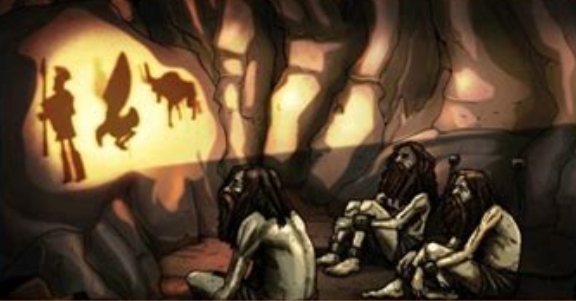
Plato’s cave is two-thousand year-old story that describes the human situation as like prisoners in a cave, chained so their backs face the entrance through which sunlight streams (Figure 3.27). The cave is dark so to see others, they look at their shadows cast on the cave wall, which over time they assume are real and act accordingly.
Socrates told this story to Plato to illustrate that the perceived world is like a shadow puppet-show, based on light from the Good that acts like our sun. The analogy has flaws, as the puppets making the shadows are presented as matter, but the concept that what we see is caused by what can’t see equates to the proposal that the physical world is a virtual reality, based on quantum theory.
Quantum theory can now update Socrates vision in scientific terms, so the cave is physicalism, its walls are our space, the chains that bind were created by evolution, and the shadows on the cave wall are observations caused by physical events. This update avoids the need for contrived puppets, as our shadows collide when we do, so if the prisoners had a dog, it would be shadow-driven too. Socrates cave allegory is then supported by quantum theory today.
Modern physics sees itself standing in the sunlight of science before the dark cave of quantum theory, but Socrates would see physicists chained in the cave of physicalism, calling the shadows they see real, and denying both the quantum sunlight and that our space is just a surface.
Why then don’t we turn from the shadows to see their cause? As Socrates explained, it is difficult because turning from darkness to sunlight is blinding. It hurts us to look at it, so we turn back to the shadows we know. Hence when Einstein tried, the quantum sunlight blinded him, so he looked back at the shadows to find hidden variables. Bohr tried too, but his impenetrable Copenhagen suit blocked out the quantum sunlight entirely, so he decided it was unreal.
Physics then decided that the quantum world was dangerous, even to imagine, so it quarantined it behind walls of equations that only initiates could read. It formed a quantum club, whose first rule is that there is no quantum world, to use the quantum light to predict our shadow future without looking at it. Socrates intuition, that a hidden light creates what we observe like shadows on a wall, is then denied by those with their backs to it, who use what they declare doesn’t exist.

Yet among the guards of quantum theory, the bravest still turn to try to catch a glimpse. For example, Wheeler compared quantum reality to a great smoky dragon (Wheeler, 1983), a fearsome beast that is powerful but mythical. In contrast, quantum realism proposes as Socrates would, that Wheeler’s great smoky dragon does exist and the world we see is its smoke (Figure 3.28). In this view, quantum reality isn’t a shadow world beyond physical reality, but the real world whose shadows are the physical events we see.
Table 3.3 compares quantum realism and physical realism for light, but if our universe began as light, how did matter arise? The next chapter addresses this question.