One of the strangest predictions of general relativity is that if a large body collapses under its own gravity, nothing can stop it becoming a black hole, a region of space with gravity so strong that even light can’t escape. Astronomers have discovered that nearly every super-massive galaxy, including our own, has a black hole at its center.
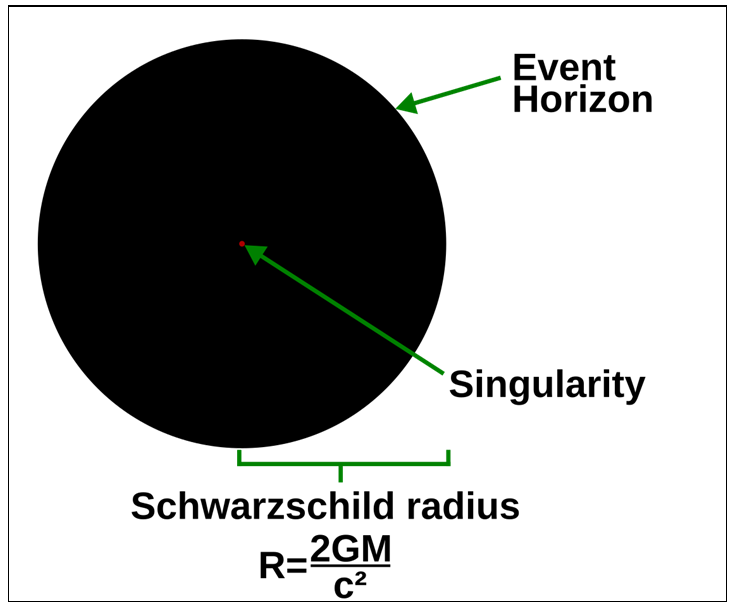

Current physics has no force to stop this collapse, so a black hole is considered to be a point of infinite mass density called a singularity, surrounded by an event horizon that is the region where light can’t escape its gravity (Figure 5.11). This is based on the equations but in most sciences, an equation that gives an infinity is an error not a fact.
Processing models can’t have infinities because they aren’t calculable, so in this model, matter can’t become infinitely dense because space can’t become infinitely small. Our space, like a screen, has a pixel limit, and each pixel has a finite bandwidth, so a black hole is a region of space at maximum capacity not a singularity. Just as the finite refresh rate of space limits the speed of light, its finite bandwidth limits the density of mass in a black hole. What stops the collapse of a black hole then isn’t a force, but the ability of space itself to support matter.
It follows that black holes expand as they acquire matter because more space is needed to handle it. The Schwarzschild radius of a black hole is linearly proportional to its mass, but if that mass was at a point, its effect should decrease as an inverse square like gravity.
A black hole is a volume of space at maximum capacity, not a singularity of infinite density. Instead of radiating light, it absorbs it, so black holes are in effect dark stars that take in energy (Barcelo et al., 2009). Sagittarius A*, the center of our galaxy, then isn’t a hole at all, but a super-massive dark star with a halo of light that keeps its stars together (4.7.6). We who are made of matter see a black hole as destructive, but for our galaxy, it is beneficial.