Superposition is the quantum principle that lets one photon go through both slits simultaneously in the two-slit experiment. Solving a normal equation gives one solution that satisfies its conditions but solving a quantum wave equation gives a set of solutions, where each is the probability that a physical event will occur. These solutions evolve over time, as the wave spreads, but at any moment only one of them can physically happen.
This mathematics has the strange feature that for any two solutions, their combination is also a solution, called a superposition (Note 1). Yet while single solutions match familiar physical events, these combined solutions never physically occur, so quantum states superpose in ways that physical states can’t. For example, in Young’s experiment, the photon goes through both slits at the same time in a superposed state but we never observe a photon in both slits at once. This ability to superpose makes quantum waves more powerful than particles.
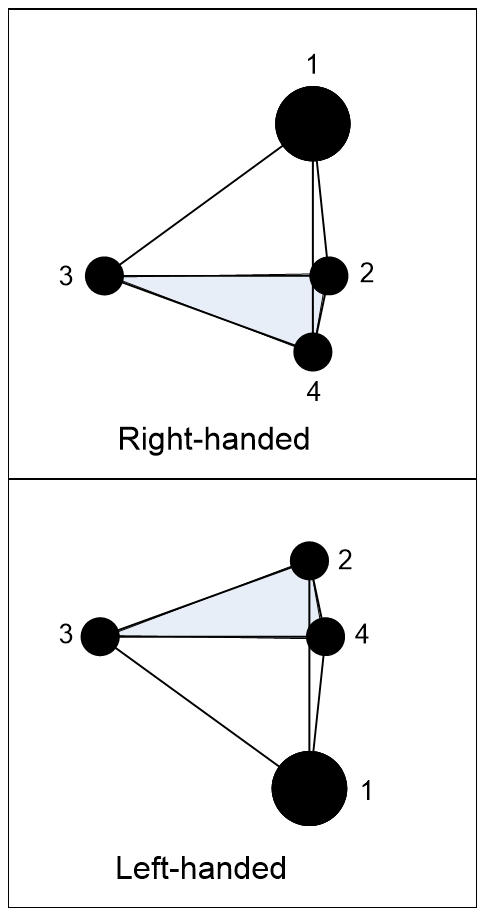
molecule states
Superposition applies not only to photons but also to molecules. For example, ammonia molecules have a pyramid shape (Figure 3.20) with a nitrogen atom apex (1) and a base of hydrogen atoms (2, 3, 4). This molecule can occur in right or left-handed forms, but to turn a right-handed molecule into a left-handed one, a nitrogen atom must pass through the pyramid base, which is physically impossible (Feynman et al., 1977) III, p9-1. Yet according to quantum theory, if both these states are valid solutions, so is their combination. The ammonia molecule can then be in a right and left-handed superposition in the quantum world!
This explains the otherwise inexplicable finding that an ammonia molecule can be left-handed one moment and right-handed the next, even though it can’t physically change between these states. The explanation is that it exists in a left and right-handed superposition so we can observe either one, just as a photon superposed between two slits can be observed in either one.
To think superposition is just ignorance of a hidden physical state is to misunderstand it, as superposed quantum currents can flow both ways round a superconducting ring at once, but physical currents would cancel (Cho, 2000). As Young’s experiment shows, the superposed photon really does go through both slits at once, so what is physically impossible is just business as usual in the quantum world.
In processing terms, superposition occurs because network processes spread in every possible way ignoring physical limits, so a photon going through two slits literally half-exists in both, as quantum waves can spread in ways that particles can’t.
Why then don’t superpositions occur physically? If a physical event is a processing restart triggered by a point request, this isn’t possible. Just as restarting a computer stops anything else it is doing, restarting a quantum process is the same, so while an ammonia molecule can spread into two quantum states at once, it can only restart from one of them. Superposed quantum states never occur physically because a physical event restarts one or the other, not both. But if molecules can superpose, why then can’t cats?
Note 1. If Y1 and Y2 are state solutions of Schrödinger’s equation then (Y1 + Y2) is also a valid solution.