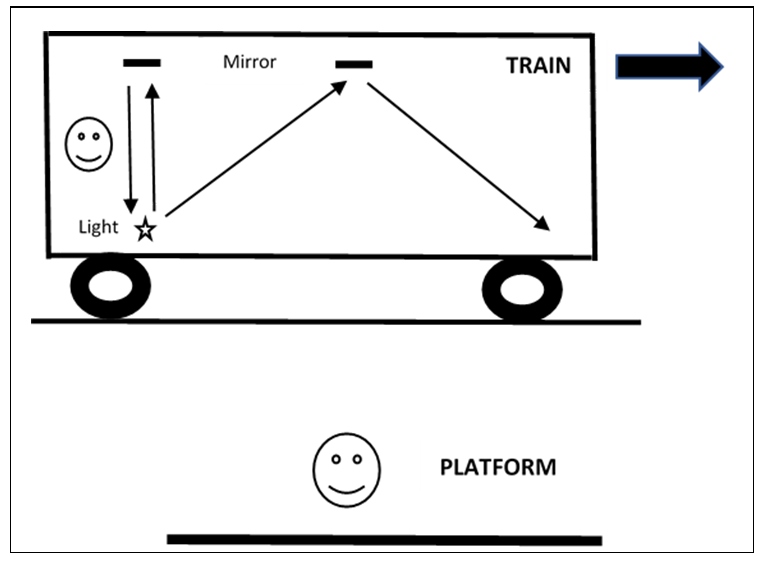
To simplify the problem, Einstein reduced it to why the speed of light is the same for two observers. He imagined a train, with a light on the floor that shines up to a mirror on the ceiling, then reflects back (Figure 5.4). A train passenger sees the light go straight up and down, and when the train moves nothing changes, but an observer on a platform watching the train go by sees it travel a longer path. If both observers have the same time and space, the speed of light will be different, but in our world it isn’t. Einstein concluded that space and time had to change to get the same speed of light.
Lorentz saw his transformations as mathematical curiosities but Einstein saw that they made Poincare’s relativity work, so for the universe to be as Poincare described, space and time had to change as Lorentz described. If space and time didn’t change to make physics invariant (Note 1), the speed of light would vary with every observer!
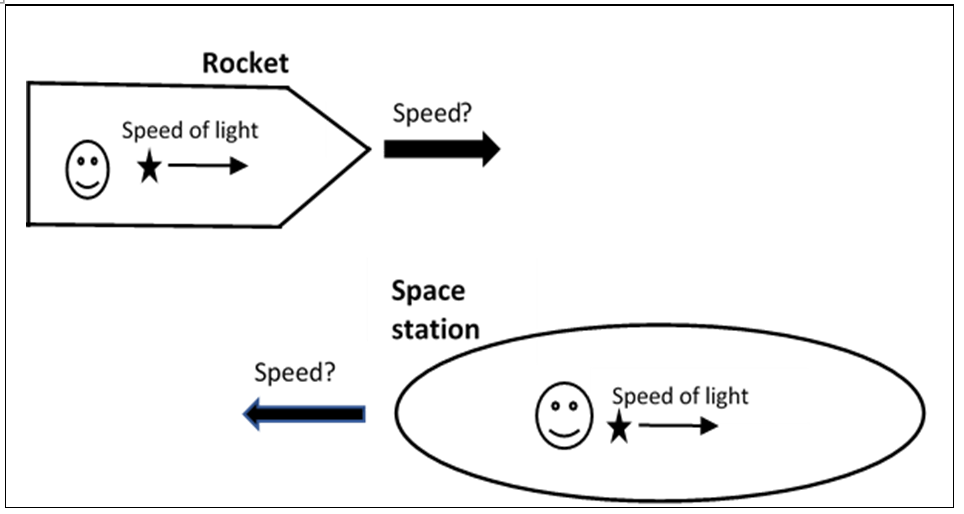
The implications of his conclusion are strange indeed. For example, imagine a rocket flying past a space station in orbit (Figure 5.5). It seems impossible that people on the rocket and on the space station both see light moving at the same speed, but they do! If they didn’t, our physics wouldn’t work on Mars.
One could ask who is really moving, the rocket or the space station, but it doesn’t matter. If the rocket moves, its space and time contract and dilate, and if the space station moves, the same applies. Regardless of how the rocket and station move relative to each other, distance and time change to keep the speed of light the same for both.
This defies common sense but experiments have verified that time and space really do change as matter moves faster or slower. It seems weird, but as Einstein said, this is why our universe isn’t weird. The speed of light is invariant because time and space change to make it so.
Note 1. Einstein preferred the term invariance for his theory but relativity stuck.