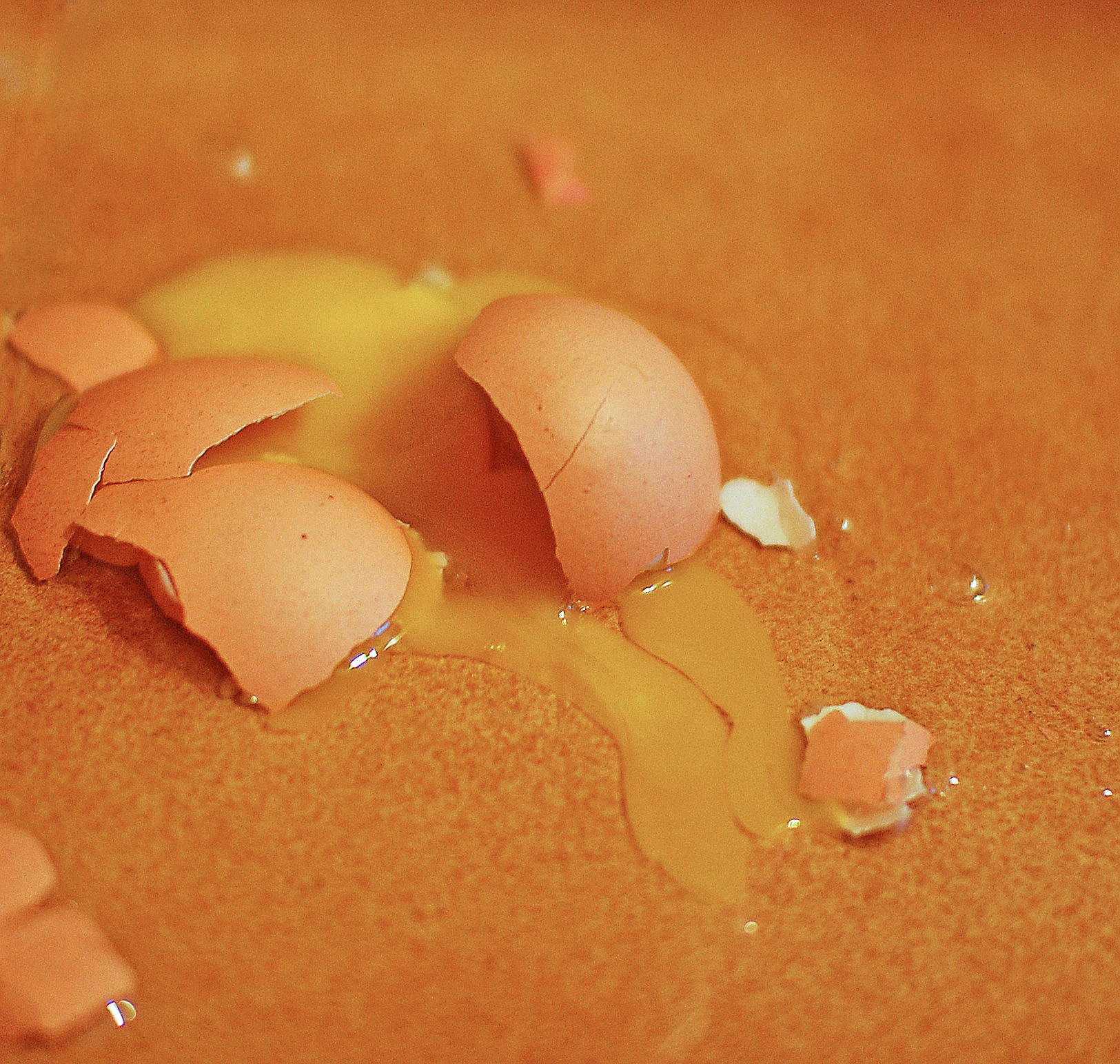
The second law of thermodynamics explains what the first law can’t, that what is in theory reversible, in practice isn’t. For example, running a video of the earth orbiting the sun looks much the same, but playing a video of an egg breaking in reverse evokes laughter. Yet by the first law, the events of egg breaking are just as reversible as the earth’s orbit, so why doesn’t it happen? The second law answer is that order never increases in a closed system, so eggs don’t unbreak (Figure 5.17).
Entropy is how physics describes disorder or randomness, and Boltzmann defined it as the number of possible microscopic states that can produce a macroscopic state. By this definition, when a colored gas injected into an empty bottle spreads, entropy increases. The gas molecules begin concentrated at a point (Figure 5.18), which only a few molecule combinations allow, so entropy is low. Then they disperse into a spread-out state that more molecule combinations allow, so entropy increases. In general, entropy always increases or stays constant because disorder is more probable than order.
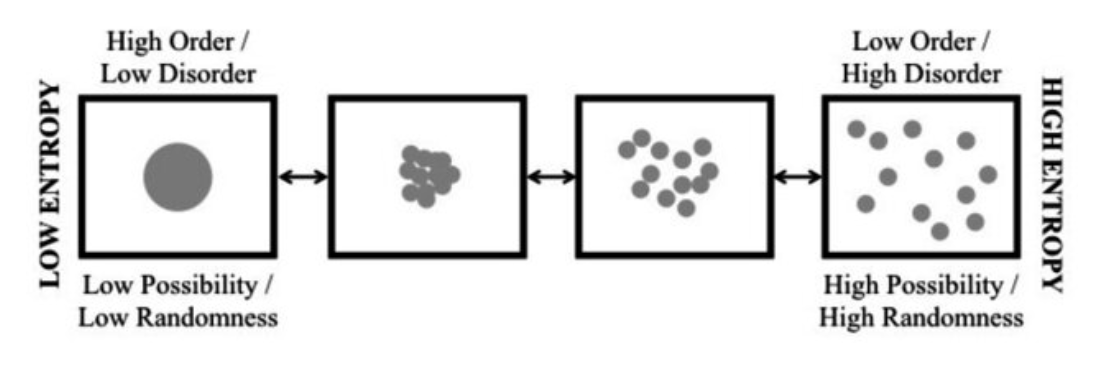
A gas injected into a bottle will probably spread over time, but its molecules could by chance all move back to a point. This is unlikely but possible, so the second law is a statistical law not a causal law. Objects don’t have to become more disordered, but in a constantly changing world, they probably will. Disorder then increases for the same reason that constantly shaking a bottle disperses its contents.
Heraclitus compared our reality to a river that is never the same from one moment to the next because it always changes. This Heraclitean flux can be attributed to the quantum law of all action (3.6.3), that anything possible eventually happens as quantum events explore every option. Our world is then an ocean of change because the quantum world is the same. If the second law of physics is based on the first law of quantum theory, it is universal, but how then does order arise?