In current biology, evolution is a purposeless process with random outcomes, so re-running it should give different results because randomness doesn’t repeat (Gould, 1990). Yet it can also converge to the same result, as birds, bats, insects, and fish all evolved flight independently, so replaying the evolution of life might give much the same solutions (Morris, 2003).
We can’t reverse time to re-run evolution but we can run evolutionary algorithms, programs that solve problems by imitating evolution. They first generate an initial population of possible solutions, then evaluate their fitness, to reject those that don’t work. Selected parent solutions are then combined and mutated to produce offspring that are again evaluated, and this repeats until a solution emerges. This method can solve hard problems that logical calculations can’t and if an answer exists, re-running the algorithm repeatedly finds it. The program has no purpose and is based on trial-and-error, but it always ends up in the same place, so it isn’t directionless.
Evolutionary potential studies that replay evolution with generations of simulated bacteria find that Gould’s theory that evolution never repeats is incorrect (Blount, 2017). Natural selection doesn’t plan ahead, but if the solution space is small, it isn’t just happenstance either.
If life is unlikely, as it is, evolution will find the same solutions, so replaying it will give the same results. Cells will still evolve membranes to survive and copy themselves to ensure it. Some will discover how to use solar energy by photo-synthesis, giving plants as primary producers that animals feed on as secondary consumers, and on each other, using senses like sight and smell, and flagella, fins, limbs, or wings to move. If repeating evolution gives the same results, it has a direction and so isn’t going nowhere. The tree of life then, like all trees, has an up direction, despite Gould’s contrary claim.
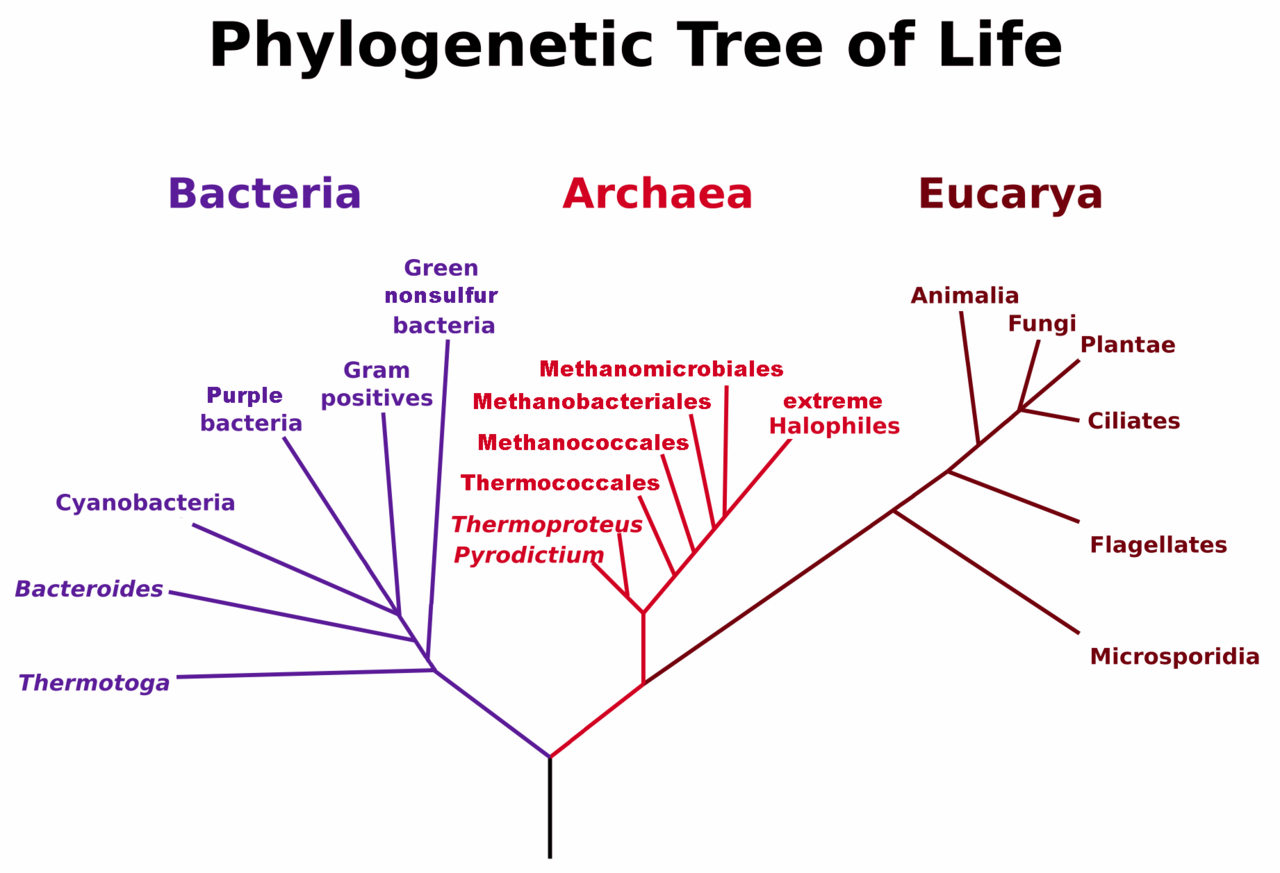
Figure 5.19 represents the solution space for life, and the periodic table does the same for matter. Based on cosmogenesis, hydrogen arose a few million years after the big bang but it took billions more years to make heavy elements like iron that we need to make hemoglobin in our blood. Atoms then evolved as life did, by finding ordered combinations that survive, so the evolution of matter also has a direction, because repeating it would give the same elements.
In general, evolution discovers new combinations that survive or are stable, including those that increase order. Each step leads to more possibilities, so the tree branches as it grows. Matter is the trunk that the tree of life sits on, as it produced the complex molecules needed for life, so the evolution of life was based on the evolution of matter.
Evolution has a degree as well as a direction, as its tree rises based on order-increasing steps. Some branches lead upwards, to increase order, while others extend sideways without increasing order, as when bacteria mutate. In Figure 5.19, when bacteria and archaea merged into eukaryotes, the complex cells that produced plants and animals, it was an order-increasing step. Order increases when species merge as it does when quarks and electrons merge into atoms, because when two or more entities become one, order increases as randomness reduces. The complex cells that led to plants and animals are then more evolved than bacteria, and so a higher branch on the tree of life.
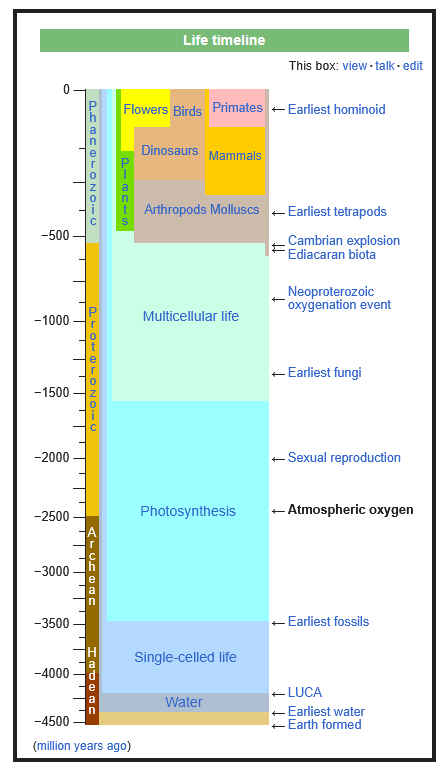
In current biology, bacteria are said to be as evolved as we are, or more as they have been here longer, but time elapsed doesn’t measure evolution. Hydrogen was the first atom but it isn’t the most evolved, as stars like our sun turn it into Helium that is more evolved. Likewise, we are more evolved than bacteria because our ancestry has more order-increasing steps. We are the tip of an upper branch, while bacteria spread at its base. Evolution is described by a tree not a matrix for a reason. Fungi that spread as a matrix on the forest floor remain fungi, but a tree changes as it grows up. Likewise the tree of life increases order as it rises, as eukaryotes are more evolved than bacteria so they should be shown higher on Figure 5.19. The timeline of life shows a steady increase in order (Figure 5.20), so the height of the evolutionary tree that produced it should also reflect the degree of order achieved.
Yet aren’t we a glorious accident, as Gould says? Of course we are. If a meteor hadn’t hit the earth 65 million years ago to wipe out 75% of all life, mammals would still be small animals hiding underground in a dinosaur world, and humans wouldn’t exist. We are an evolutionary accident, but aren’t all its products? The first atom was an accident, as was the first molecule, cell, plant, and animal, so what is new? Evolution is based on accidents but the universal trend to order isn’t an accident at all, as where a tree fruits is an accident but that it fruits isn’t.
We are then special based on our position atop tree of life, but it doesn’t exist just for us. 99% of all species that ever lived are extinct today, so if we destroy ourselves, we may join them. Yet even if we explode our bombs in a nuclear holocaust, the earth will bloom again in a few thousand years, to let another species take our place, as we did that of the dinosaurs. Life finds a way, but isn’t fussy about which one. Homo-sapiens is the lucky ape that won the evolutionary lottery, but some species had to because sentient life is possible, so evolution will find it.
Evolution affects all life, as the sun shines on all, but some call this indifference:
“The universe we observe has precisely the properties we should expect if there is, at bottom, no design, no purpose, no evil and no good, nothing but blind pitiless indifference. … DNA neither knows nor cares. DNA just is. And we dance to its music.” (Dawkins, 1995), p133.
Yet if we all dance to the music of our genes, Dawkins does too, as he re-invents the old universe is a machine theory in biology terms. Quantum theory debunked that idea last century by letting photons make choices, and evolution debunks it today by letting creatures do the same, so genes don’t entirely determine our future. Biological nihilism, like physical nihilism, leads nowhere and fails at the same hurdle, that choice exists on every scale.
The permutations and combinations of life are so vast that no design can predict them, so evolution is a good strategy. Everything connects, so who knows what will produce value? For example, fungi are neither plants nor animals but they help forests thrive and gave us penicillin, so they aren’t pointless. Evolution doesn’t make errors as we do because given two paths, it takes both, just as quantum reality does. It does however take time, so while life began almost as soon as it could, the early fossil record has no complex life because it hadn’t evolved yet.
Our universe isn’t a machine manufacturing a product to a pre-ordained blueprint, but an evolution trying every possibility, as if it was looking for something. It is like an algorithm set up to solve a problem, but what then is the problem, and how can our universe achieve it?