Electrical and magnetic effects are cancelled by their opposites, but gravity has no opposite so what can stop it? If gravitons caused gravity, anti-gravitons could block them but it never happens, just as anti-gluons could destroy the gluons that hold the nucleus together, but they don’t, even though anti-gluons are said to exist. Why then is gravity unstoppable?
In this model, the quantum network passes on processing before physical events occur, so they can’t affect it. The gravity gradient around matter then spreads in a way that no anti-gravity shield can block. It also spreads at the speed of light, so the sun’s gravity takes about eight minutes to reach earth, just as its light does. Hence, if the sun suddenly vanished, the earth would carry on orbiting around it for another eight minutes!
Yet matter stops light, which is quantum waves, so why can’t it stop gravity? When a photon hits a screen, it stops spreading and restarts with a new direction, but when earth’s distribution reaches an object, it just carries on spreading. The processing before and after a matter restart is the same, so the gravity gradient isn’t blocked by matter as light is.
Note also that gravity makes anti-matter objects fall down not up. For example, a hydrogen atom tends to fall to earth under its gravity, and anti-hydrogen atoms do the same. The earth’s gravity increases the processing closer to it, so an anti-hydrogen atom still restarts more often where the field around it is stronger. It would take an anti-matter planet the size of the earth to cancel its gravity, but that doesn’t happen in our universe.
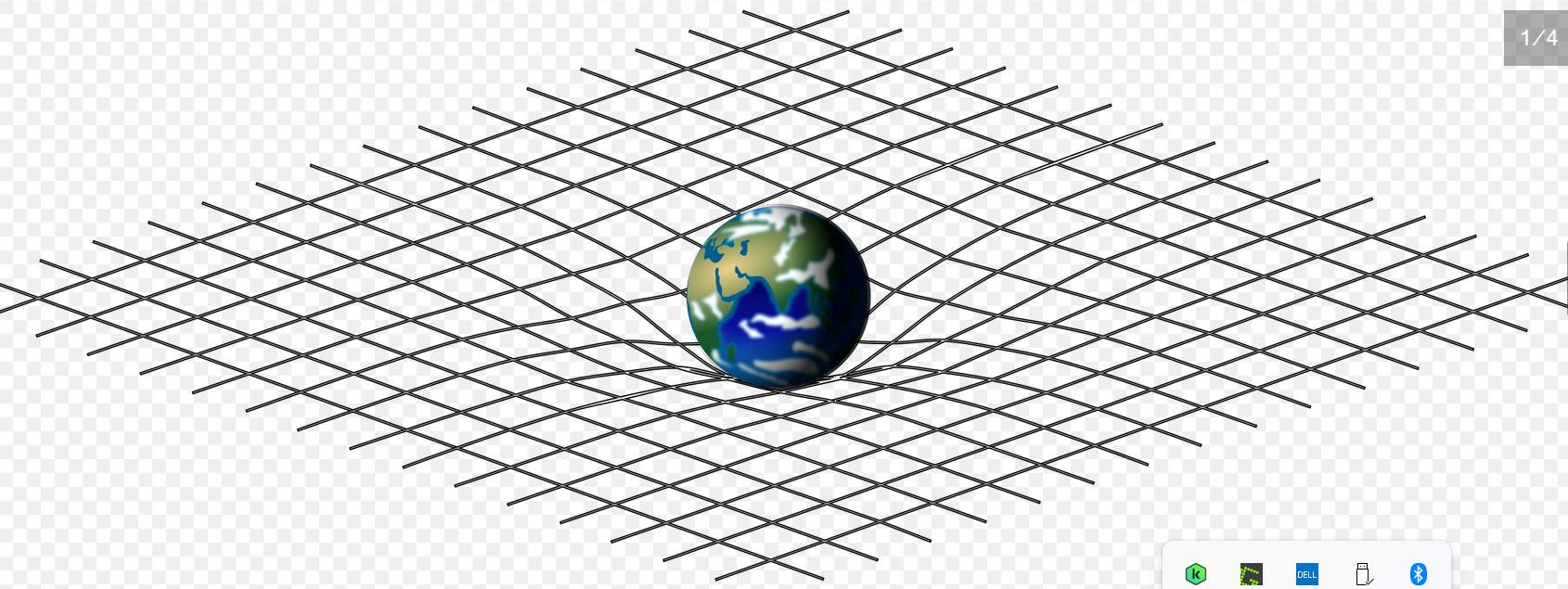
An object accelerates as it falls to earth because the gravity gradient increases as it falls, so it moves faster. Einstein saw this as the earth curving space and time around it (Figure 5.9) but here, these changes correlate with gravity but don’t cause it, as the quantum field that causes gravity also changes space and time.