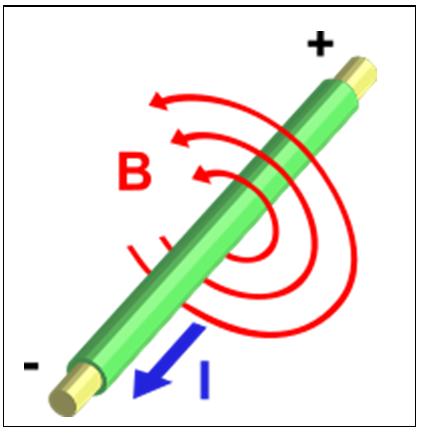
Magnetism seems distinct from electricity but Maxwell’s equations describe both, and experiments relate them. For example, a static charge isn’t magnetic but if it moves, a magnetic field appears around it, as shown in Figure 5.12 where passing a current I through the wire produces a magnetic field B. Wrapping a wire around a nail and passing a current through it then makes it a magnet, and that effect stops when the current does, so electricity can cause magnetism. The reverse is also true, as spinning a magnet with a wire around it induces a current in the wire, so electric cars are possible because magnetism and electricity relate:
“We will see that magnetism and electricity are not independent things – that they should always be taken as one complete electromagnetic field.” (Feynman et al., 1977).
Is magnetism then just charge in another guise? (Note 1) It would seem not because:
1. Static charges and magnets don’t interact.
2. The magnetic field is at right angles to the electric field.
3. Gauss’s law doesn’t apply to magnetism, which reduces more like an inverse cube.
4. Dividing a charged body gives positive and negative charges but dividing a magnet gives two more magnets, both with a north and south pole.
Magnetism behaves differently from charge, so how one field causes both is unclear. For example, light is said to be electrical and magnetic waves at right angles that cause each other, but causes creating each other in a loop is illogical. The laws of electricity and magnetism are clear separately, but their electro-magnetic combination isn’t, as if we understood horses and birds then found a strange winged horse. No credible theory explains why electro-magnetism has two effects that act differently, are at right angles, and weaken differently.
The standard model theory that same charges repel when virtual photons push them apart isn’t credible because the same photons also pull opposite charges together, and make magnets attract and repel, so one might as well say that fairies with photon wands cause electro-magnetism. A field with different effects needs different causes, not the same cause producing results after the fact.
Note 1. The logic is that a moving electron’s length is foreshortened by special relativity giving more negative electrons than positive protons in a given length of wire, so parallel wires with opposite currents attract, but this could be correlation not causation