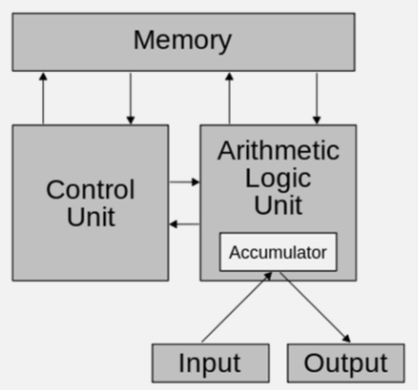
To understand brains we must know the challenges evolution faced, the first of which is survival, so while we designed computers to be efficient, brains evolved to be reliable. Most modern computers use the Von Neumann design shown in Figure 6.2, with a central processing unit (CPU) that controls input and output, but if it fails, so does the whole system. This design doesn’t work for evolution as biological parts regularly fail, and a brain that stops when part of it fails is too fragile to survive. Evolution needed a better way, so instead of a CPU, our brain is decentralized.
We can also build computers at leisure then turn them on, but evolution didn’t have that luxury because life never stops. Imagine building an airplane where the first component has to fly or you can’t add the second! The bee’s neuron sliver then has to work for it, just as our brain works for us, or we wouldn’t be here. We don’t work on live computers because it is too risky, but evolution had to because brains are always plugged into life. The evolutionary answer was a neural hierarchy that lets one layer run things while another evolves and also provides a backup if the new one fails.
Finally, computers are essentially input-driven, as even AI needs a question to trigger it, so a computer just sits there if you don’t use it, but an animal left alone will actively explore its environment and even run away. A brain whose nerves acted like cogs in a machine couldn’t evolve, so evolution selected for nerves that initiated their actions. Every brain region then has autonomy, the ability to act by itself in a way that computer parts don’t, because evolution required it.
In conclusion, computers centralize control in a CPU, based on a single-layer motherboard, and are input-driven, while brains are decentralized, based on a multi-layer hierarchy, and are driven by the autonomous activity of nerves. The following modules explore these evolutionary features of decentralization, hierarchy, and autonomy in more detail.