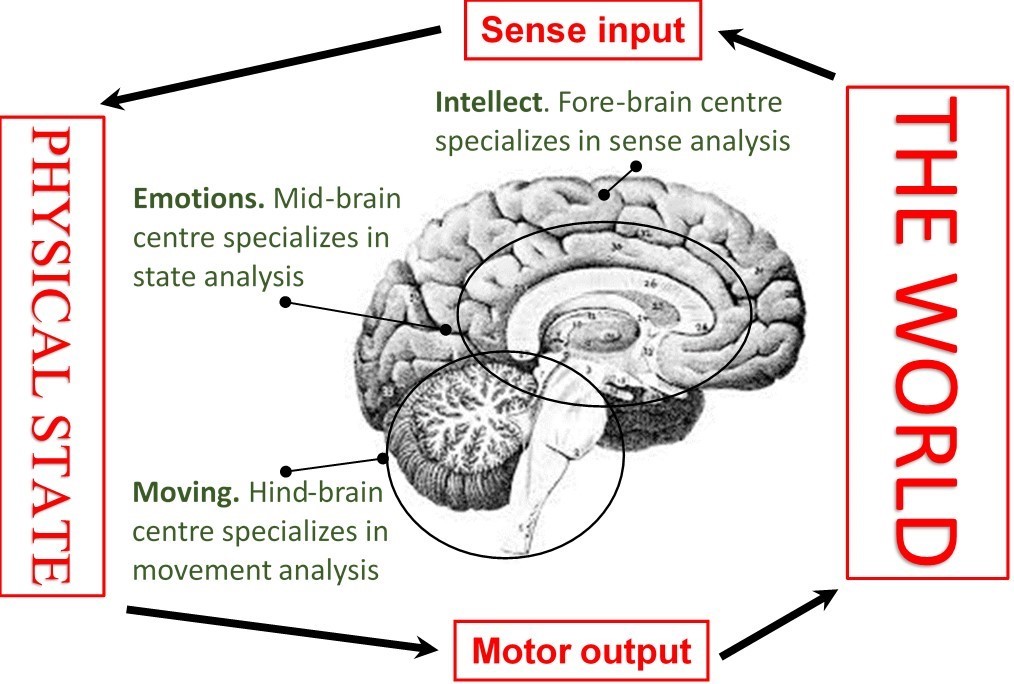
The human brain doesn’t come with an instruction manual but if it did, it would stress that many ways to control a feedback loop is a feature not a bug. An airline cockpit is full of knobs and dials, so international flights have two pilots and an autopilot for routine tasks, giving a backup in case one pilot is indisposed and also more options in an emergency. If airliners have three control centers, it isn’t surprising that our body evolved a brain cockpit that is the same (Figure 6.33).
The forebrain, midbrain, and hindbrain also specialized to handle sense input, body state, and movement sequences respectively, just as tank crews specialize in planning, loading, and driving. People can run, blush, and talk at the same time because the brain can move, set body states, and communicate simultaneously.
The brain distributes control as the Internet does, to let each party act of its own accord as it sees fit. Special air service (SAS) teams illustrate this, as when facing a cliff, the climbing expert takes charge, and at sea the naval expert does, and this helps the team survive. The brain shares control in the same way, between specialists that each have their own input, processing, and output so they can act as the situation requires. Our brain is then a team that shares control rather than a neural dictatorship.
But what happens if these brain centers conflict? They can’t talk as people do because they in effect have different languages, and each is too busy with its own input to try. For example, a person with a spider phobia can discuss their fear to accept that a harmless spider isn’t a threat, but put a little spider on the table and they jump in fear! The intellect knows the spider isn’t dangerous but the emotions still press the panic button when one appears. There is no knowledge transfer because the midbrain learns in its own way, by experience not thought. Yet three centers doing their own thing is also useful, as I recall once talking to someone when an object fell from a shelf above and my hand reached to catch it without a thought. This response wasn’t a reflex, as the hindbrain had to constantly monitor space, calculate a trajectory, and direct a coordinated catch movement.
How we respond to situations is then complex. For example, an accidental fall on a hard surface can cause serious injury, so what decides whether we break a bone and end up in hospital or just get back up? It happens in less than a second so a cortical voluntary response is usually too slow. The midbrain is fast enough but its response of tensing all the muscles can injure bones or joints worse than the fall itself. In most cases, the best tactic is to relax and let the hindbrain handle the fall, but it needs practice, so parachutists have to learn to fall and roll in a relaxed way to avoid injury. Using the right center for the job isn’t easy, as while the cortex can prime a roll left or right, and fear can avoid the accident in the first place, only the hindbrain can handle the moment of falling. As someone who rode a motorcycle for many years, and fell off it regularly, I can confirm that learning to relax in a fall isn’t easy.
We then have a three-in-one brain that supports fast responses, emotional directives, and complex thoughts, as illustrated by the following story:
Once upon a time there were three brothers who delivered goods in a city to earn money by flying a small plane. Elder brother Hunter flew the plane by manually manipulating its lower flight controls, and the others tagged along. Middle brother Milo was still a child, so he sat in the cockpit to adjust the aircon knob and monitor the fuel gauge. Baby brother Finn just looked out the window commenting on what he saw, occasionally shouting Watch Out!
And so it went for years, until one day they bought a bigger plane that could travel between cities. Hunter still flew it as before, but Milo got more buttons, like the throttle he used to boost engine performance in takeoff. It also came with a camera so while Hunter just memorized his maneuvers, Milo stored time-tagged photos in an album of memories, marking the important ones and those that gave reward or were dangerous. He then took over scheduling where to go and when, as he knew the benefits and dangers, including when to refuel the plane or stop for maintenance. The plane also had pre-set buttons for common situations, like a white button that readied it to refuel, and a red button to prepare for action, so Milo used them to set up the plane in advance. Meanwhile Finn was still figuring out what was out there so he used symbols to represent features like red. His warnings about unexpected events helped Hunter to adapt, but the others still mostly ignored him as they ran the plane.
The brothers made more money and eventually acquired an intercontinental jet with a state-of-the-art computer. Hunter already had a simple radar that showed objects as a dot location and direction, so he stuck with that. Milo also had the pictures he needed to manage his dials and knobs, so fell to Finn to use the computer. He used it to control the plane, not as fast as Hunter, but enough to demonstrate new flight maneuvers to add to Hunter’s repertoire. He also used it communicate with other planes using symbols, so he took charge of that. His role also changed from just observing events to predicting them by analyzing trends and causes using Milo’s memory albums. Finn then focused on planning, as he could simulate the potential outcomes of different actions before deciding on one, though this could take a while.
The brothers worked as a team by dividing up the work as follows: Hunter handled the action details, Milo managed scheduling priorities, and Finn planned ahead and communicated with other planes. They then dominated the airways because three pilots are better than one when each does what they are good at.
Evolution produced a brain with three centers of control for good reasons, but why then do we experience one person? We assume one decision maker but neuroscience assures us that it isn’t so:
“In contrast to this first-person experience of a unified self, modern neuroscience reveals that each brain has hundreds of parts, each of which has evolved to do specific jobs – some recognize faces, others tell muscles to execute actions, some formulate goals and plans, and yet others store memories for later integration with sensory input and subsequent action.” (Nunez, 2016), p55.
This contrast between our unified self-experience and brain decentralization then raises the problem of how sensations, memories, and goals generated in distant brain areas are integrated into a single object experience.