The unification of gravity, electricity, and magnetism has long been a dream of physics, but while virtual photons unified electricity and magnetism, virtual gravitons couldn’t explain gravity. Then, as the standard model invented particles to explain forces, the dream was lost, because one field couldn’t generate all its particles.
But if the strong, weak, and Higgs fields are unnecessary inventions (4.5.3), the dream of a unified field theory re-emerges, as the fields to unify are again just gravity and electro-magnetism. This unification could be called the gravito-electro-magnetic field, but the quantum field is simpler.
What then is the quantum field? In simple terms, it is the quantum values that explain light and matter in quantum theory. Schrödinger’s equation describes how these values spread, but not why they collapse to a point in a physical event, but processing can overload a network and restart at a point. Matter is then a repeating overload that always restarts (4.5.8), with these properties:
1. Mass. The net process value from +1 to -1 in one or more dimensions.
2. Charge. The net process remainder from +1 to -1 in one or more dimensions.
3. Spin. The process spin direction, which can be up or down for an axis.
Matter spreads these properties around itself, like ripples in a bucket (Figure 5.15), as a distribution that alters the quantum field to cause gravity. Gravity then acts invisibly at a distance, like magic, but it is no illusion or trick, just quantum vibrations acting lawfully. Those who can’t imagine this call quantum waves imaginary, but why then does Schrödinger’s equation constrain their imaginations?
The quantum field also sets the above values throughout space to generate the physical world we see. For example, if its values are null, we see empty space, but if they are mass +1, charge -1, and spin ±1, we see an electron, and so on.

In Figure 5.16, the mass, charge, and magnetism of matter spread into the quantum field around it. Mass strengthens the field nearby to cause a gravity field, charges alter the field between them to cause an electrical field, and magnets alter the field between them to cause a magnetic field.
The effect in all cases is that matter moves when the quantum field around it is stronger or faster one way, as even a small bias can give movement in our time.
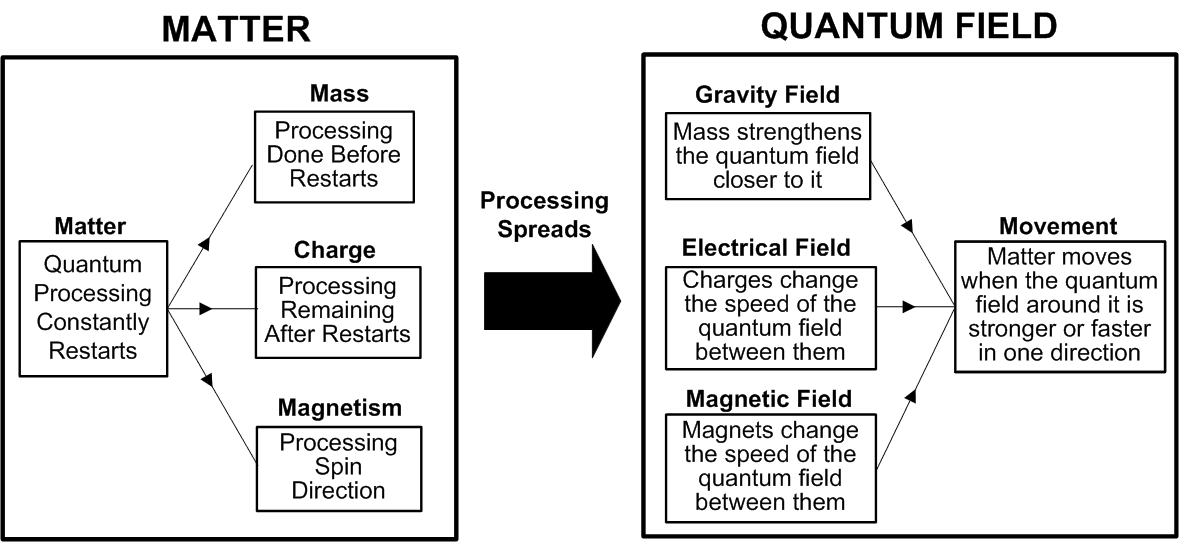
Matter doesn’t just sit there, but spreads its mass, charge, and spin into the space around it to cause the fields of gravity, electricity, and magnetism. These fields then all arise from one quantum field with three aspects, namely net strength (mass), net remainder (charge), and spin direction (magnetism), and the same quantum activity can also explain the other fields of physics (4.5.8).
The alternative view, that the quantum field is imaginary, leads to the many fields and particles of the standard model, so there can be field unification or particles, but not both. Quantum realism only needs one quantum field to explain all the forces of physics. The next section explores how the same field creates order as well as disorder.