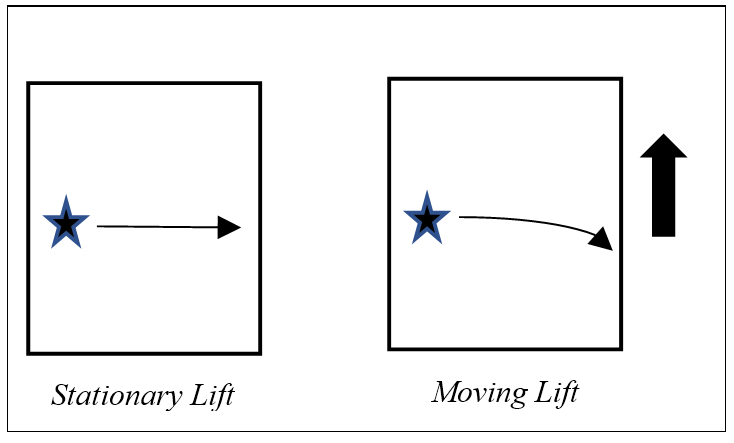
Astronomers have long known that light bends when it passes a star although photons have no mass for gravity to act on, but Einstein predicted this. He imagined a light shining in a lift going up, as shown in Figure 5.10. As the lift rises, the light curves relative to it, so if gravity equates to an acceleration, stars should bend light passing by, and they do. Light passing a star bends but from its perspective, it is going in a straight line, just as light in the lift is. Stars then don’t bend light by pulling it, but by changing its space.
This model also expects a star to bend light, because its gravity gradient will cause refraction (3.6.2). Light refracts when it enters a denser medium like water because it spreads more slowly in it, as slowing down one side of a wave skews it that way. Water then bends light because it is a denser medium, not by exerting a force.
Likewise, the gravity gradient of the sun makes space nearer to it a slower medium for light because it has more to do. Gravity makes space closer to the sun denser, so light bends when it enters it, just as it does when it enters a denser medium like water. The sun bends light by making it spread slower when it is closer, so gravity does curve space as Einstein said, but why does it also alter time?