QR3.2.2 We are Flatlanders

Transverse waves vibrate at right angles to their movement, but light moves in every physical direction so it can’t vibrate in our space. If light vibrated in a physical direction, it couldn’t move that way, so space wouldn’t be isotropic (the same in every direction). In simple terms, after space lets light move in three dimensions, there are no free directions for a transverse wave to vibrate into. Light then is a transverse wave that can’t vibrate transversely within our space.
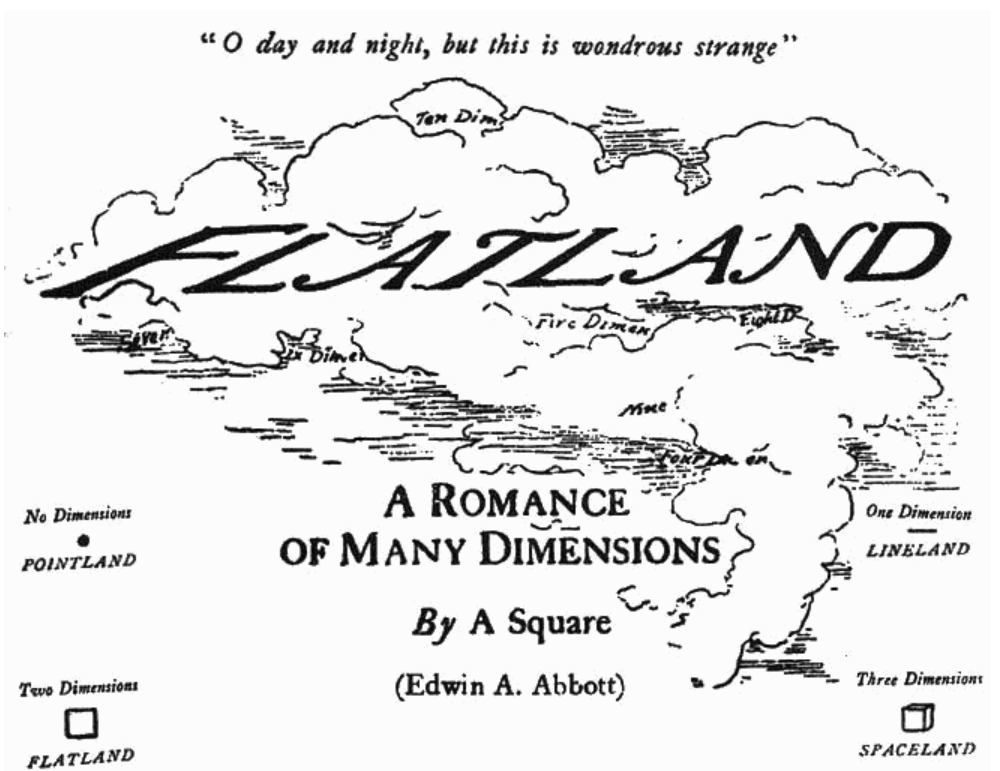
Edwin Abbot’s Flatland

However, if our space is a surface, then light could move on it as waves do on a lake, but in three dimensions not two. If light is a transverse wave vibrating outside our space, as complex number theory describes it, then we are 3D “Flatlanders”.

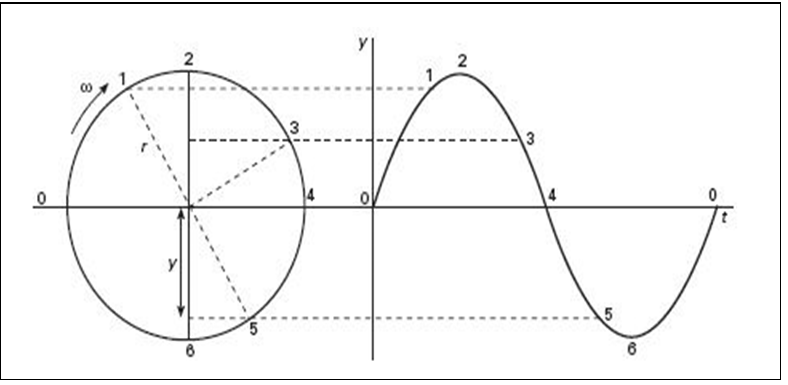
In Abbot’s story, Flatlanders were beings who lived their lives on a surface that had only two dimensions (Abbott, 1884), so they could see a circle but had to imagine a sphere. Now suppose a point entity moved on their land that set values in a circle at right angles to it (Figure 3.8a). Flatlanders could then explain it as a vibration in an imaginary plane, just as we explain light in complex number theory. As the point moves, it would trace out a sine wave with a frequency and a polarization plane in their space (Figure 3.8b), again as we have for light. They could then explain this moving point as an imaginary vibration, as we do for electromagnetism (Figure 3.8c).
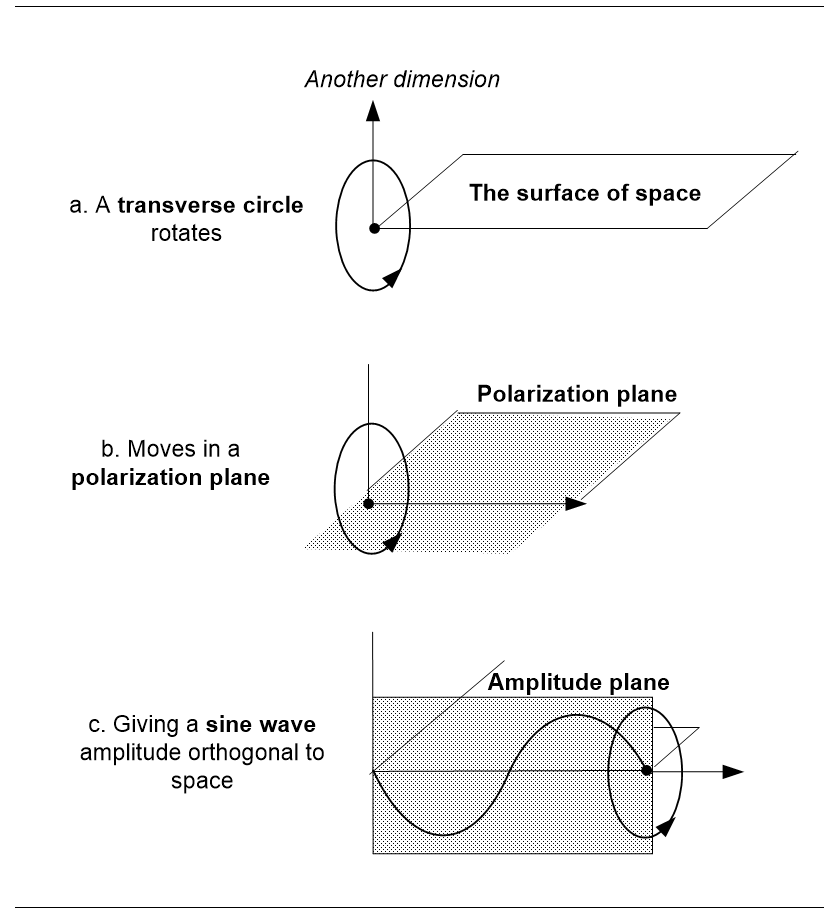
Figure 3.8. A circle moving at right angles to a plane in our space is a sine wave

Complex numbers then could explain electro-magnetism because light really does vibrate outside space, so:

“In quantum mechanics there really are complex numbers, and the wave function really is a complex-valued function of space-time.” (Lederman & Hill, 2004), p346.

Complex numbers describe light as rotating outside our space (Note 1), see Figure 3.9. Science calls this rotation imaginary because it doesn’t exist in our space, just as Flatlanders might call a rotation outside their space imaginary. But in their case, there really is a third dimension, so our case could be the same. If our space is a surface in a higher dimensional network, then light can vibrate into a fourth dimension as the equations say.

If our space is a surface inside a quantum network, then light can vibrate transversely. It can’t leave that surface, just as water waves can’t leave the surface of a pond, so if we are the same, we can’t leave our space. If so, we are three-dimensional Flatlanders, who call a vibration transverse to our space imaginary, but what vibrates when light does?

Note 1. Complex number theory describes a rotation into an imaginary plane. In normal multiplication, multiplying a number by two doubles it, e.g. 5 x 2 = 10. Multiplying by 4 adds it four times, e.g. 5 x 4 = 20. In complex multiplication, i is a 90° rotation into an imaginary plane, so times 2i is a 180° rotation that turns a number into its negative, e.g. 5 x 2i = -5. Times 4i is a 360° rotation that has no effect, so 5 x 4i = 5.
Next

QR3.2.1 Light is a Wave

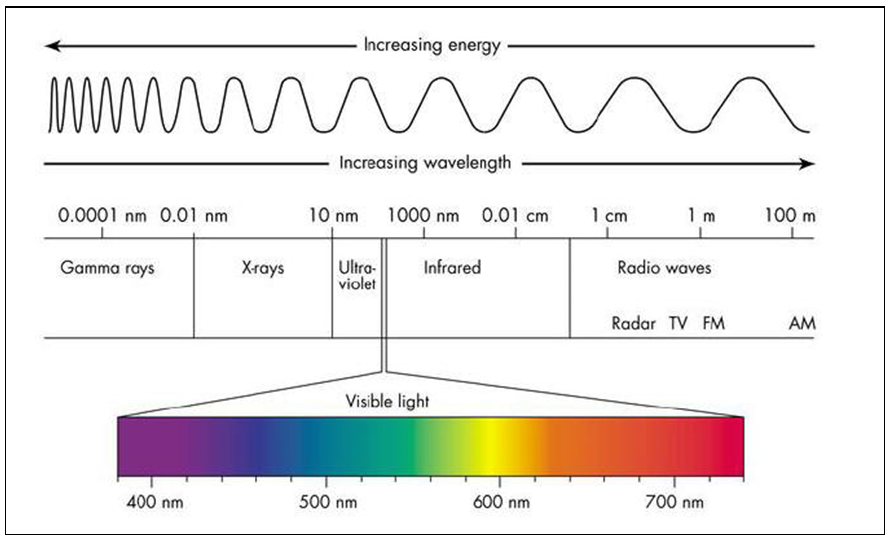
Figure 3.5. The electromagnetic spectrum

Current physics describes light as the vibration of an electro-magnetic field that exists throughout space. When this field vibrates slowly, it is radio waves, faster vibrations are visible light, and very fast vibrations are x-rays or gamma rays (Figure 3.5). Visible light is the part of the electro-magnetic spectrum that vibrates about a million-billion times a second, gamma rays are a billion times faster, while radio waves vibrate just a few times a second. All these waves are then the same vibration at different frequencies, so the term light will from now on refer to any electromagnetic wave.

In optics, light moving on an axis is a ray of light. A ray of light can polarize in many ways, but filters can produce a ray that is polarized only one way. Lasers can also produce a single pulse, which is one photon at one frequency polarized in one plane.

Such techniques can produce light rays that are out-of-phase, so the crests of one ray oppose the troughs of another. Each ray is then separately visible, but they combine to give darkness, as the out-of-phase rays cancel each other, just as out-of-phase water waves do. This light + light = darkness result confirms that light is a wave, because particles can’t do this. Note that flashlight beams can’t do this because they aren’t polarized.

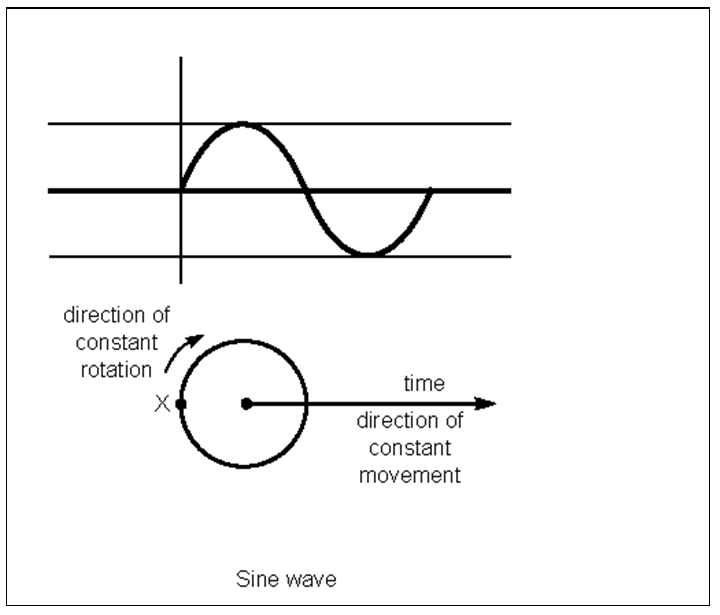
Figure 3.6. A moving circle maps to a sine wave

Light is also a sine wave, which in mathematics maps to a moving circle (Figure 3.6), so a pointer turning in a circle like a clock hand produces a sine wave as it moves (Figure 3.7). Water waves are also sine waves, caused by forces acting at right angles to the water surface.

.

.

Figure 3.7. A sine wave is a moving rotation

When a water wave arrives at a point on a pond surface, it pushes water molecules up until gravity pulls them back down, then the elasticity of the water pushes them back up, etc. The wave just moves water molecules up and down, so corks just bob up and down as a wave passes. What travels as a wave across a pond is the transverse up-down vibration, not the water itself, and this vibration maps to a moving circle.

In theory, light should work the same way but when the electro-magnetic field vibrates, nothing physical goes up or down and there is no physical direction for it to do so. Physics says light is an electro-magnetic vibration, but there is no physical basis for that. Naming a cause doesn’t explain it, so the term electro-magnetic field is just a placeholder for a vibration that isn’t understood. However a surface in the quantum network can transmit light waves just as a two-dimensional pond surface does, but in three-dimensions.

Next

QR3.2 Quantum Waves

Quantum waves can’t be explained in physical terms because the equations of physics describe them as vibrating in a plane outside our space. Light is a quantum wave that can travel in empty space, but what is empty can’t vibrate, so physics has to describe it as a wave of nothing that vibrates nowhere. In this section, light is a processing wave that spreads on a network surface, so it really is a transverse wave as the equations describe. Quantum waves are passed on by a quantum network that is the “… primary world-stuff” (Wilczek, 2008, p74), whose points are essentially the “atoms of space” (Bojowald, 2008).

3.2.1. Light is a Wave

3.2.2. We are Flatlanders

3.2.3. The Medium of Light

3.2.4. The Speed of Space

Next

QR3.1.5 How Come The Quantum?

Feynman once famously said:

“… all the mystery of quantum mechanics is contained in the double-slit experiment.” (Satinover, 2001), p127.

Quantum theory explains the double-slit experiment as follows:

A photon is a quantum wave that spreads in space by the equations of quantum theory. This wave goes through both slits to interfere with itself as it exits, but if observed immediately collapses to be a particle at a point, as if it had always been so. If we put detectors in the slits, it collapses to one or the other with equal probability. If we put a screen behind the slits, it goes through both, interferes with itself, then collapses to a point on the screen based on the prior interference.

This explanation works, but it doesn’t say what the wave is that goes through both slits, or why it collapses to a point when observed, hence Wheeler’s question: How come the quantum?

To understand how strange this is, suppose the first photon in a two-slit experiment hits the screen at a point to become the first dot of what will always turn into an interference pattern. Now suppose that in another experiment with a detector blocking the other slit, the first photon goes through the same slit to hit the screen at the same point, to be the first dot of what will never be an interference pattern. The difference between interference or not should be in the first physical events, but they are identical – a photon goes through the same slit to hit the same screen point.

The only difference is that the slit the second photon didn’t go through is blocked, but how can blocking a path a photon didn’t take stop the interference pattern? Equally, how can leaving open a slit the photon could have gone through but didn’t cause the interference? This implies that in our world, a counter-factual event that didn’t physically happen can change a physical outcome.

In a purely physical world, counter-factual effects are impossible, as is quantum theory’s unlikely tale of waves that collapse to a point when observed. Quantum theory may be the most successful theory in the history of science, but why it works is a mystery to physics, and it breaks down to two key questions:

1. What are quantum waves? What exactly spreads through space as a wave? The current answer, that quantum waves don’t exist so it doesn’t matter, is unsatisfactory.

2. What is quantum collapse? How do quantum waves collapse to a point when viewed? The current answer, that they collapse because they do, is equally unsatisfactory.

Until it answers these questions, quantum theory is a recipe with no rationale, not a theory of reality. In the story of Pinocchio, a man wanted a son but couldn’t have one so he made a puppet instead, but it wasn’t a real boy. Likewise, physics today wants a physical theory of sub-atomic events but can’t have one so it made quantum theory instead, but it isn’t a real theory. Quantum theory is then just a puppet of physics that is used but not considered real. However if it becomes a real theory, then the answer to the above questions can be discovered.

Next

QR3.1.4 The Copenhagen Compromise

In the 1920’s, after centuries of dispute over whether light is a wave or particles, Bohr devised the compromise that holds today, that they are complementary views, so both are true, and nothing better has been found since:

“…nobody has found anything else which is consistent yet, so when you refer to the Copenhagen interpretation of the mechanics what you really mean is quantum mechanics.” (Davies & Brown, 1999), p71.

This don’t ask, don’t tell policy lets a photon be a wave when we don’t look, as long as it’s a particle when we do, so physics can use particle or wave equations as convenient. In no pond do rippling waves behave like particles, and on no pool-table do billiard-balls behave like waves, but Bohr managed to sell the big lie [Note 1] that light is a wavicle. As Gell-Mann said in his 1976 Nobel Prize speech:

“Niels Bohr brainwashed a whole generation of physicists into believing that the problem (of the interpretation of quantum mechanics) had been solved fifty years ago.”

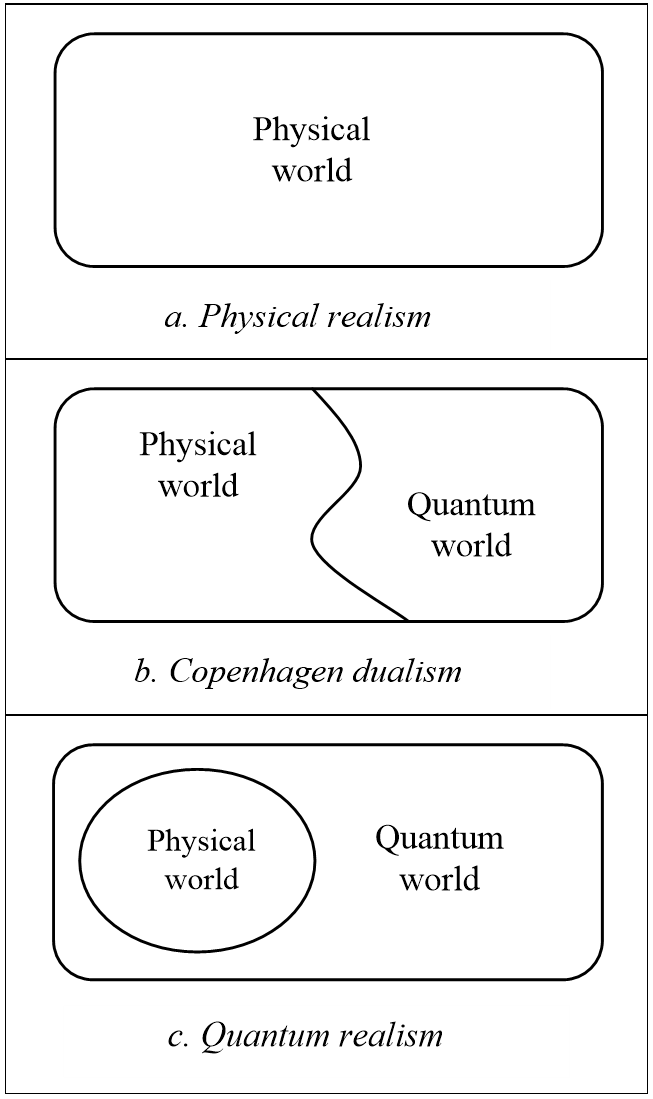
Quantum theory describes light as a wave that vibrates outside space as Maxwell’s equations specify, but a physical world can’t support that. Figure 3.4 shows the options for physics. The first is physicalism, that only the physical world exists, so quantum waves don’t exist (Figure 3.4a). But are physicists who use quantum waves to predict what light does then like shamans who predict what people will do based on spirit messages that don’t exist?

Figure 3.4. a. Physicalism, b. Copenhagen dualism, c. Quantum realism

Bohr’s answer was that physicists aren’t shamans because the quantum world can be real for the purpose of physics but not actually real. In this double-think, the quantum world exists for our equations but doesn’t exist in reality, which in effect lets the physical and quantum worlds co-exist somehow (Figure 3.4b). But that quantum events exist only for the convenience of physics was an admission of failure not a theory success (Audretsch, 2004), p14.

In public, Bohr accepted the quantum world but in private, denied that it existed at all, so he chose to use quantum theory but deny what it meant. Copenhagen dualism, like Descartes’s mind-body dualism before it, is a mystical marriage of convenience between incompatible domains.

The quantum realism alternative to physicalism and Copenhagen dualism is that physical events are a subset of quantum events (Figure 3.4c). The quantum world then generates the physical world within it, so classical mechanics is a subset of quantum mechanics. The Copenhagen doctrine put the quantum world in its place, which is to serve the physical world, but it still didn’t answer Wheeler’s question, how come the quantum?

Next

Note: A “big lie” is a statement so outrageous that people think it must be right or it wouldn’t be said.

QR3.1.3 The Double-Slit Experiment

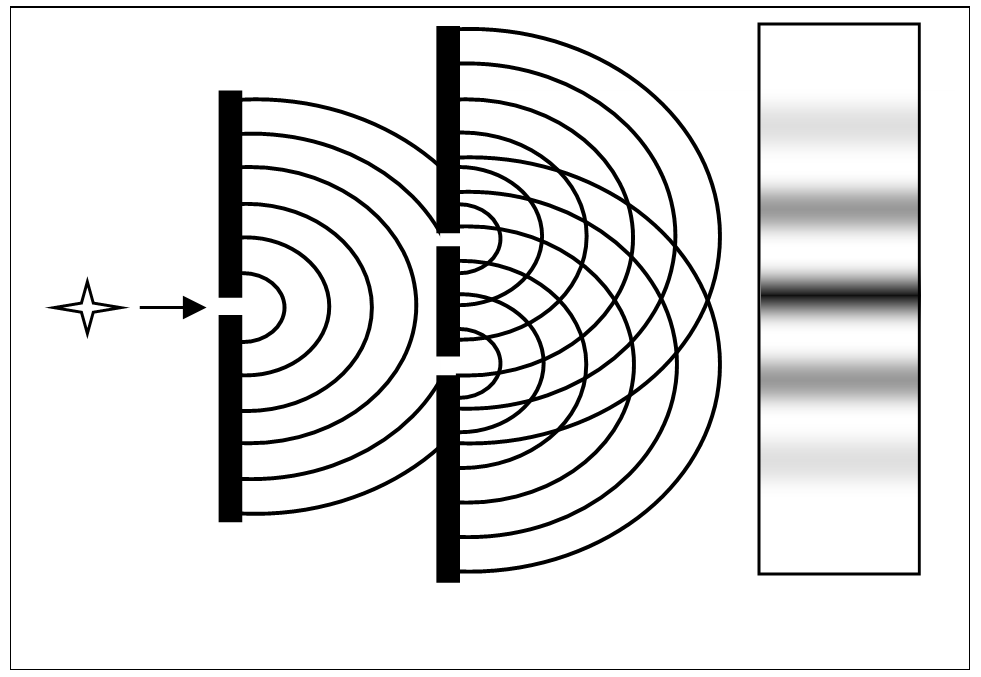
Figure 3.2. Young’s double slit experiment

Young’s double-slit experiment is a simple measurement discovered over two hundred years ago that still baffles physics today. Light shone through two slits gives an interference pattern on a screen (Figure 3.2). Only waves interfere like this, so light must be a wave, but why then do its rays hit at a point? Conversely, if light is made of particles, why do they interfere like a wave?

To explain this puzzle, physicists used lasers to send one photon at a time through the slits. Each photon then gave a dot on the screen, as a particle would, but over time the dots formed the familiar interference pattern, whose most likely impact was behind the barrier between the slits! The effect was independent of time, so one photon shot through the slits each day still gave the same pattern. Since each photon doesn’t know where the last one hit, how can interference occur?

It seemed that each photon was going through both slits to interfere with itself! In an objective world, we could just observe whether a photon went through both slits, but our world doesn’t work like this. Detectors placed in both slits to see where the photon goes just fired half the time, as expected, so one photon always went by one slit or another, never through both. How then is interference possible?

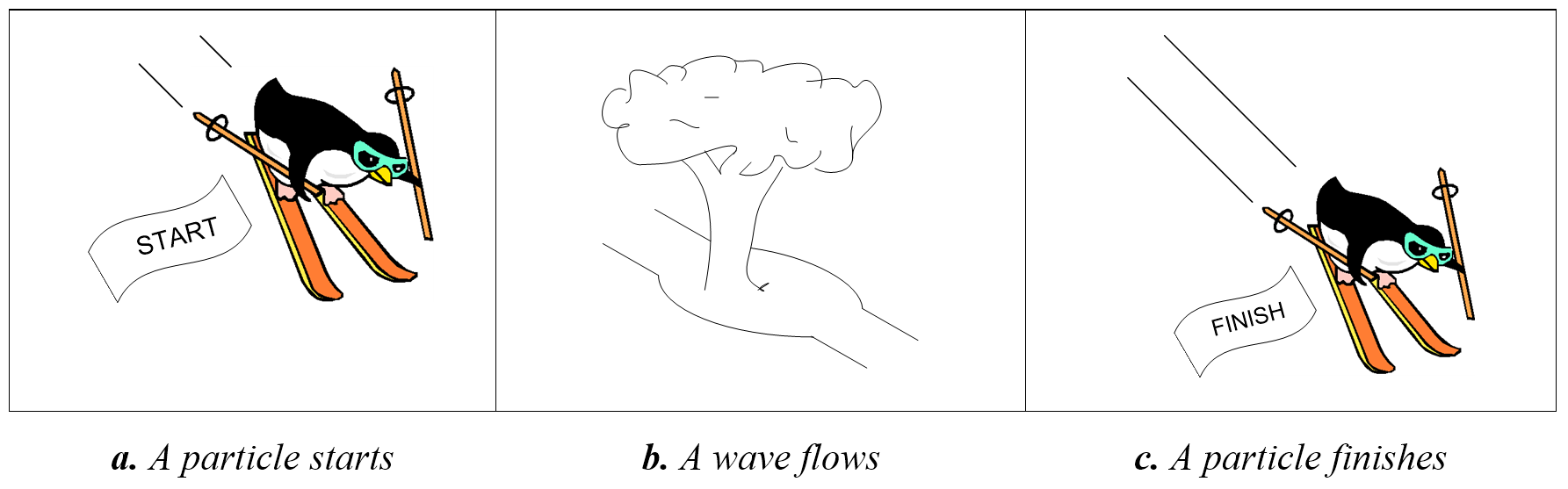
The puzzle is that when we look at the slits, there is just a photon particle, but when we don’t look, there is interference. It is as if one skier set off, went around both sides of a tree, but still reached the finish line as one skier (Figure 3.3).

Figure 3.3. Wave-particle duality

In summary, the problem is:

1. If a photon is a wave, how can it hit the detector screen at a point not a smear?

2. If a photon is a particle, how can going through one slit give an interference pattern?

And this wave-particle duality doesn’t just apply to light, as electrons, atoms, and even molecules exhibit Young’s two-slit interference (M. Arndt, O. Nairz, J. Voss-Andreae, C. Keller, & Zeilinger, 1999), so they also act like waves.

Next

QR3.1.2 Particle or Wave?

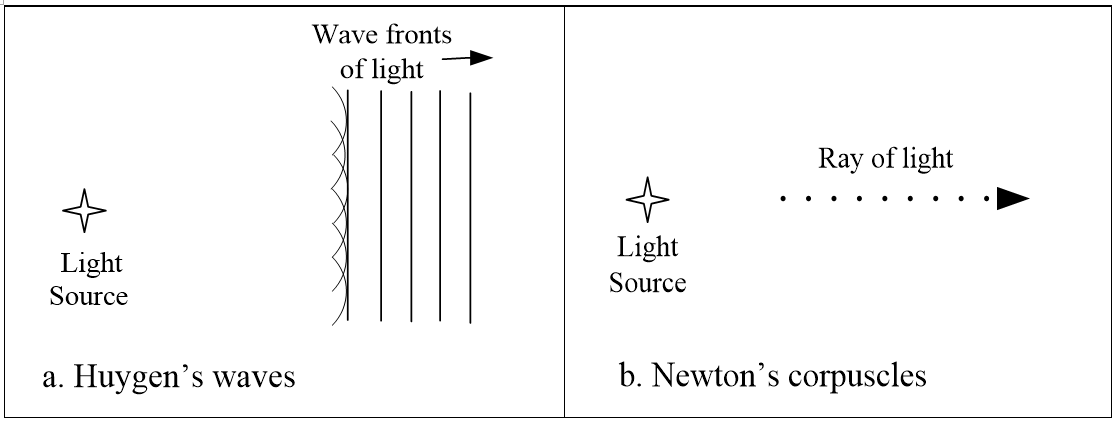
Figure 3.1. a. Huygen’s wave front. b. Newton’s corpuscles

The question of whether light is a particle or a wave has a long history. In the seventeenth century, Huygens observed that light beams at right angles pass through each other like waves, but arrow-like particles would collide. He concluded that light is a wavefront spreading in all directions, with each point the origin of a new little wavelet. The wavelets behind the wavefront interfere, as the trough of one cancels the crest of another, so the result is a forward moving wavefront that acts like a ray of light (Figure 3.1a). Huygen’s Principle, that each point of the light wavefront is a new wavelet source, explained reflection, refraction, and diffraction, so light is a wave.

In contrast, Newton observed that light travels in straight lines, rather than bending round corners as sound does when someone is talking in the next room, so he concluded that light consisted of corpuscles that traveled in straight lines (Figure 3.1b) in his optics. His model explained only reflection and refraction but it carried the day, so light was then seen as particles.

So it remained until two hundred years later, Maxwell used Faraday’s field idea to write down the equations of light as an electro-magnetic wave, based on a mechanical model of rotating vortexes. The equations worked and were accepted, so that seemed to confirm that light was a wave.

However, waves need a medium, so light should travel by means of an ether that permeated space. The speed of light should then vary relative to that ether, but the Michelson-Morley experiment showed that it didn’t, so if light didn’t travel in a physical ether, it couldn’t be a wave. Then Einstein concluded from the photo-electric effect that light comes in particle-like packets, called photons, which suggested that light was made of particles!

The science of light had swung from Huygens’ waves, to Newton’s corpuscles, to Maxwell’s waves, to Einstein’s photon packets, with no clear winner, so physics finally gave up. It decided that light is wave and a particle, even though that seems impossible. Three centuries after Huygens and Newton, we still don’t know whether light is a wave or a particle and the current wave-particle duality essentially enshrines our ignorance. Science can explain light as a particle, or as a wave, but it can’t explain how it can be both.

Next

QR3.1.1 Light is a Mystery

In science, the question of what light is reduces to how it manages to do what does, but that is often inexplicable. Even after centuries of study, physics still can’t explain why light:

1. Doesn’t fade. All physical waves fade over time by friction but light doesn’t, as a photon from a distant star that has traveled for millions of years still produces a dot on a screen.

2. Has a constant speed. The speed of a wave depends on the medium it travels through, but light travels at a constant speed in empty space for no apparent reason.

3. Is like a wave and a particle. Waves aren’t particles nor are particles waves, but light is sometimes like a wave and sometimes like a particle, which doesn’t make sense.

4. Always takes the fastest path. A particle can’t know the fastest path to any destination in advance, but light always finds that path, somehow.

5. Defines its path when it arrives. A particle can’t pick the path it took to a destination when it arrives but light seems to do just that, which is very strange.

6. Can reveal an object it didn’t physically touch. In a purely physical world, it should be impossible to detect an object without touching it, but light can do exactly that.

7. Seems to vibrate outside space. Light waves vibrate as other waves do, but according to the equations that describe it, do so in a dimension outside our space, which is odd.

Current physics describes light as an electromagnetic wave made up of photon particles but how can it be both? A water wave doesn’t arrive at a point like a particle but a photon does. A particle can’t take many paths at once like a wave but light seems to. Physical waves don’t act like particles and particles don’t act like waves, so how can light be both? Surely science can decide if light is a particle or a wave?

Next

QR3.1 What is Light?

Long before science, light was considered primal, as light from the Egyptian sun god Aten sustained all, and in the bible, light was created before the sun, moon, stars, or man. In physics today, a photon of light is the simplest of all its particles. Light is all around us but how it operates remains a mystery, for as Einstein wrote just before he died:

“All these fifty years of conscious brooding have brought me no nearer to the answer to the question ‘What are light quanta?’ Nowadays every Tom, Dick and Harry thinks he knows it, but he is mistaken.” (Walker, 2000), p89.

Even today, science still can’t answer the apparently simple question, what is light?

QR3.1.1 Light is a Mystery

QR3.1.2 Particle or Wave?

QR3.1.3 The Double-Slit Experiment

QR3.1.4 The Copenhagen Compromise

QR3.1.5 How Come The Quantum?

Next

Chapter 3.

Quantum Realism Part I. the observed Reality…

Chapter 3. The Light of Existence

Brian Whitworth, New Zealand


“There is a theory which states that if anyone discovers exactly what the Universe is for and why it is here, it will instantly disappear and be replaced by something even more bizarre and inexplicable. There is another theory which states that this has already happened.”

Douglas Adams, 1995.

In the beginning, there was light, but not as we know it today. In the last chapter, our universe began as one white-hot photon in one unit of space, but this first event instantly led to the chain-reaction that physics calls inflation. Inflation then created all the light that has ever existed in a million, billion, billion, billionth of a second, until the accompanying expansion of space diluted the light enough to stop it. The result was a small plasma ball of white-hot light and space that then expanded at light speed to form all the galaxies and stars we see today. In this view, light alone was the first existence, so what is it? Download Whole Chapter

QR3.1.   What is Light?

QR3.2.   Quantum Waves

QR3.3.   Quantum Processing

QR3.4.   Processing Spreads

QR3.5.   Processing Restarts

QR3.6.   How Light Travels

QR3.7.   Quantum Spin

QR3.8.   Physics Revisited

QR3.9.   Reality Bites

Summary Table

Discussion Questions

References

Next