Last century, physics invented a tale of quantum waves that spread at light speed then collapse instantly into physical events that begin the waves again. It made no sense, because physical waves can’t restart like that, but these strange waves predicted atomic events amazingly to give modern technologies like (Jenner, 2014):
- Transistors that run devices like smartphones work thanks to quantum laws.
- Medical devices like MRI (Magnetic Resonance Imaging) look within the body without surgery thanks to quantum laws.
- Global Positioning Systems (GPS) let us navigate the world thanks to quantum laws.
- Lasers scan barcodes at supermarkets thanks to quantum laws.
- Solar panels convert sunlight into electricity thanks to quantum laws.
- LEDs (light-emitting diodes) run the sensor lights on TVs thanks to quantum laws.
Without quantum laws, these technologies wouldn’t exist. Last century, physics called the theory behind them imaginary because its physically impossible but if the technologies are real, surely the theory behind them is too! One possibility that wasn’t considered before computers came along is that quantum waves are processing waves spreading on a network. If so, quantum waves can:
- Evolve stepwise. Quantum theory describes waves that evolve discretely rather than continuously. Processing waves can do this because the network passes them on step-by-step each cycle. Quantum waves can then evolve as quantum theory says because they are processing waves spreading on a network.
- Superpose to a limit. Quantum theory describes waves that superpose like probabilities up to a limit of one, unlike physical waves that can be any height. Processing waves on a network can do this because each network point has a finite processing limit that it can handle. Quantum waves can then superpose to a limit because each network point has a bandwidth limit.
- Collapse instantly. Quantum theory describes waves that collapse instantly to restart at a point, which physical waves never do. Processing waves on a network can do this because a process can restart at a point. Quantum waves can then collapse instantly because a processing wave can restart at a network point.
- Entangle at a restart point. Quantum theory describes waves that entangle into one when they restart at the same point in a physical event, while physical waves just pass through each other and never merge. Processing that restarts at the same point could merge into one because two processes can be combined into one. Quantum waves could then entangle at a point because their processing merges.
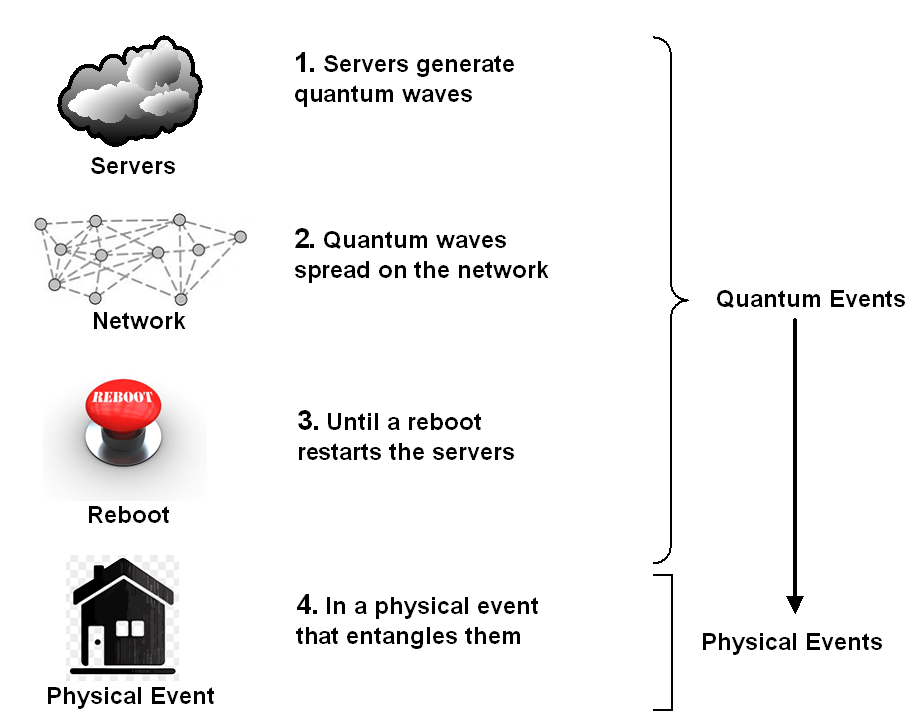
Later chapters provide more details, but essentially quantum weirdness can be explained in computing terms. If processing waves on a network can evolve stepwise, superpose to a limit, collapse instantly, and entangle, then quantum theory describes what actually happens, as quantum events cause physical events given these concepts:
- Servers. A server is needed to generate and restart a quantum wave process.
- Network. A network is needed to spread and superpose quantum wave processing.
- Reboot. A network point that overloads must reboot to request a server restart.
- Physical event. A physical event must be a point overload that restarts and entangles the processes involved.
Figure 2.15 then summarizes how quantum events cause physical events.
A photon is a processing wave that spreads on a network until it overloads a point, in a physical event that restarts it again, so light is never lost. When we interact with a photon wave, the resulting physical event allows an observation, but reduces it to a particle-like point. Quantum waves then exist all around us, but when we “touch” them, they turn into physical events. The physical world we observe is then like a painting that appears only when painted, one brushstroke at a time, and we aren’t the only painters, as atoms also paint events. The surface painted on, which we call space, can curve, and the clock counting the strokes, which we call time, can slow down, as Einstein deduced. Relativity gives each painter their own canvas and clock, so space and time are generated locally, along with each physical event.
Hawking concluded that time and space began when our universe did, but also argues that nothing existed before that based on physicalism, that only the physical exists (Hertog, 2024). It follows that not only did something (our universe) come from nothing, its space and time did too, which makes no sense. The alternative proposed here is that the primal reality that began our universe also created its space and time.
To think the first event just made light or matter is to underestimate it, as space and time were needed as well. We can imagine the making of objects but not of time and space. Science expected the first event to create matter, and theology expected it to include us, but the evidence is that our universe didn’t start with humans, animals, sky, or earth as they are now, but with what led to them, a primal seed that after fifteen billion years grew into galaxies, stars, planets, life, and us. If the first event made not only things but also space and time, and continues to do so today, the rabbit-hole of quantum reality runs deeper than even its advocates suppose.
Table 2.1 compares quantum realism with physicalism for space and time, so the reader can decide which explains the evidence better. The following chapters extend the above model to explain light (Chapter 3), matter (Chapter 4), and relativity (Chapter 5). There is also a testable prediction that current theory denies – that pure light can collide (4.5.9).