QR2.1.1 The Quantum Network

The idea that physical events are generated is radical but not new, given the following proposals:

1. Fredkin. Proposed that for physical events to be generated “…only requires one far-fetched assumption: there is this place, Other, that hosts the engine that “runs” the physics.” (Fredkin, 2005) p275.

2. Wilczek. Proposed that what generates the physical is “… the Grid, that ur-stuff that underlies physical reality(Wilczek, 2008 p111).

3. Wheeler. Proposed that some sort of processing generates matter “… every physical quantity, every it, derives its ultimate significance from bits … a conclusion which we epitomize in the phrase, it from bit.” (Wheeler, 1989).

4. D’Espagnat. Proposed that a “veiled reality” generates time, space, and matter. (D’Espagnat, 1995).

5. Campbell. Proposed that a “Big Computer” generates our reality (Campbell, 2003).

6. Barbour. Proposed that time is generated by a landscape where “The mists come and go, changing constantly over a landscape that itself never changes(Barbour, 1999) p230.

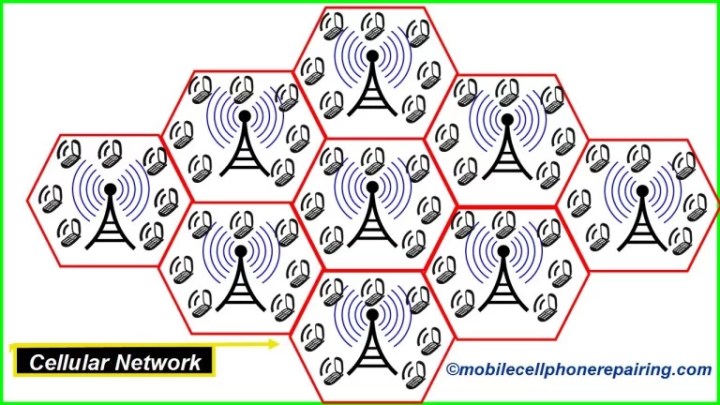
Figure 2.1. A cellphone network

These proposals suggest that something else generates physical events, so let Fredkin’s engine, Wilczek’s ur-grid, Wheeler’s bit source, D’Espagnat’s veiled reality, Campbell’s big computer, and Barbour’s landscape all refer to a primal network that existed before our universe began. Our cellphone networks consist of stations that actively support local phones, where each station connects to its neighbors (Figure 2.1), so let the network proposed be the same, except each station is a point of space that supports local entities, not phones. Space itself is then a network of points, just as Feynman viewed it, according to Hiley:

I remember … Richard Feynman … saying that he thought of a point in space-time as being like a computer with an input and output connecting neighboring points.” (Davies & Brown, 1999) p138.

Feynman imagined space as a network, whose points had inputs and outputs like a computer. Let us therefore also imagine space as a network, which is empty when its output is null, and when it isn’t, shows something else, like a photon or electron. Behind this concept is the same processing that runs our quantum computers.

But if quantum processing generates matter, is matter just information, as Wheelers It from Bit implies? Before exploring how a quantum network could create a space and time like ours, let us clarify what information is.

Next

QR2.1 Quantum Processing

Quantum theory describes the quantum processes that generate physical events. We know that quantum processing occurs because quantum computers use it and they work, but how does it run and what does it do? This section suggests that it runs on a quantum network and is, in our terms, the creation of processing.

QR2.1.The Quantum Network

QR2.1.What is Information?

QR2.1.Reloading Reality

QR2.1.4    Quantum Cloning

QR2.1.5  Processing Waves

Next

Chapter 2.

Quantum Realism Part I. The Observed Reality

Chapter 2. Creating Space and Time

Brian Whitworth, New Zealand

“To me every hour of the light and dark is a miracle,Every cubic inch of space is a miracle”

Walt Whitman

A virtual world can represent a space and time to its inhabitants. This chapter analyzes how a virtual world could generate a space and time that would appear to its residents as ours do to us.                             Download Whole Chapter

QR2.1 Quantum Processing

QR2.2 Creating Space

QR2.3 Creating Time

QR2.4 Implications

QR2.5 Re-engineering Physics

Summary Table

Discussion Questions

References

Next

Chapter 1 Discussion Questions

The following questions are addressed in this chapter. They are better discussed in a group to allow a variety of opinions to emerge. The relevant section link is given after each question:

1.   In what sense is current physics a hollow science? What is missing? (QR1.1.2)

2.   Why is it hard to argue for a mental world as well as a physical one? (QR1.2.2)

3.   How does an objective reality differ from a virtual reality? (QR1.2.3)

4.   Has science proved that the physical world is an objective reality? (QR1.2.3)

5.   How does quantum realism agree with The Matrix movie? How does it differ? (QR1.2.5)

6.   How are quantum realism and physical realism the same? How are they different? (QR1.2.5)

7.   Could science still operate in a virtual reality? (QR1.2.6)

8.   What physical evidence fits the theory that the physical world is a virtual reality? (QR1.3.1)

9.   Why do many physicists deny that quantum events cause physical events? (QR1.3.2)

10.  Can the physical world compute itself? Give reasons. (QR1.4.1)

11.  Could a physical universe that is all there is create itself in a big bang? Give reasons. (QR1.4.2)

12. How did our space begin if there was no time for it to begin in? (QR1.4.2)

13. How did our time begin if there was no space for it to begin at? (QR1.4.2)

14.  How can space be both nothing and something? (QR1.4.3)

15.  Why can’t anything go faster than light? (QR1.4.4)

16.  Is physics more scientific because it studies real physical events? (QR1.4.5)

17.  Is quantum realism falsifiable? Is physical realism falsifiable? (QR1.5.1)

18.  How can quantum realism be evaluated scientifically? (QR1.5.2)

19.  What is Occam’s razor? Does it support physical realism? (QR1.6.1)

20.  Is the physical universe eternal, all-pervasive, all-powerful, and self-existing? (QR1.6.2)

21. Does quantum realism change the equations of physics? If not, what does it change? (QR1.6.3)

22.  Is quantum realism a theory of everything (TOE)? If not, why not? (QR1.6.4)

Next

Chapter 1 References

Aspect, A., Grangier, P., & Roger, G. (1982). Experimental Realization of Einstein-Podolsky-Rosen-Bohm Gedankenexperiment: A New Violation of Bell’s Inequalities. Physical Review Letters, 49(2), 91–94.

Atkins, P. (2011). On Being: A scientist’s exploration of the great questions of existence. Oxford University Press. https://en.wikipedia.org/wiki/Peter_Atkins

Audretsch, J. (2004). Entangled World: The fascination of quantum information and computation. Wiley.

Baggot, J. (2013). Farewell to Reality: How fairytale physics betrays the search for scientific truth. Constable.

Barrow, J. D. (2007). New theories of everything. Oxford University Press.

Bone, J. (2005). The social map and the problem of order: A re-evaluation of “Homo Sociologicus.” Theory & Science, 6(1).

Bostrom, N. (2002). Are you Living in a Computer Simulation? Philosophical Quarterly, 53(211), 243–255.

Chaitin, G. (2006). The limits of reason. Scientific American, 294(3), 74–81.

Cho, A. (2000). Physicists Unveil Schrodinger’s SQUID. Science, 287(31 March).

Deutsch, D. (1997). The Fabric of Reality. Allen lane.

Esfeld, M. (2004). Quantum Theory: A Challenge for Philosophy! In J. Audretsch (Ed.), Entangled World (pp. 271–296). Wiley-VCH.

Everett, H. (1957). “Relative state” formulation of quantum mechanics. Rev. of Mod. Phys., 29, 454–462.

Ford, K. W. (2004). The Quantum World: Quantum Physics for Everyone. Harvard University Press.

Fredkin, E. (1990). Digital Mechanics. Physica D, 254–270.

Gödel, K. (1962). On Formally Undecidable Propositions.

Greene, B. (2004). The Fabric of the Cosmos. Vintage Books.

Gribbin, J. (2000). The Search for Superstrings, Symmetry, and the Theory of Everything. Little, Brown & Company.

Guth, A. (1998). The Inflationary Universe: The Quest for a New Theory of Cosmic Origins. Perseus Books.

Hafele, J. C., & Keating, R. E. (1972). Around-the-world atomic clocks: Observed relativistic time gains. Science, 177, 168–170.

Hevner, A. R., March, S. T., & Park, J. (2004). Design Science in Information Systems Research. MIS Quarterly, 28(1), 75–105.

Hogg, M. A. (1990). Social Identity Theory. Springer-Verlag New York.

Hossenfelder, S. (2018). The Present Phase of Stagnation in the Foundations of Physics Is Not Normal. Nautilus, November.

J. Khoury, B. A. O. (2001). Ekpyrotic universe: Colliding branes and the origin of the hot big bang. Phys. Rev. D64, 12.

Kant, I. (2002). Critique of Pure Reason. In M. C. Beardsley (Ed.), The European Philosophers from Descartes to Nietzsche. The Modern Library.

Kelly, K. (2002). God is the Machine. Wired, 10(12).

Kuhn, T. (1970). The Structure of Scientific Revolutions: Vol. Second Edition, Enlarged. The University of Chicago Press.

Kwiat, P. G., Weinfurter, H., Herzog, T., Zeilinger, A., & Kasevich, M. A. (1995). Interaction-free Measurement. Phys. Rev. Lett., 74, 4763.

Lloyd, S. (1999). Universe as Quantum Computer. arXiv:Quant-Ph/9912088v1, 17 Dec.

Lloyd, S. (2006). Programming the Universe. A Quantum Computer Scientist Takes On the Cosmos. Alfred A. Knopf.

McCabe, G. (2005). Universe creation on a computer. Stud.Hist.Philos.Mod.Phys.36:591-625.

Nikoli´, H. (2008, Access Date). Quantum mechanics: Myths and facts. Http://Arxiv.Org/Abs/Quant-Ph/0609163v2.

Piccinini, G. (2007). Computational modelling vs computational explanation: Is everything a Turing machine and does it matter to a philosophy of mind? The Australasian Journal of Philosophy, 85(1), 93–115.

Power, A. (2010). The online public or cybercitizen. SCRIPTed – A Journal of Law, Technology & Society, 7(1). http://www2.law.ed.ac.uk/ahrc/script-ed/

Pratchett, T., Stewart, I., & Cohen, J. (1999). The Science of Discworld. EBURY PRESS/Random House, London.

Raspanti, M. (2000). The Virtual Universe. Authorhouse.

Rhodes, R. (2001, Access Date). A Cybernetic Interpretation of Quantum Mechanics. http://www.bottomlayer.com/bottom/Argument4.PDF

Schmidhuber, J. (1997). A Computer Scientist’s View of Life, the Universe and Everything. In C. Freksa (Ed.), Foundations of Computer Science: Potential-Theory-Cognition Lecture Notes in Computer Science (pp. 201–208). Springer.

Sheldrake, R. (2012). The Science Delusion. Coronet Books.

Smolin, L. (2001). Three Roads to Quantum Gravity. Basic Books.

Smolin, L. (2006). The Trouble with Physics. Houghton Mifflin Company.

Svozil, K. (2005). Computational Universes. Chaos, Solitons & Fractals, 25(4), 845–859.

Tegmark, M. (1997, Access Date). The interpretation of Quantum Mechanics: Many Worlds or Many Words. arXiv:Quant-Ph/9709032v1.

Tegmark, M. (2007). The Mathematical Universe. In R. Chiao (Ed.), Visions of Discovery: Shedding New Light on Physics and Cosmology. Cambridge Univ. Press.

Tegmark, M., & Wheeler, J. A. (2001). 100 Years of the Quantum. Scientific American, Feb, p68-75.

Vacca, J. (2005). The World’s 20 Greatest Unsolved Problems. Prentice-Hall.

Whitworth, B., & Ahmad, A. (2013). The Social Design of Technical Systems: Building technologies for communities. The Interaction Design Foundation.

Wigner, E. (1960). The Unreasonable Effectiveness of Mathematics in the Natural Sciences. In Communications in Pure and Applied Mathematics, vol. 13, No. I. John Wiley & Sons, Inc.

Wolfram, S. (2002). A New Kind of Science. Wolfram Media.

Zuse, K. (1969). Calculating Space. MIT.

Next

Acknowledgements

Thanks to Onofrio Russo (NJIT) who aroused my interest in this by telling me what Dirac told him about light.

Thanks for helpful comments and advice to (in alphabetical order):

Akram Ben Aissi, Steve Alvarez, Mehmet Ata, Alethea Black, Gayle Dean, Tom Campbell, David Chartrand, Jonathan Dickau, Andrew Eaglen, Kent Forbes, Robert Frot, Carl Grove, Kevin Hyndman, Lucian Ionescu, Ben Iscatus, Tim Jones, Bogdan Lazar, Alex Lightman, Alexander Macris, Bruce Maier, Mason Mulholland, Paul Olivier, Ervin Olah, Kevin Player, Ross Rhodes, John Ringland, Paul Smith, Claudio Soprano, Gunnar Jörgen Viggósson, Ram Vimal, Bryan Warner, Marty Wollner, Ian Wilson and Eden Yin.

Especial thanks to Celso Antonio Almeida, Matthew Raspanti and Belinda Sibly for detailed edits of the rough early chapters.

I also thank my son Alex who always helps me think more clearly. Still, the mistakes are mine alone.

QR1.6.4 A Query of Everything

Science has long challenged our human tendency to make ourselves the center of things, so:

Since our earliest ancestors admired the stars, our human egos have suffered a series of blows.” (Tegmark, 2007).

The human ego is the idea we have of ourselves, the set of core beliefs we mean by I, it naturally prefers to be important, but science ignores that.

For example, we once thought we were at the center of the universe and the sun and stars moved around us, so the question “Where are we?” didn’t arise because we already knew the answer. That we were at the center of everything made us feel important, so when Galileo and Copernicus challenged geocentrism, they also challenged the ego idea that things revolve around us. Science now tells us that humanity lives on a little planet, circling a medium star, in a galaxy of a hundred billion stars, in a universe of at least that many galaxies, so we are like a colony of bacteria on one leaf on a tree in a vast forest. Yet this ego blow was the price we paid to understand astronomy.

Human beings also thought they were the center of life on earth and animals and plants were put there just for us, so the question “When did we begin?” didn’t arise because we already knew the answer. That we had always been there made us feel important, so when Darwin challenged creationism, he also challenged our ego idea that life revolves around us. Science now tells us that humans only evolved from animals a few million years ago, after dinosaurs had ruled the earth for two-hundred million years until a meteor wiped them out, so we are just another species, and bacteria, insects, and plants all exceed us in biomass. Yet this ego blow was the price we paid to understand biology.

Today, people often see themselves as being at the center of a brain that controls the body, so the question “Who am I?” doesn’t arise because we already know the answer. That we are a mind that observes and chooses what the body does makes us feel important, so when neuroscientists challenge the dualism that a mind controls the body, they also challenge the ego idea that our bodies revolve around us. Science now tells us that our brain has no central processing unit as a computer does, but is just a set of neural assemblies that coordinate somehow (Chapter 6), so the brain doesn’t support a mental self. Yet this ego blow is the price we are paying to understand the brain.

The trend is clear; our ego assumes that we are central but science repeatedly finds that we aren’t. We aren’t the center of the universe, of life on earth, or even our brain, but old habits die hard. We still think that what we observe is real because we observe it, so the question “What is real?” doesn’t arise because we already know the answer. That we are the knower of reality makes us feel important, so when quantum theory challenges physicalism, it also challenges the ego idea that we know reality. Science is now telling us that the physical world isn’t real because the quantum world causes it, so we are living in a virtual reality. Yet this ego blow is the price we have to pay to understand quantum reality.

These challenges to our illusion of superiority don’t affect what we are but what we think we are, the ego. For example, the illusion of scientific omniscience (Sheldrake, 2012) is the egoism that we already know everything, or soon will. Hence, instead of a theory of everything, which is impossible by Gödel’s proof that all theories are incomplete (Gödel, 1962), science suggests a query of everything that explores the quantum ground underlying the images we see.

Table 1.1 (see Next) compares physical realism and quantum realism, for the reader to compare. 

Next

QR1.6.3 How Science Changes Axioms

Normal science expands knowledge by theories based on assumed axioms but sometimes scientific revolutions called paradigm shifts alter those axioms (Kuhn, 1970). The history of science then consists of long periods of normal science punctuated by occasional paradigm shifts that change its foundations.

For example, Euclid’s axiom that parallel lines can’t converge was accepted for two thousand years until it was realized that on curved surfaces like the earth, parallel longitudes do converge at the poles. Changing that axiom allowed hyper-geometries that work on curved surfaces, so Euclid’s geometry was just the special case of a flat surface. Einstein’s relativity was another paradigm shift that made Newtonian mechanics a special case. Science then sometimes advances by improving its axioms.

What then are good axioms? They are those that predict more than one fact (Chaitin, 2006) to let theories based on a few axioms predict many facts. Ignoring this criterion by adding a new axiom for every new fact increases size not success, just as putting a shack on every new plot of land gives a shanty town not a city. Theories that produce a lot of knowledge using a few axioms are like towers that produce a lot of value on a small plot of land. A paradigm shift is then needed when theory isn’t increasing knowledge, and particle physics today is in this category, as:

One experiment after another is returning null results: No new particles, no new dimensions, no new symmetries.” (Hossenfelder, 2018).

As new facts were discovered, new particles were invented to explain them, so particles increased but not their predictions. Gravitons were invented to explain gravity but they predicted nothing new. Massive field particles were invented to explain neutron decay but again predicted nothing new, and a Higgs particle was needed to explain their mass, but it also led nowhere. Particle physics became more complex but hasn’t made a breakthrough in decades, which suggests a paradigm shift is needed.

The shift proposed is to base physics on quantum waves not the particles of physicalism. This change seems radical but disruptive innovations are often the price of progress (Sandström, 2010). Yet the disruption isn’t great, as Schrödinger’s equation for example still works but just describes what exists not what doesn’t. The benefit is that physics can advance, just as astronomy did  when it stopped making the earth the center of the universe, but both cases require us to stop believing that we already know.

Next

QR1.6.2 The Ideology of Physicalism

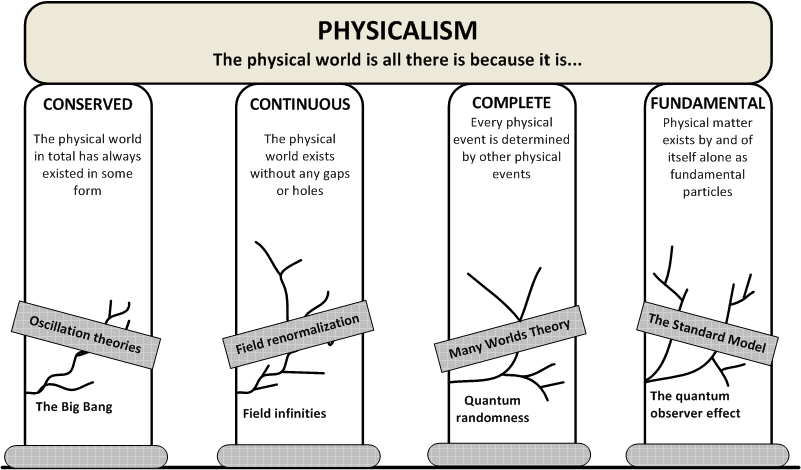
If everything is physical, then physical events have only physical causes, which in current physics are particles of matter or energy that exist in space and time to exert a force. This predicts a physical world that is conserved, continuous, complete, and fundamental, but these foundations have fault lines that need theoretical patches, as follows:

1. Conserved. If the physical world is all there is, it must be conserved in total. Parts of it can transform, as water can turn into vapor, but the total should be in an eternal steady state. Yet big bang theory cracked this pillar last century, as what once began can’t be eternal. One patch that covers this fault is the speculation that a big crunch follows a big bang, in an ongoing oscillation that is in effect a steady state.

2. Continuous. If the physical world is all there is, space and time must be continuous, without gaps, for particles to be fundamental. If time had gaps, a fundamental particle couldn’t exist in the gap and so wouldn’t be fundamental. If space had gaps, a fundamental particle could move into a gap where it couldn’t exist and so again wouldn’t be fundamental. Yet field theories that assume continuity produce infinities, and what is infinite is impossible. The patch that covers up this fault is the mathematical method of renormalization, which Feynman called a dippy process as it just defines the problem away.

3. Complete. If the physical world is all there is, everything must have a physical cause, but events like atomic decay have no physical cause, as no physical history can predict when a radioactive atom emits a photon. Quantum theory adds that quantum collapse is random, so every physical event also involves randomness. The patch in this case was the ludicrous idea that every random choice creates an entire new universe, to give a multiverse that avoids randomness.

4. Fundamental. If the physical world is all there is, particles should be fundamental, but in the two-slit experiment, electrons move through both slits as waves that produce an interference pattern and only become particles when observed. The patch that covers this fault is the standard model’s wave-particle duality that lets particles also be waves, so particles aren’t really fundamental.

Figure 1.7 The four pillars of physicalism

Figure 1.7 shows the four pillars of physicalism, their faults, and the needed patches. These pillars, as the necessary assumptions of physicalism, have implications, for if the physical world is always:

1. Conserved, then it must be eternal,

2. Continuous, then it must be all-pervading,

3. Complete, then it must be all-powerful, and

4. Fundamental, then it must self-existing.

That the physical world is conserved, continuous, complete, and fundamental therefore equates to saying that it is eternal, all-pervading, all-powerful, and self-existing, all properties once attributed to God. The implication of physicalism is then that the physical world has properties that were once considered divine, so it is an ideology, no different from the theism of religions.

Physicalism as an ideology not a fact can no more prove its statements about physical reality than religion can prove its statements about God, so instead of a divine scripture with all the answers, the physical world now does. But if the physical world is eternal, why did it begin? If it is all-pervading, why are there Planck limits? If it is all-powerful, why are there random events? And if it is self-existing, how can it expand? Have we then just swapped one ideology for another? 

To accept the ideology of physicalism one must believe that our world began itself, that infinities can be defined away, that photons can spawn new universes, and that particles can be waves. To say that physicalism has shaky foundations is then an understatement, so why does it still stand?

The answer seems to be that the ideology of dualism is even less appealing so physicalism is better than nothing, but there is another alternative, that quantum events create physical events as quantum theory says. Physicalism and dualism both assume physical realism, that the physical world is real, so that the quantum world is real is quantum realism.

Quantum realism makes the physical world a virtual reality that is inevitably impermanent, digital, contained, and dependent. A virtual reality has to begin, so it is impermanent not eternal. It consists of discrete pixels and cycles, so it is digital not all-pervading. It is inside another reality, so it is contained not all-powerful. It is also constantly created, so it is dependent not self-existing. If the physical world is impermanent, digital, contained, and dependent, as later chapters suggest, to attribute divine properties to it is foolish. However to reject the ideology of physicalism, science has to change its current axioms.

Next

QR1.6.1 Occam’s Razor

Occam’s razor is to not multiply causes unnecessarily by preferring the simpler theory. A century ago, Bertrand Russell argued that life isn’t virtual by appealing to common sense and Occam’s razor:

There is no logical impossibility in the supposition that the whole of life is a dream, in which we ourselves create all the objects that come before us. But although this is not logically impossible, there is no reason whatever to suppose that it is true; and it is, in fact, a less simple hypothesis, viewed as a means of accounting for the facts of our own life, than the common-sense hypothesis that there really are objects independent of us, whose action on us causes our sensations.” (Russell, 1912).

Does the same argument still apply today? It is still common sense that there is a reality out there apart from us, but that our entire universe once existed at a point isn’t common-sense at all, as it is just as likely that our universe booted up from a small beginning. 

The favor of Occam’s razor has also changed. In Russell’s time, physics needed relatively few particles, each with mass, charge, and spin, but now it needs forty-eight particles that have twenty-four properties, plus five invisible fields generating fourteen virtual bosons, just to explain the basics. To explain inflation, neutrinos, or dark matter, needs even more fields, particles, and bosons. And our best universal theory, string theory, needs eleven dimensions to work at all.

It’s hard to imagine anything more complex than physics today, so if it is preferred, it isn’t because of its simplicity. In contrast, the following chapters explain the same facts using one quantum process, one extra dimension, and one quantum field. Last century, physicalism was the simpler theory, but fast forward a hundred years, and quantum realism is far simpler, so now Occam’s razor cuts the other way.

Next