QR3.8.7 The Uncertainty Principle

Heisenberg’s uncertainty principle is that one can’t know both the exact position and momentum of a quantum entity at the same time. Physics calls these facts complementary, as they are separately knowable but jointly unknowable. This isn’t expected of an objective particle but quantum theory insists that measuring either property denies all knowledge of the other entirely. To understand this, consider that every measurement is an information transfer:

“… a measuring instrument is nothing else but a special system whose state contains information about the “object of measurement” after interacting with it:” (Audretsch, 2004), p212.
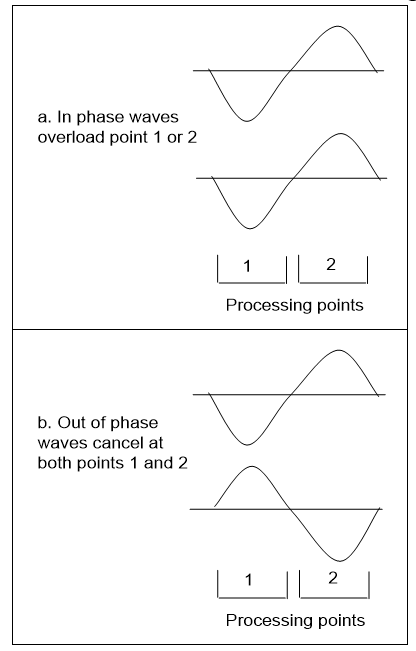
Figure 3.25. Waves interacting

Now if every measurement is physical event triggered when quantum waves interact, it is one wave gaining information from another. Figure 3.25 shows a simple case of two quantum waves interacting over two points of space, that can overload it two ways:

a. If they are in phase, one point can randomly overload, to give an exact position, but no length information is provided.

b. If they are out of phase, both points cancel to give an exact wave length, but no position information is provided.

It follows that a known wave interacting with an unknown one can reveal position or wavelength but not both, with no repeats. If the result gives a position, there is no wavelength data and if it gives a wavelength, there is no position data. In both cases, the observed wave has given all the information it can to the interaction. One wave observing another can give position or length but not both, and since length is needed to define momentum, this equates to the uncertainty principle.

The uncertainty principle follows from the nature of wave interactions, based on De Broglie’s equation (Note 1). In this model, Planck’s constant represents a core network process that no information transfer can be less than, so the change in position plus momentum can’t be less than Planck’s constant (Note 2). The uncertainty principle then reflects how processing waves interact.

Next

Note 1. If p is momentum, λ is wavelength and h is Planck’s constant, then p = h/ λ

Note 2. Mathematically δx.δp ≥ ħ/2 where x is position, p is momentum and ħ is Plank’s constant in radians.
QR3.8.6 The Holographic Principle

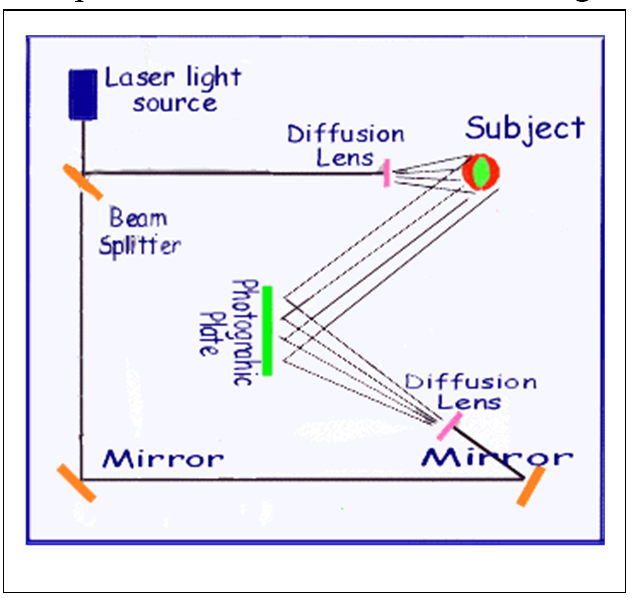
Figure 3.24. Producing a hologram

Our eyes see depth because light from different distances reaches our eyes slightly out of phase. Photos only store light intensity, so they don’t show depth, but holograms can show depth by storing the phase differences that encode it. A hologram is made by splitting laser light and letting the half that shines on the object interfere with the other half, to give a pattern (Figure 3.24). Light later shone on that pattern recreates the original object as a hologram.

The holographic principle is that we observe our universe like a hologram, or more precisely:

“Everything physically knowable about a volume of space can be encoded on a surface surrounding it” (Bekenstein, 2003).

This principle, widely accepted in physics, is that everything we observe about our world can be encoded on a flat surface, just like a hologram. The information in a space seems to depend on its volume, but if more and more memory chips are packed into a space, to increase its information, the end result is a black hole whose entropy depends on its surface area, not its volume.

Entropy in physics measures system disorder but also relates to information. A black hole has more entropy than anything else for its volume, and the information it contains depends on its surface area not its volume, so the holographic principle is maintained by the behavior of black holes (Bekenstein, 2003).

Note that the holographic principle is necessary if our world is virtual. Every virtual event has to be observed from some direction, so the act of observing uses up one dimension of space, which leaves only two dimensions to transfer information. The information transferred to a point in a three-dimensional virtual world can then always be painted on the surface of a sphere around it because that is how it is delivered. That our world is virtual requires the holographic principle, and conversely, that the holographic principle applies in our world suggests that it is virtual.

The holographic principle doesn’t mean our world is two-dimensional. That it presents in two dimensions doesn’t make it operate as such, so space still has three degrees of freedom. It applies because every observation comes from some direction so there are only two dimensions to deliver information across. The holographic principle describes how physical events are observed, not how space works.

Equally to imagine that our world is like a Star Trek hologram that we can enter and leave at will is misleading. Our bodies are its images, so if we left this hologram, or if it ever stopped, our bodies would disappear along with everything else physical, and the only way to recover it would be to start again from the beginning, over fourteen billion years ago.

Next

QR3.8.5 Entanglement

Quantum entanglement is another quantum law with no physical equivalent. It is that quantum entities restarting at the same point unify to become one system, so any physical change instantly affects all of them, at any distance. Thus while physical particles must be close to interact, entangled photons that are light years apart still interact instantly.  

For example, when a Cesium atom emits two photons in opposite directions, they entangle into one system with net zero spin. Both photons still spin up or down randomly, but if one is measured spin up, the other instantly becomes spin down. Experiments find it always so, but if each photon’s spin is random, how does the other instantly know to be the opposite, at any distance?

Einstein called this spooky action at a distance because it was faster-than-light, and so suggested an experiment to disprove it (Einstein, Podolsky, & Rosen, 1935). When the test was made, based on Bell’s theorem, it supported entanglement, even for photons too far apart to connect at the speed of light (Aspect, Grangier, & Roger, 1982). This was one of the most careful experiments ever done, as befits the ultimate test of quantum theory, and it found that entanglement does occur faster than light, despite Einstein’s objection.

How then can an event at one location affect another at any distance? According to particle physics, it can’t, but by the evidence, it does. If two photons heading opposite ways are separate particles that spin randomly, why can’t both spin up, or both spin down? Quantum theory insists that the initial spin is conserved, but gives no clue as to how. Nature could conserve spin by making one photon spin up and the other down from the start, but apparently this is too much trouble. Instead, it lets both photons spin either way, until one is observed, then instantly adjusts the other to be the opposite, wherever they are in the universe. Entangled states, now common in physics, have no physical explanation (Salart, Baas, Branciard, Gisin, & Zbinden, 2008).

Figure 3.23. Entanglement as merged processing

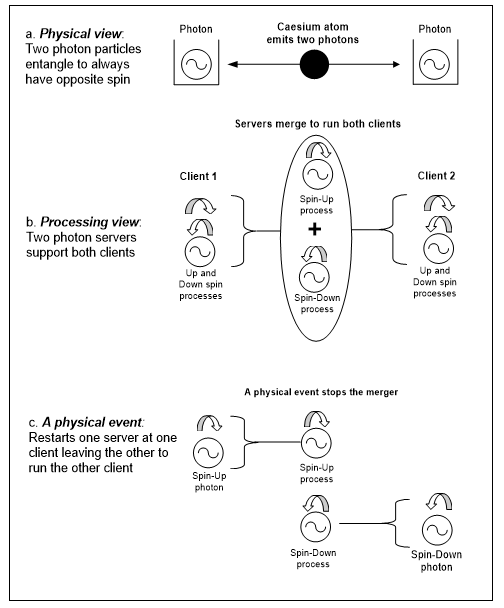
Particles can’t entangle as quantum theory describes but processes can. We see two photon particles leaving a Cesium atom (Figure 3.23a) but what if they are two processes? When a Cesium atom emits two photons at a point, their processing can merge and then just spread as it always does, so instead of each photon going its own way, both in effect go both ways. Just as one photon can take many paths and let a later event decide the one it took, two photons can go both ways and let a later physical event decide which went which way.

In network terms, the photon servers just share their client jobs, so the wave front going left is run by two servers, as is the one going right (Figure 3.23b). The entangled photons look and act like separate photons, but each is in effect half spin-up and half spin-down.

Why then is the initial total spin always conserved? When a network overload occurs the merger ends when one server restarts, leaving the other to run the other photon with the opposite spin. Which server restarts is random, as it depends which one is available, but spin is always conserved because the processing before and after a physical event is always the same (Figure 3.23c).

Entanglement is then non-local for the same reason quantum collapse is, that client-server effects ignore the network transfer rate that defines the speed of light. By comparison, the speed of a point moving across a screen depends on its refresh rate but a CPU can instantly change any pixel regardless of screen position. Likewise, photon servers are equidistant to all points on the screen of our space, so it doesn’t matter how far apart entangled photons are.

Entangled photons adjust spin instantly because both photon servers share the work of both wave fronts, so are already in place to handle any physical event. Nothing has to go anywhere, as when either server restarts, the other just carries on running the other wavefront, so entanglement doesn’t contradict Einstein’s speed of light limit.

Super-conductivity is also based on entanglement, when many electrons entangle so every electron is run by their merged servers. Electricity then flows with no resistance because, in effect, nothing is moving in a superconductor metal. Bose-Einstein condensates let any number of quantum entities merge in this way. 

Next

QR3.8.4 Non-physical Effects

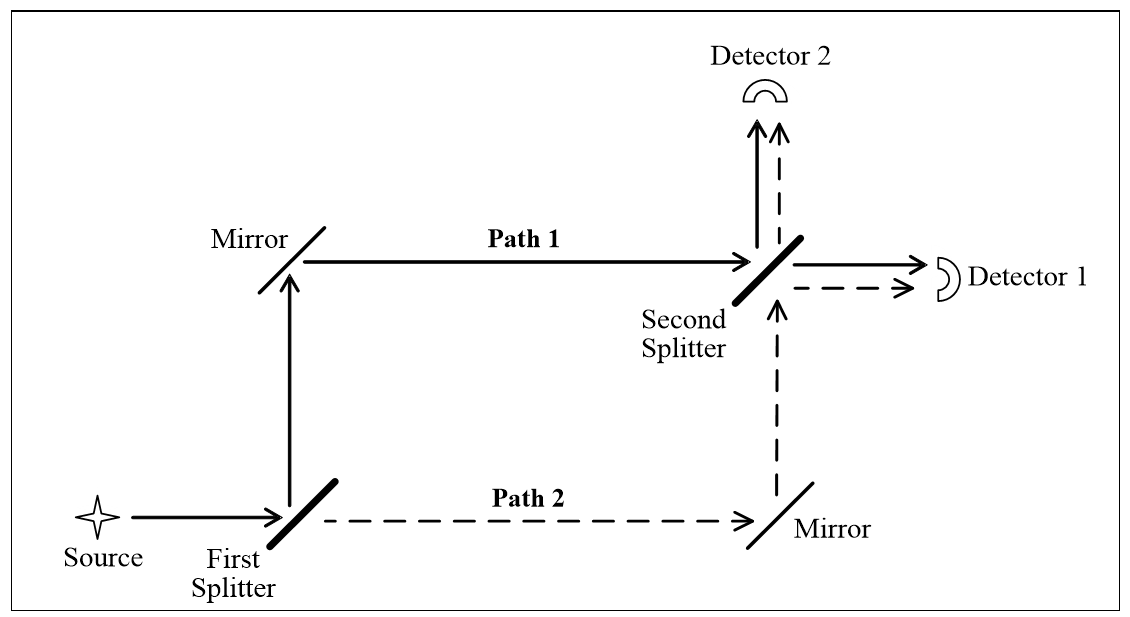
Quantum theory lets physicists detect an object without physically touching it, which in a purely physical world should be impossible, using a Mach-Zehnder interferometer (Figure 3.22). 

Figure 3.22. The Mach-Zehnder interferometer

This device works as follows. First, it splits light into two paths that go to the two detectors, where the mirrors make the paths cross. The result is that each detector fires half the time, as expected. Then a second light splitter is added where the paths cross to split the light again. If half the light shining on the first splitter goes down path 1, and half goes down path 2, then adding a second splitter splits the light again, half to each detector, so there are four paths to the two detectors. Light going down path 1 goes to both detectors, as does light going down path 2, so how do they respond?

The result is that detector 1 still fires but detector 2 never does! There is no physical explanation for this, but quantum theory explains it, based on quantum waves, as follows:

As photon waves evolve down the paths, each mirror or splitter turn delays its phase by half. Both paths to detector 1 have two turns, so they add because they are in phase. In contrast, path 1 to detector 2 has three turns while path 2 has two, so they cancel out because they are out of phase. Detector 2 then never fires because the waves from the two paths to it always cancel.

This setup allows a very unusual result. If a light sensitive object is put on path 2, the previously silent detector 2 sometimes fires, even when the object didn’t detect any light. This never happens if path 2 is clear, so this proves there is an object on path 2, yet no light went that way. The results (Kwiat et al, 1995) are unequivocal:

1. With two clear paths, only detector 1 fires.

2. If an object blocks path 2, detector 2 sometimes fires, even when no light touched the object.

Quantum theory then explains what materialism can’t (Audretsch, 2004), p29, as follows:

Light waves evolve down both paths, so they hit the path 2 object half the time. The other half of the time they go down path 1, but if path 2 is blocked, the waves to detector 2 no longer cancel out, so it fires sometimes, even when the path 2 object registers no light. Detector 2 then only fires if there is an obstacle on path 2.

To illustrate how strange this is, suppose a light-sensitive bomb blocks path 2 but we don’t know its there. With luck, sending one photon down the system will trigger detector 2, proving the bomb is there without exploding it. This is bad bomb detection because half the time it sets the bomb off, but it can detect a bomb on a path no light took. Table 3.2 shows the four paths, their probability, and the detector results. Half the time the bomb goes off, or detector 1 fires, but if detector 2 fires without triggering the bomb, there must be a path 2 obstacle blocking the quantum wave that stops detector 2 firing.

Non-physical detection proves that in our world light can detect an object without touching it! It follows that quantum waves must exist because physical particles can’t do this.

Next

Table 3.2. Quantum Wave Paths

Path

Probability

Result

No Bomb

Path 2 Bomb

Path 1 to Detector 1

25%

Detector 1 fires

Detector 1 fires

Path 2 to Detector 1

25%

Detector 1 fires

The bomb goes off

Path 1 to Detector 2

25%

Detector 2 never fires

Detector 2 fires but the bomb doesn’t go off

Path 2 to Detector 2

25%

Detector 2 never fires

The bomb goes off

QR3.8.3 Delayed Choices

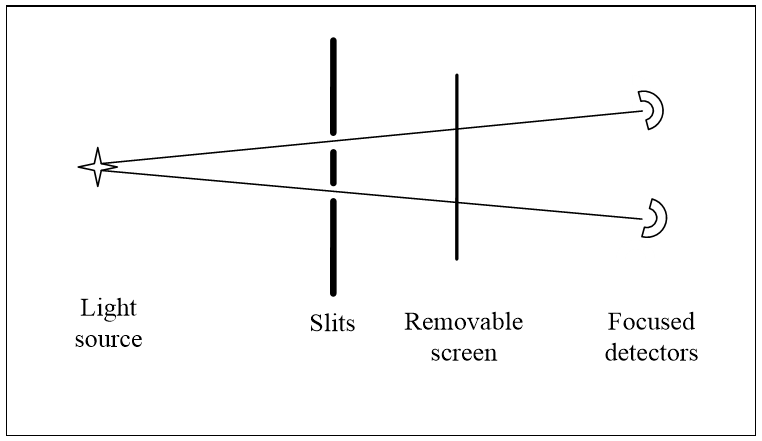
Figure 3.21. Delayed choice experiment

That photons travel about a foot per nanosecond allows a delayed choice two-slit experiment. Two detection options are used, either the usual screen, or telescopes that focus on one slit or the other (Figure 3.21). The trick is that the choice between them is made after the photon passes the slits, when the screen is either quickly removed or not. If the screen is used, there is interference, so the photon passed though both slits, but if the telescopes are used, only one fires, so it just took one path. A detector turned on after the photon passes the slits decides the path it took before that, so can the future then change the past:

“It’s as if a consistent and definite history becomes manifest only after the future to which it leads has been settled.” (Greene, 2004), p189.

The distances involved are irrelevant, so a photon could travel from a distant star for a million years, then decide, when it hits a telescope on earth, if it physically came via galaxy A or B. As Wheeler says:

“To the extent that it {a photon} forms part of what we call reality… we have to say that we ourselves have an undeniable part in shaping what we have always called the past.” (Davies & Brown, 1999), p67.

Physicalism then implies that the future can affect the past, which puts all of physics in doubt! In contrast, this model lets a photon take every path and pick one when it arrives so it denies the “undeniable” conclusion that we can change the past. Computing calls this strategy, of leaving choices until the last possible moment, just-in-time computing. It lets supermarkets restock based on current point-of-sale data rather than historical estimates.

The photon in Figure 3.21 is immune to delayed events thanks to just-in-time computing. It goes through both slits as usual, and if a screen is there gives interference, but if not, just carries on until it hits a telescope, which restarts it with a path that went through one slit. If the screen is there, we conclude the photon went through both slits, but if the telescopes are there, we conclude it went through one slit. Swapping the screen in and out after the photon passes the slits doesn’t matter at all because the physical event that defines the path occurs on arrival.

If light is made of physical particles, delayed choice experiments imply backwards causality, but if it is a processing wave, the causality that physics relies upon remains intact.

Next

QR3.8.2 Schrödinger’s Cat

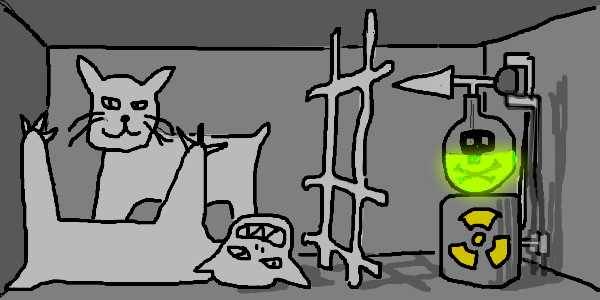
Schrödinger’s cat

Schrödinger found superposition so odd that he illustrated its absurdity by a thought experiment. He imagined his cat in a box with a device that would release poison gas if it detected a photon of light, then added a radioactive source that randomly emitted photons. The box is closed, so no-one knows when the gas is released, but according to quantum theory, the source and device are a system that superposes a photon being detected and not detected, until it is observed. Hence, that the poison is released and not released also superposes, so the cat is in an alive-dead superposition until Schrödinger opens the box! But how can a cat be alive and dead? Or if cats can’t be alive and dead, how can a photon exist and not exist? Or if a photon can do this but a cat can’t, when does the superposition stop?

Schrödinger’s example illustrates that quantum-scale events make no sense at the macro-scale because that a cat can be both physically alive and dead is ludicrous. Yet quantum theory doesn’t actually predict this because it doesn’t require the observation that stops a superposition to be human. In this model, every physical event is an observation, so the photon superposition stops when the detector observes it, regardless of what Schrödinger sees. It then releases the poison and the cat dies. Before opening the box, Schrödinger doesn’t know if his cat is alive or dead, but the cat does (or did). If quantum superposition is stopped by any observation, not just ours, there is no alive-dead cat.

Quantum theory requires every physical event to be an observation by what causes it, and as usual, its logic is impeccable. Every entity that interacts physically then also observes that event, so this rule is universal. In contrast if only humans observed, we would be necessary for physical history to occur, which is unlikely. In quantum theory, our universe began as a superposition that only an observation could stop, but we didn’t exist then. It follows that just Schrödinger wasn’t needed to stop the superposition in his cat’s box, we weren’t needed to stop the superpositions that led to past physical events, as quantum waves have been collapsing into physical events since the beginning of time. 

In quantum theory, observation formally causes physical events, so is our world a dream? The observer alone causes a dream but the world we see isn’t only caused by us, so it isn’t a dream in this sense. If every physical event is a mutual observation, as it seems to be, then we aren’t creating the universe alone, everything is, as the photon we observe is also observing us. That every physical event is an observation implies a virtual world but not a dream world. 

Schrödinger’s alive-dead cat then doesn’t illustrate the absurdity of quantum theory but its depth. That every active entity in our universe observes to stop superpositions allows physical history to emerge from quantum possibilities.

Next

QR3.8.1 Superposition

One strange quantum rule is superposition, which in the two-slit experiment lets one photon go through both slits simultaneously in a superposition. Solving an equation usually gives one solution that satisfies its conditions, but solving a quantum wave equation gives a set of solutions where each is the probability that a physical event will occur. These solutions evolve over time, as the wave spreads, but at any moment only one of them can physically happen.

This mathematics has the strange feature that for any two solutions, their combination is also a solution, called a superposition (Note 1). Yet while single solutions match familiar physical events, these combined solutions never physically occur, so quantum states superpose in ways that physical states can’t. For example, in Young’s experiment, the photon goes through both slits at the same time in a superposed state, but we never observe a photon in both slits at once. This ability to superpose underlies the mysterious efficacy of quantum theory.

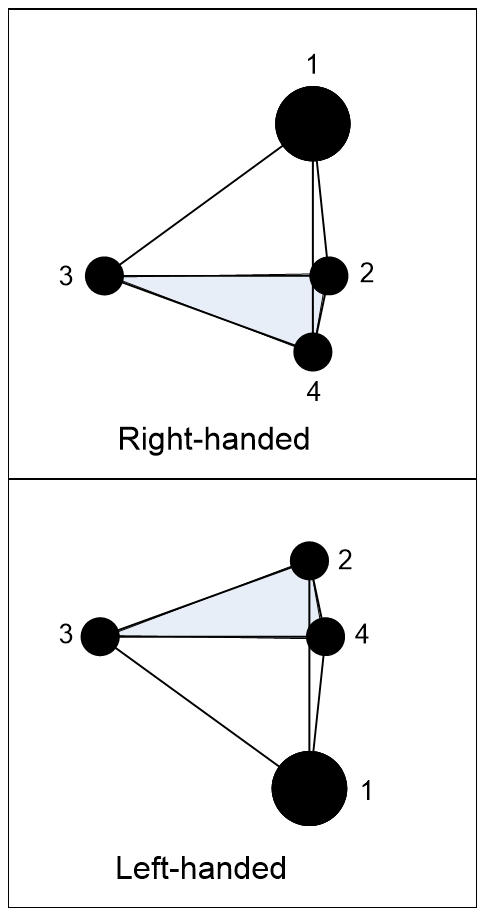
Figure 3.20. Ammonia
molecule states

Superposition applies not only to photons but also to molecules. For example, ammonia molecules have a pyramid shape (Figure 3.20) with a nitrogen atom apex (1) and a base of hydrogen atoms (2, 3, 4). This molecule can occur in right or left-handed forms, but to turn a right-handed molecule into a left-handed one, a nitrogen atom must pass through the pyramid base, which is physically impossible (Feynman et al., 1977) III, p9-1. Yet according to quantum theory, if both these states are valid solutions, so is their combination. The quantum world then lets an ammonia molecule be in a right and left-handed superposition!

This explains the otherwise inexplicable finding that an ammonia molecule can be left-handed one moment and right-handed the next, but can’t physically change between these states. It then exists in a left and right-handed superposition so we can observe either one, just as a photon superposed between two slits can be observed in either one.

To think superposition is just ignorance of a hidden physical state is to misunderstand it, as superposed quantum currents can flow both ways round a superconducting ring at once, but physical currents would cancel (Cho, 2000). As Young’s experiment shows, the superposed photon really does go through both slits at once, so what is physically impossible is just business as usual in the quantum world.

In processing terms, superposition occurs because network processes spread in every possible way ignoring physical laws, so a photon going through two slits literally half-exists in both, as the photon wave can spread itself around in ways that a particle can’t.

Why then can’t superpositions occur physically? If a physical event is a processing restart triggered by a point request, this isn’t possible. Just as restarting a computer stops anything else it is doing, restarting a quantum process is the same, so an ammonia molecule can be in two quantum states at once but can only restart from one of them. Superposed quantum states never occur physically because a physical event restarts one or the other, not both. But if molecules can superpose, why can’t cats? 

Next

Note 1. If Y1 and Y2 are state solutions of Schrödinger’s equation then (Y1 + Y2) is also a valid solution.

QR3.8 Physics Revisited

If a photon is a processing wave, quantum theory can be literally true because it can be modelled by a process. Quantum theory makes no sense physically but can be explained by computing, so this section revisits the quantum rules that have baffled physics for over a century.

3.8.1. Superposition

3.8.2. Schrödinger’s Cat

3.8.3. Delayed Choices

3.8.4. Non-Physical Effects

3.8.5. Entanglement

3.8.6. The Holographic Principle

3.8.7. The Uncertainty Principle

Next

QR3.7.3 Polarization

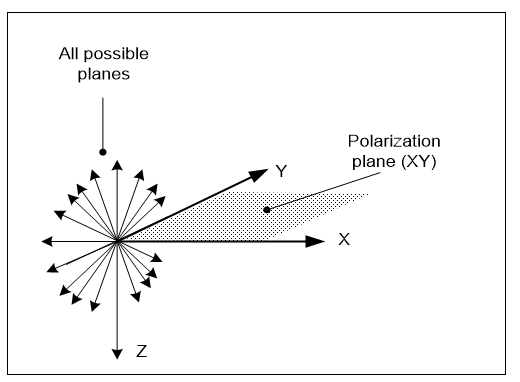
Polarization is the property of a transverse wave that describes its vibration direction, so that light can polarize confirms it is a wave. If quantum spin actually occurs, as proposed here, it will have a rotation axis around which the spin occurs. If a photon spins around its movement axis as a bullet does (Figure 3.19), its vibration is turning around that axis, but why then doesn’t the spin of a photon alter its polarization?

Figure 3.19. A photon spins like a bullet

To understand this, consider a book sitting on its edge on a table. If the book spins within the plane of the table, its height direction doesn’t change because it is at right angles to table. Hence, if the table surface is our space, a photon spinning in our space doesn’t change the transverse vibration direction that defines its polarization (Note 1).

However when a filter that blocks horizontally polarized light is turned, it lets through more and more light until eventually it all gets through. Why then does turning a filter reduce the polarized light it blocks but turning a photon doesn’t affect its polarization? In the table analogy, the book height represented the vibration amplitude of a photon moving across the table surface. Spinning the book didn’t alter its height, but a filter is like a thin wall that blocks a wave moving on the table when it is face-on. But as that wall is turned, it obstructs the wave less, until at right angles it lets it all through (Note 2). 

Why then do some photons pass entirely through a filter on an angle? Again, it is because a physical event is an all-or-nothing affair. The filter reduces the probability that instances get through but if one is detected, the entire photon restarts there. By the same logic, what passes through the filter is also an entire photon. The photon travels like a wave because it is a wave, but is detected like a particle because processing always restarts completely.

Next

Note 1. Let the photon’s wave amplitude be in a direction Q, at right angles to its polarization plane XY. Now if the photon spins in the plane YZ, this swaps its Y and Z values but leaves Q unchanged, as it is at right angles to that spin. It follows that a photon can spin around its movement axis X without altering its amplitude vibration, and hence its polarization plane.

Note 2. If Q is the quantum amplitude it reduces as Q.Cos(q°), where q° is the angle between that amplitude and the filter direction in quantum space, so at a 90° angle it has no value, as Cos (90°) = 0.

QR3.7.2 Quantum Directions

If our space is a three-dimensional surface, light wave vibrations can travel on it as water waves travel on the surface of a pool, given quantum directions outside our space. 

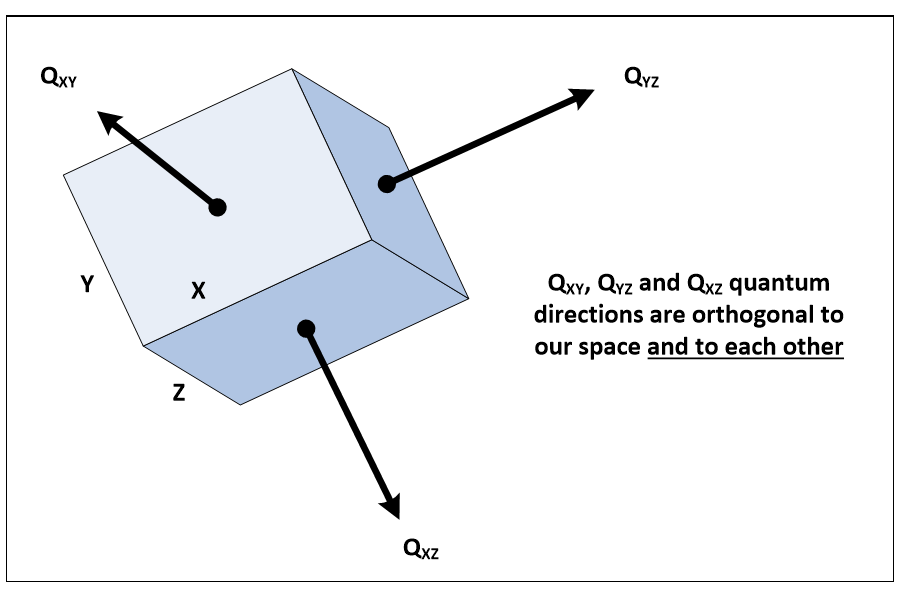
One might expect adding a quantum dimension to our space to add one new direction, but according to mathematics it adds three. In Figure 3.18, each of the three perpendicular planes that cut through a point in space has its own distinct quantum direction, so adding a dimension to space produces three new quantum directions at right angles to each other (Note 1).

A photon is then a transverse wave that vibrates in a direction at right angles to its polarization plane. Current physics calls this direction imaginary, but if quantum directions actually exist, light passing through a point can vibrate in three directions, all at right angles to each other (Figure 3.18).   

Figure 3.18. Quantum directions outside our space

Light moving in a given direction then has two independent ways to vibrate, because its movement uses up one dimension. This explains why light can polarize in two ways, vertical and horizontal, based on the two quantum directions available to its axis of movement. These polarizations are at right angles to each other, so a filter blocking vertical polarized light doesn’t block horizontal polarized light, and vice-versa, as observed.

Vertically polarized light vibrates in a quantum direction at right angles to horizontally polarized light, so a filter that blocks one doesn’t block the other, but what happens if the filter turns on an angle?

Next

Note 1: If physical space has dimensions (X, Y, Z), let quantum space have dimensions (X, Y, Z, Q), where Q is a fourth quantum dimension. A point in physical space with three orthogonal planes XY, XZ and YZ through it then has three orthogonal quantum directions outside our space. A photon with any polarization plane can vibrate into a quantum direction at right angles to it.