According to special relativity, being inside a plane going at a constant speed is like being stationary because time and space change to keep it so. General relativity extends special relativity to explain gravity by changes in space and time as well.
Electrons are only one-dimensional matter so photons can fill their other dimensions to make them move as light does. The matter-photon hybrid is held together because quantum entanglement unifies entities that restart at the same point. Electrons then always move, as light does, but slower because they are only like light on two dimensions.
In contrast, quarks that combine into atoms have a symmetric distribution, so they don’t always move as electrons do. Yet they still have free channels for photons to occupy, as their higher generations show, so atoms can acquire photons to move as electrons do. Light hitting a solar sail then moves it because its matter absorbs photons that bias its distribution in one direction. The sail matter already trembles in all directions, so adding photons that bias its tremble one way moves it.
The alternative idea that photon particles push the sail struggles because photons have no mass, and relativistic mass is a troublesome concept in physics. The simpler view is that the sail moves because it acquires photons that bias the quantum field around it.
This acquisition also explains why mass increases as objects go faster, as more photons produce more interference, which increases the processing that in this model is mass. The increase isn’t linear because interference doesn’t increase linearly with load, as networks like the Internet show. Mass then increases as movement increases, as relativity states.
Matter then has inertia, a tendency to keep on moving, because when it acquires photons to make it move, they stay with it, to keep it moving the same way.
Special relativity replaces the idea that matter moves because particles push it with the idea that it moves because space and time change. General relativity then adds that a large mass like the earth can move the matter around it in the same way.
According to quantum theory, a point of matter doesn’t sit at a fixed point but trembles about its quantum distribution. Schrödinger deduced this quantum fuzziness from the Dirac equation and called it zitterbewegung. Point matter is then indeed at a point, but not always the same one, like a dot constantly redrawn by a painter whose trembling hand creates a fuzzy patch. Matter then isn’t inert but constantly jiggling, like quivering rod.
Light advances every quantum cycle, at about 1043 times a second, so it travels about 300 million meters in a second. If matter moved like this, rockets could reach the moon in about a second, but it can’t. Matter restarts as often as light moves but if it teleported every time, it would have no life, so it trembles slower than light moves. Yet atoms still jiggle at a fantastic rate, so why don’t they move as light does? They don’t because if they tremble the same in every direction, these tiny movements cancel to give no overall effect, but if something alters that, they will move.
That matter constantly trembles means it doesn’t need a push to make it move, as it is already moving, just equally in every direction. All it needs though to move in our terms is to tremble one way more often, and making its distribution stronger one way can do that.
An objective space has only one type of movement, of the object, but virtual spaces allow two. In Figure 5.7, we can move the car by shifting its pixels one way, or leave the car center-screen and scroll the background behind it. Click on the Figure link to see a video of a car moving, then note that the car stays still as its background moves. To distinguish these two methods, let moving an image across a screen be absolute movement, and moving the background behind a stationary image be relative movement.
If our space is virtual, then our movement can be absolute or relative, so Einstein’s claim that light moves absolutely but matter doesn’t could make sense. Is a matter teleport then absolute or relative? A teleport restarts an entity at a new point, and the simplest way to do this on a network is to reset its connections. A network can’t just swap the processing of two points but can easily swap their links, so quantum tunneling is a connection reset rather than a relocation.
The distribution around a quantum entity is its space, each point of which is also a source with its space. Matter then moves not by changing its network location as light does, but by changing its space, as special relativity suggests. A matter teleport is two network points instantly swapping their distributions, so it is relative movement based on changing its space as defined above.
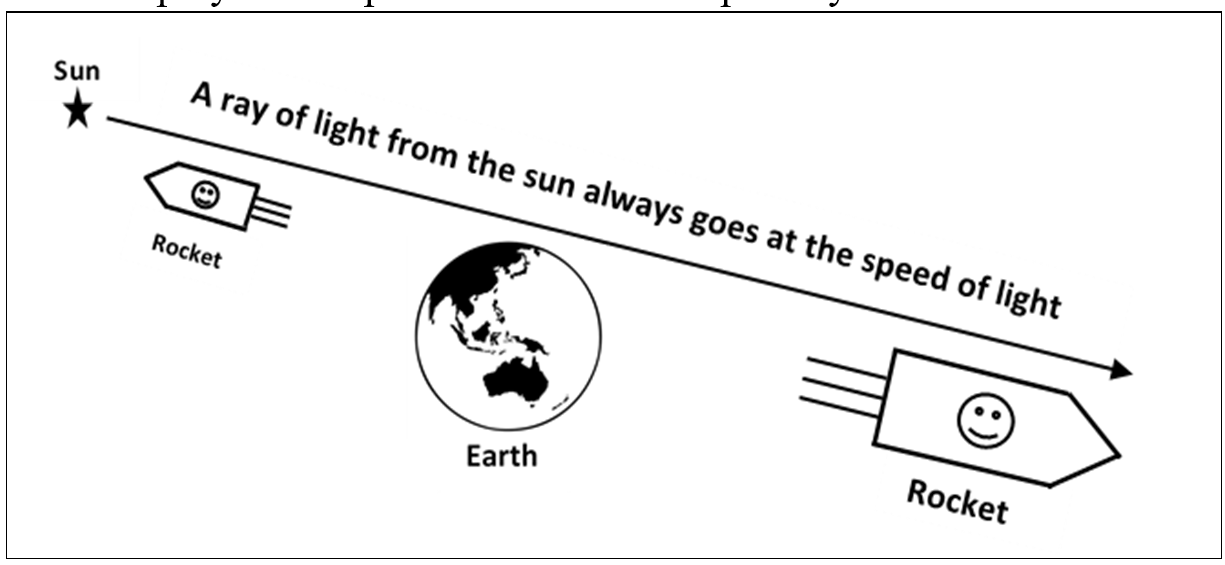
Like the car in Figure 5.7, matter moves by changing the space around it, not its own location. The speed of light coming towards it then doesn’t change when matter shifts its background because to light, it is stationary. Equally, light always leaves a moving rocket at the speed of light because in absolute terms, the rocket isn’t moving at all! The same photon also passes rockets going to and from the sun at the same speed because again, neither are moving absolutely (Figure 5.6). Special relativity then works because light moves absolutely but matter moves relatively.
The idea that we move by changing our space but stay in the same absolute place is strange, but nothing else explains special relativity. Particles can’t, as they move absolutely, and the equations don’t explain how dead matter can alter space and time. Our senses tell us that the space around us has changed, and it has, but relativity tells us that is because space moved, not us.
For example in a moving car, as trees and houses scroll by, it feels like you are still and the world is moving around you, and relativity agrees that space is moving not you. In effect, space is being pulled towards you, so a ball thrown up in a speeding car acts as if the car is still because it actually is. This keeps the laws of physics the same everywhere, regardless of how matter moves.
Why then does time dilate when matter moves? For matter, time ticks by as life events, but a teleport ends the cycle ends with a connection reset not a life event. For example, a muon in space lives for only a millionth of a second until a neutrino hit decays it, but if it moves faster, it lives longer because a teleport before a neutrino hit dodges the bullet. A quantum cycle can end with a life event or a teleport, so matter can live or move, but not both at once. Movement then dilates time as special relativity predicts because a teleport loses a life event. And when matter teleports one way, any measure made that way is less, so space also contracts in that direction.
Relativity gives every bit of matter its own frame of reference, with its own space and time, because its distribution is its space, and a life cycle is a tick of its time. Moving by teleport changes both, to contract space and dilate time, but what decides its movement direction?
Light has a constant speed in this model because the quantum network passes it on every cycle. Every point of a light wave is a new wave source, as Huygens proposed, so it moves forward because its wave-front advances but its backward spread cancels out (3.1.2). It is also a processing wave that can restart at any point where it overloads the network, in a physical event.
Light then moves constantly and occasionally restarts, but if matter is a standing wave that is always restarting, it shouldn’t move at all. Light is like a boat with one engine that moves it forward, while matter is like a boat with two engines that oppose, to keep it in one place. Yet both have active engines that spread ripples, so matter has a quantum distribution just as light does.
Matter as a standing wave shouldn’t move, yet it can go where light can’t. Light from a lamp in a box can’t escape but an electron in an impenetrable Gaussian field can suddenly appear outside it, like a marble in a sealed bottle popping up outside it. Physics calls this quantum tunneling, when an electron just appears at a point without taking a path there, in what is in effect a teleport.
How is this possible? Particles can’t teleport, but quantum theory lets an electron collapse and restart at any point in its distribution, just as photon does when it hits a screen. This collapse occurs instantly and ignores any obstacles, so if an electron’s distribution extends beyond the Gaussian field, it just arrives there. Note that light in a box can’t do this because its wave front reaches the walls as its distribution does, so it always teleports back into the box. Quantum collapse then explains quantum tunneling as the electron restarting at a point in its distribution.
To sum up, light is a wave that moves by point-to-point transfer and sometimes teleports, but matter is a standing wave that only moves by teleport. Quantum tunneling then isn’t just how matter sometimes moves, but how it always does. Matter moves when it collapses and restarts at another point in its distribution, as light only does when it hits a screen in a physical event, so the same quantum rules apply.
In general, matter moves differently from light, but why then doesn’t its movement affect the speed of light? The answer lies in what Einstein didn’t explain, which is how space and time change when matter moves.
Light as photon particles that move by themselves alone could just go faster and faster, but it doesn’t. Current physics knows that light has a fixed speed in space but not why, so it is just given. However light as a processing wave spreading on a network can only go as fast as it is passed on, so the speed of light in space is 299,792,458 meters per second, no more and no less, because that is how fast space refreshes. The speed of light is then actually the speed of space (3.2.4).
Likewise, matter particles moving by themselves should be able to go at any speed, but special relativity requires them go slower than light, and common sense can’t say why. It also makes light from a speeding rocket always leave it at the speed of light, but why light ignores the relative movement of matter is just as obscure. The key question then is how does matter move?
Light goes at the fantastic speed of 670 million miles per hour, which is to the moon and back in less than a second, so can we achieve this speed? What if a rocket going at half the speed of light shot a bullet forward at half the speed of light? Unfortunately, doing this changes time and space, so the bullet only goes at four-fifths the speed of light.
Can we gradually speed up a rocket up to the speed of light? Nature again intervenes by increasing the rocket mass until at near the speed of light its near infinite mass needs a near infinite force to move it, so this doesn’t work either. In theory, in a rocket going 5mph slower than the speed of light, one could throw a ball at 5mph per hour to reach the speed of light but in practice, we can’t produce the force needed to throw the ball. And one might expect light to leave the rocket’s headlights at almost twice the speed of light, but again nature plays with space and time to avoid this.
This seems to deny the conservation of mass, and the thermodynamic law that energy in a closed system can’t be lost, but if energy and mass convert by E=mc2, nothing is really lost. But whether mass is energy, or energy is mass, or both are aspects of something else, isn’t clear.
Figure 5.6. Light always travels at the speed of light!
Relativity contradicts all our intuitions about movement. For example, if two rockets left the earth at half the speed of light, one to the sun and one to Pluto (Figure 5.6), relativity requires light from the sun to pass both rockets at the same speed! But how can the same photon pass rockets going in different directions at the same speed? This makes no sense in classical terms.
The equations work but, like those of quantum theory, deny common sense. How can space, which is the measure of movement, itself move? How can time, which is the measure of change, itself change?Einstein deduced that space and time had to change for our world to be as it is, but not why. Perhaps he expected physics to explain it later, but a century on, we are no wiser.
In this model, light sets the speed limit of our universe because the network of space passes it on every cycle, so nothing can go faster, but the same model also portrays matter as a stationary standing wave, so how does matter move at all?
Special relativity states that time slows down for matter objects as they move faster to keep the speed of light constant. Einstein didn’t give a reason but in this model, it is because moving faster increases the load on the quantum network, so our life slows down at high speed for the same reason that a game screen slows down in a big battle (2.3.1).
His example of an astronaut who returns after years of high-speed space travel to find that his twin on earth is an old man then could happen. Experiments confirm that a muon traveling at 99.5% of the speed of light, which should travel 300 meters in its millionth of a second life, actually travels 3,000m, so speed extended its life tenfold. Relativity lets a rocket accelerating at one g go to our nearest galaxy and back in 60 years, but it would return to an earth that is four million years older (Harrison, 1986, p157). For the rocket crew, time would pass as usual, but one of their years is thousands of years on earth, so they are actually in slow motion.
Relativity implies that time stops at the speed of light, so a matter clock sitting on a photon wouldn’t tick at all. Light from the Andromeda galaxy takes 2.5 million of our years to arrive on earth but according to relativity, no time at all passes for the light itself. It also starts and ends its journey at the same location by length contraction! Needless to say, this makes no sense, as how can light move at all if its time stops? It can’t, so matter time can’t apply to light.
Time passes for matter when life events occur, but light can travel for millions of years without a physical event, so its time doesn’t pass that way. For light, time ticks by as the network passes it on, but for matter, time only passes as physical events occur. The definitions are different, so time for light is based on absolute quantum cycles, but time for matter is based on life events which, as will be seen, don’t occur when it moves. Light then is the ultimate messenger because it never stops for itself but constantly moves on, in absolute time, as fast as our universe allows.
Why is the speed of light constant instead of say, the speed of lead? What makes light the gold standard of movement? One reason is its role in causality. Imagine a rocket going to a planet at nearly light speed and then returning to earth. If the rocket’s speed altered the speed of light, a message sent on the way to the planet could arrive after one sent coming back. Hence, if the rocket exploded after rounding the planet, one might first see the blast then get a crew message that all is well, like getting a cheery email from a person after attending their funeral. In our world, causality is always maintained because the speed of light is always constant.
In theory, a rocket that left earth faster than light could go back in time to return before it left. As Buckley points out, given faster than light travel, relativity, and causality, a universe can support two but not all three at once. Going faster than light would breach the causality of events we observe, but it can’t happen because light, the messenger of causality, doesn’t allow it.
Light then must move differently from matter. If matter and light moved the same way, then light would need a push to go faster again after it slowed down in water say, but needless to say, it doesn’t. Light speeds up when going from water to a vacuum with no push needed.
In general, it takes effort to move matter but it takes effort to slow light down. A brick thrown at 10mph from a car going at 100mph leaves at about 110mph, but light leaves a rocket going at half the speed of light at exactly the speed of light! How does light, and only light, do this?
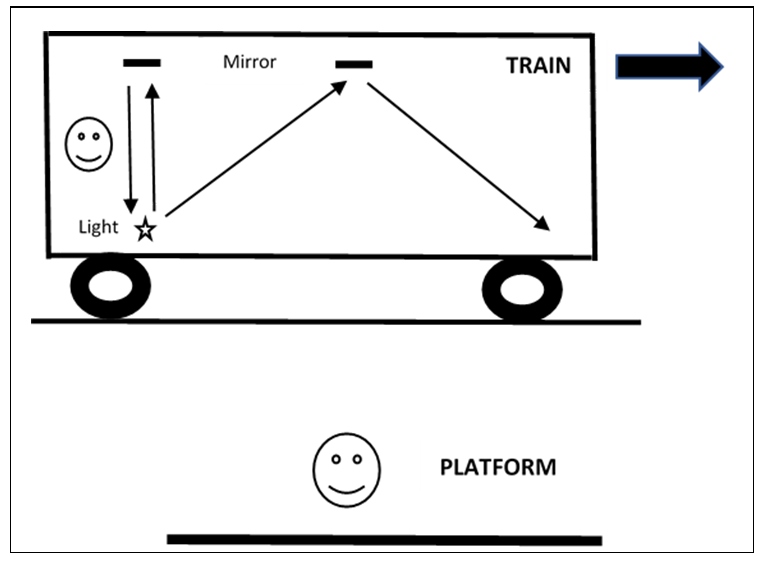
To simplify the problem, Einstein reduced it to why the speed of light is the same for two observers. He imagined a train, with a light on the floor that shines up to a mirror on the ceiling, then reflects back (Figure 5.4). A train passenger sees the light go straight up and down, and when the train moves nothing changes, but an observer on a platform watching the train go by sees it travel a longer path. If both observers have the same time and space, the speed of light will be different, but in our world it isn’t. Einstein concluded that space and time had to change to get the same speed of light.
Lorentz saw his transformations as mathematical curiosities but Einstein saw that they made Poincare’s relativity work, so for the universe to be as Poincare described, space and time had to change as Lorentz described. If space and time didn’t change to make physics invariant (Note 1), the speed of light would vary with every observer!
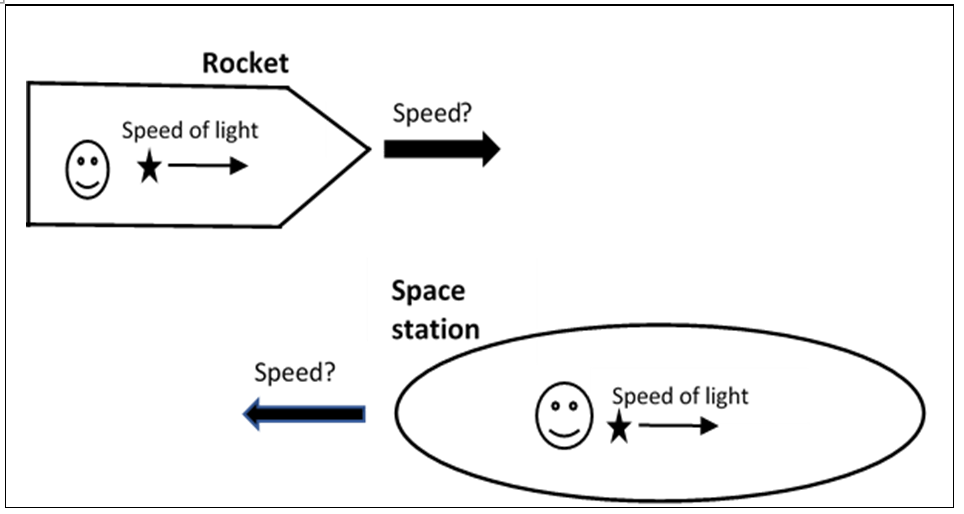
Figure 5.5. A rocket passing a space station
The implications of his conclusion are strange indeed. For example, imagine a rocket flying past a space station in orbit (Figure 5.5). It seems impossible that people on the rocket and on the space station both see light moving at the same speed, but they do! If they didn’t, our physics wouldn’t work on Mars.
One could ask who is really moving, the rocket or the space station, but it doesn’t matter. If the rocket moves, its space and time contract and dilate, and if the space station moves, the same applies. Regardless of how the rocket and station move relative to each other, distance and time change to keep the speed of light the same for both.
This defies common sense but experiments have verified that time and space really do change as matter moves faster or slower. It seems weird, but as Einstein said, this is why our universe isn’t weird. The speed of light is invariant because time and space change to make it so.
Note 1. Einstein preferred the term invariance for his theory but relativity stuck.