QR5.5.3 Spin Spreads

Dividing a positive-negative charge produces positive and negative parts, but splitting a magnet gives two more magnets, each with its own north and south pole (Figure 5.13). Joining two small magnets also gives a big one, so big magnets come from small ones, and the smallest possible magnet is the electron.
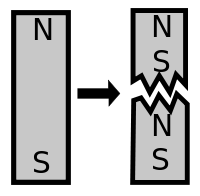
Figure 5.13. Splitting a magnet gives two magnets

Metals like copper conduct electricity when their electrons move, but the electrons in plastics can’t move freely, so they can’t conduct electricity. This is also why metals can be magnets but plastics can’t. The electrons of metals are little magnets that usually point randomly, but when they all point the same way, the result is a big magnet (Figure 5.14). In contrast, the fixed electrons of plastics can’t align like this, so they can’t be magnets. Magnetism, like electricity, is then based on electrons.

Physics describes an electron as a tiny magnet, whose north pole is at right angles to its spin and its south pole is the opposite, so spin relates to magnetism. If matter distributes itself to cause gravity by its mass, and electrical effects by its charge, could its spin cause magnetism? In quantum theory, all matter spins, so it is a basic property like mass and charge. Current physics calls the spin of an electron imaginary because point particles can’t spin, but in this model, electrons spin in quantum space (4.7.1).
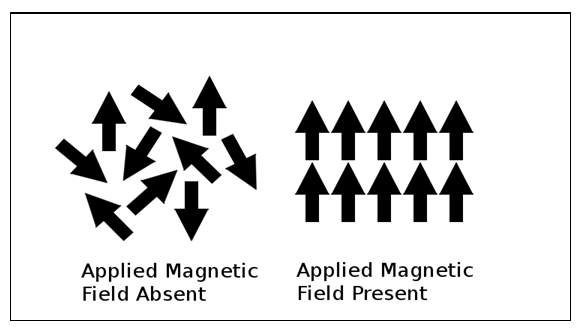
Figure 5.14. Electrons align to give magnetism

If quantum spin causes magnetism, its direction defines the magnet’s north and south poles, so they are directions not parts, just as a plate has a top and bottom. This explains why charges can divide, as a black and white plate can split into black and white parts, but a magnet can’t divide into north and south poles, any more than a plate can split into top and bottom parts. Thus, a north pole can’t exist without a south pole, as one spin direction always allows the opposite.

Yet physicists still postulate magnetic monopoles, particles with one magnetic pole, because Maxwell’s equations of magnetism don’t prohibit them (Rajantie, 2016), and particle theory encourages such speculations, despite no evidence. But if spin causes magnetism, monopoles are impossible, so this is just another fruitless search for particles, like that for gravitons.

What then is the effect of spin? The Pauli exclusion principle lets opposite-spin electrons occupy the same point but not same-spin electrons. Here, this is because electrons can spin in different regions of quantum space (4.7.1). Hence, if one spins up and the other down, they don’t overlap, but same-spin electrons compete for the same space. Spin lets opposite spin electrons occupy the same point but not same spin electrons.

Processing always spreads on the quantum network, so the distribution around matter includes its spin, as well as mass and charge. Spin doesn’t affect gravity much, but it does interact, as between opposite poles, opposite spins can co-exist, to in effect deepen the space between them. In contrast, between same magnets, same-spins compete, so the space there is shallower.

When opposite poles deepen the space between them, the network there runs faster because more space means less interference. Matter restarts more often where the field is faster, so the magnets move together, i.e. attract. But between same poles, same-spins compete for the same space, so the network runs slower, making the magnets restart more often away from each other and move apart, i.e. repel. Magnets then attract or repel by biasing the speed of the quantum field between them, as charges do, but based on spin not charge.

Charge and magnetism both involve electrons, so why don’t static charges affect magnets? If magnetism is a spin direction, and charge is a processing remainder, these properties won’t interact. Spin doesn’t change charge, and charge doesn’t change spin, so they don’t affect each other. 

Why then are electrical and magnetic fields at right angles? Electrons as one-dimensional matter can only move as matter on one axis. When an electric field creates a current, electrons must align their matter axes to move the same way, which also aligns their spins. An electron moving on its matter axis spins at right angles to that, so magnetic and electrical effects are at right angles even though electrons cause both.

Currents cause magnetism because aligning electrons to move in one direction also aligns their spins to cause magnetism. Electrons moving down a wire spin one way, and in the other direction spin the opposite way, to give an opposite magnetic effect. Equally, when a magnet moves, it acts to align the electron’s axes so they move as a current.

Spin also explains why magnetism fades faster than charge. Charge decreases as an inverse square because it spreads in two-dimensions, but when spin deepens space, magnetism also spreads in another dimension. The effect disappears between same poles, so magnetism fades on average more than an inverse square but less than an inverse cube, as observed.

Gravity, charge, and magnetism act at a distance by altering the quantum field. Gravity alters the field strength to attract only, while charges and magnets alter the field speed, to attract or repel, and in all cases, objects move when the quantum field around them changes.

Next

QR5.5.2 Remainders Spread

Mass and charge are different to us but in this model, charge is a byproduct of mass, as:

1. Mass is the net processing that runs, and

2. Charge is the net processing remainder that doesn’t run.

Mass is a bump on the network of space that repeats in a recurring overload, while charge is the processing remainder that is positive, negative, or neutral. Matter repeatedly overloads, so its mass and charge are constant properties. 

The gravity of matter is based on mass, as the earth’s mass strengthens the quantum field closer to it to make objects tremble more often that way. The effect is slight, but even a slight asymmetry causes movement in our time. Yet the network passes on all processing, whether done or not, so a matter entity’s distribution also reflects its charge. Could charged objects then move each other by altering the quantum field, as gravity does?

Recall that every point of space passes on its current processing before receiving any new processing, so each cycle has two phases:

1. Share: Pass on all current processing to its neighbors, which dilutes it, then, 

2. Execute: Run any processing received, and if it overloads, request a server restart where:

a. If the request is ignored, just carry on.

b. If the request is accepted, restart the server processing in a physical event.

Note that the share phase passes on all processing, not just of mass, but also the charge remainder. These remainders don’t affect the gravity of small objects much, but between opposite charges they cancel, so network cycles complete faster because the share phase has less processing to pass on. In contrast, between same-charge bodies the remainders add, so the cycle slows down because the share phase has more processing to pass on. Charged bodies then interact to speed up or slow down the quantum field in the space between them.

Opposite charges speed up the field between them, so they restart there more often, as servers accept requests on a first-come first-served basis. They then move together, i.e. attract. Conversely, same charges restart less often in the slower field between them, so they move apart, i.e. repel. Charges then attract or repel by biasing the speed of the quantum field between them.

It follows that charges move other charges not by pushing or pulling but by altering the quantum field between them to bias their natural tremble. Matter constantly moves microscopically so if it occurs more often one way, it moves macroscopically, but while gravity does this by changing the quantum field strength, charge does it by changing its speed. 

Why is charge stronger than gravity for small objects? In competitions where speed counts, like running, a team that is 5% faster than others wins all the races, not just 5% more. A matter restart is also a winner-takes-all competition where speed counts, so a slight increase in speed can have a big effect. Charge effects are then stronger than gravity because they bias speed not strength.

Gravity and charge move matter by biasing the quantum field differently, namely:

  • Strength. Matter tends restart more often where the field is stronger.
  • Speed. Matter tends restart more often where the field is faster.

Both effects reduce as an inverse square by Gauss’s law, so the quantum field can explain gravity and charge, but what about magnetism?

Next

QR5.5.1 Electro-magnetism

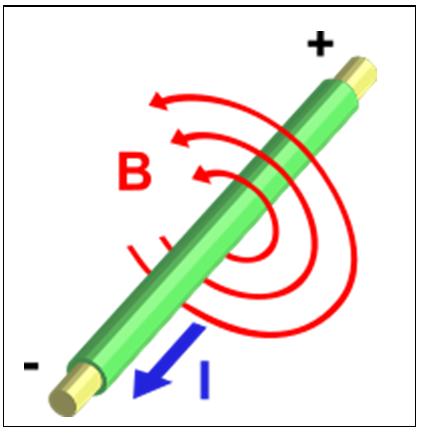
Figure 5.12. Current I creates magnetism B

Magnetism seems distinct from electricity but Maxwell’s equations describe both and experiments relate them. For example, a static charge isn’t magnetic but if it moves, a magnetic field appears around it, as shown in Figure 5.12 where passing a current I through the wire produces a magnetic field B. Wrapping a wire around a nail and passing a current through it then makes it a magnet, and that effect stops when the current does, so electricity can cause magnetism. The reverse is also true, as spinning a magnet with a wire around it induces a current in the wire, so electric cars are possible because magnetism and electricity relate:

We will see that magnetism and electricity are not independent things – that they should always be taken as one complete electromagnetic field.” (Feynman et al., 1977).

Is magnetism then just charge in another guise? (Note 1) It would seem not because:

1. Static charges and magnets don’t interact.

2. The magnetic field is at right angles to the electric field.

3. Gauss’s law doesn’t apply to magnetism, which reduces more like an inverse cube.

4. Dividing a charged body gives positive and negative charges but dividing a magnet gives two more magnets, both with a north and south pole.

Magnetism behaves differently from charge, so how one field causes both is unclear. For example, light is said to be electrical and magnetic waves at right angles that cause each other, but causes creating each other in a loop is illogical. The laws of electricity and magnetism are clear separately, but their electro-magnetic combination isn’t, as if we understood horses and birds then found a strange winged horse. No credible theory explains why electro-magnetism has two effects that act differently, are at right angles, and weaken differently.  

The standard model theory that same charges repel when virtual photons push them apart isn’t credible because the same photons also pull opposite charges together, and make magnets attract and repel, so one might as well say that fairies with photon wands cause electro-magnetism. A field with different effects needs different causes, not the same cause producing results after the fact.

Next

Note 1. The logic is that a moving electron’s length is foreshortened by special relativity giving more negative electrons than positive protons in a given length of wire, so parallel wires with opposite currents attract, but this could be correlation not causation

QR5.4.6 Black Holes

One of the strangest predictions of general relativity is that if a large body collapses under its own gravity, nothing can stop it becoming a black hole, a region of space with gravity so strong that even light can’t escape. Astronomers have discovered that nearly every super-massive galaxy, including our own, has a black hole at its center.

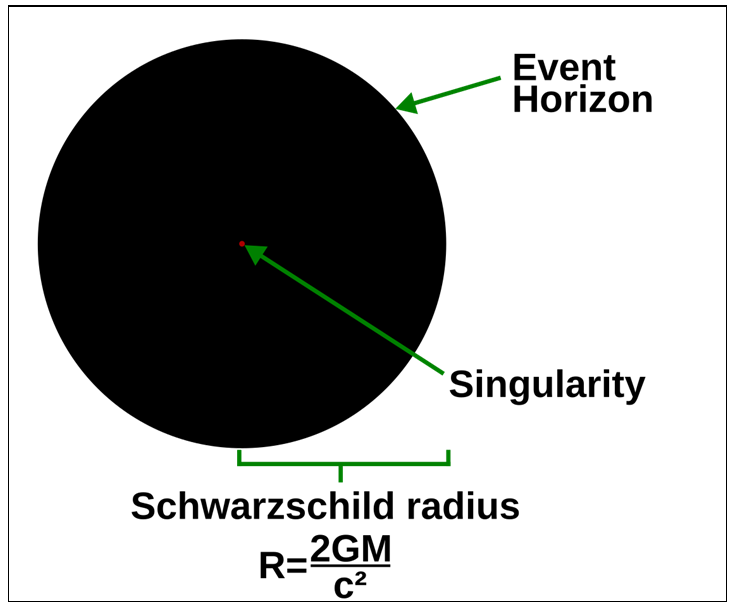
Figure 5.11. A black hole

Current physics has no force to stop this collapse, so a black hole is considered to be a point of infinite mass density called a singularity, surrounded by an event horizon that is the region where light can’t escape its gravity (Figure 5.11). This is based on the equations but in most sciences, an equation that gives an infinity is an error not a fact.  

Processing models can’t have infinities because they aren’t calculable, so in this model, matter can’t become infinitely dense because space can’t become infinitely small. Our space, like a screen, has a pixel limit, and each pixel has a finite bandwidth, so a black hole is a region of space at maximum capacity not a singularity. Just as the finite refresh rate of space limits the speed of light, its finite bandwidth limits the density of mass in a black hole. What stops the collapse of a black hole then isn’t a force, but the ability of space itself to support matter.

It follows that black holes expand as they acquire matter because more space is needed to handle it. The Schwarzschild radius of a black hole is linearly proportional to its mass, but if that mass was at a point, its effect should decrease as an inverse square like gravity. 

A black hole is a volume of space at maximum capacity, not a singularity of infinite density. Instead of radiating light, it absorbs it, so black holes are in effect dark stars that take in energy (Barcelo et al., 2009). Sagittarius A*, the center of our galaxy, then isn’t a hole at all, but a super-massive dark star with a halo of light, whose dark matter keeps its stars together. We who are made of matter see a black hole as destructive, but for the galaxy, it is beneficial.

Next

QR5.4.5 Matter Changes Time

Special relativity gives every mass in the universe its own clock. I have one, you have one, and so does every planet, but they only keep the same time if they have the same speed. General relativity adds that gravity alters time as well, so it takes a lot of computing to make GPS navigation work because the clocks of satellites tick at a different rates depending on their altitude and speed.

How then does gravity change time? Virtual time ticks by as processing cycles complete, so it runs slower as processing increases. The earth’s gravity increases the network load closer to it, so it slows down our time. A clock on top of the Empire State building ticks faster than one at the bottom because the network load is less there.

Would we live longer on a planet like Jupiter that has more gravity? To others it might seem so but to us, time would pass as usual. A large planet dilates time relative to earth, but the number of life events in our lifetime wouldn’t change, so we wouldn’t notice it.

The earth’s gravity gives the space closer to it more to do, so time passes more slowly there. We feel gravity as a force, see space as an extent, and experience time as life events, so why the equations of relativity connect them isn’t obvious. In physical terms, gravity, space, and time correlate, but the same quantum activity generates them all. Matter then causes gravity and alters space and time by changing the quantum field around itself.

Next

QR5.4.4 Matter Changes Space

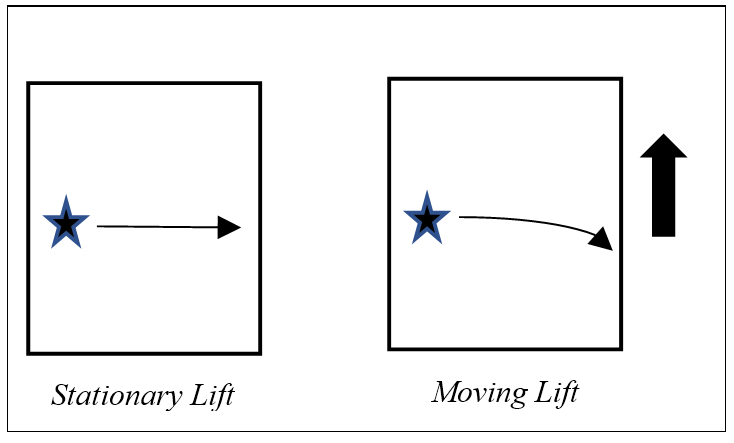
Figure 5.10. Light bends when a lift goes up

Astronomers have long known that light bends when it passes a star although photons have no mass for gravity to act on, but Einstein predicted this. He imagined a light shining in a lift going up, as shown in Figure 5.10. As the lift rises, the light curves relative to it, so if gravity equates to an acceleration, stars should bend light passing by, and they do. Light passing a star bends because from its perspective, it is going in a straight line, just as light in the lift is. Stars then don’t pull light but change space to make it bend.

This model also expects a star to bend light, because its gravity gradient will cause refraction (3.6.2). Light refracts when it enters a denser medium like water because it spreads more slowly in it, as slowing down one side of a wave skews it that way. Water then bends light because it is a denser medium, not by exerting a force.

Likewise, the gravity gradient of the sun makes space closer to it a slower medium for light because the quantum network has more to do. In effect, gravity makes space denser closer to the sun, so light bends when it enters it, just as it bends when it enters a denser medium like water. The sun then bends light by making the space closer to it a denser medium for light, so gravity does curve space as Einstein said, but why does it also alter time?    

Next

QR5.4.3 Unstoppable

Electrical and magnetic effects are cancelled by their opposites, but gravity has no opposite so what can stop it? If gravitons caused gravity, anti-gravitons could block them but it never happens, just as anti-gluons could destroy the gluons that hold the nucleus together, but they don’t, even though anti-gluons are said to exist. Why then is gravity unstoppable?

In this model, the quantum network passes on processing before physical events occur, so they can’t affect it. The gravity gradient around matter then spreads in a way that no anti-gravity shield can block. It also spreads at the speed of light, so the sun’s gravity takes about eight minutes to reach earth, just as its light does, so if the sun suddenly vanished, the earth would carry on orbiting around it for another eight minutes!

Yet matter stops light, which is quantum waves, so why can’t it stop gravity? A photon that hits a screen restarts with a new direction, but when earth’s gravity reaches an object, it moves not the earth. When matter restarts, the processing stays the same, so it just carries on spreading, to maintain the gravity gradient.

Note also that gravity makes anti-matter objects fall down not up. For example, a hydrogen atom tends to fall to earth under its gravity, and anti-hydrogen atoms do the same. The earth’s gravity increases the processing closer to it, so an anti-hydrogen atom still restarts more often where the field around it is stronger. It would take an anti-matter planet the size of the earth to cancel its gravity, but that doesn’t happen in our universe.

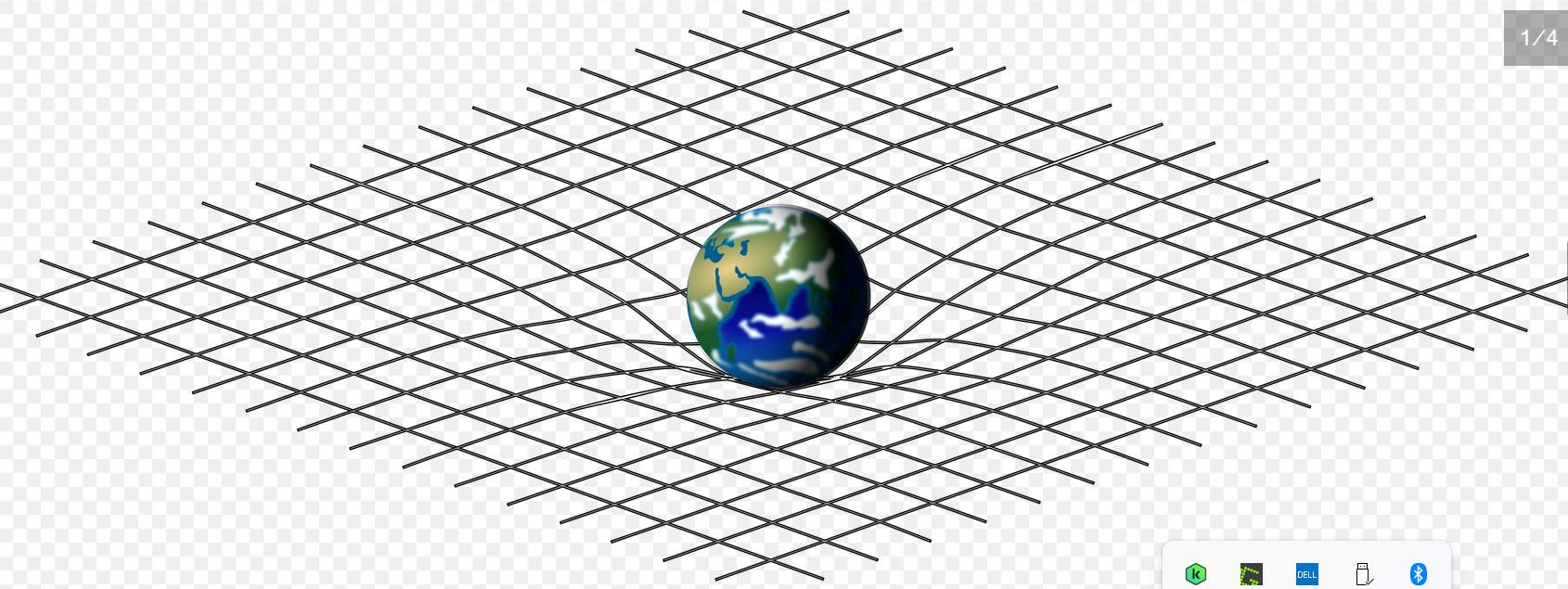
An object then accelerates as it falls to earth because the gravity gradient increases as it gets closer, so it moves faster. Einstein saw this as the earth curving space and time around it (Figure 5.9) but here, these changes correlate with gravity but don’t cause it, as the quantum field that causes gravity also changes space and time. 

Figure 5.9 The earth curves space-time

Next

QR5.4.2 The Gravity Gradient

Newton discovered gravity, but still found it inconceivable that inanimate matter caused it:

It is inconceivable, that inanimate brute matter should, without the mediation of something else, which is not material, operate upon, and affect other matter without mutual contact;…(Wilczek, 2008), p77.

Today we accept that fields act at a distance, as Wi-Fi waves from a router can provide Internet for a whole house. The earth’s magnetic field can move a compass in a plane far above it, so why can’t a gravity field hold the moon in orbit? The field now proposed to do that is the quantum field that represents the quantum processing of the network of space.

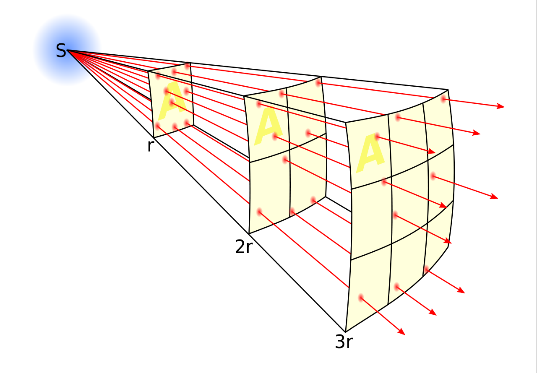
Quantum theory gives matter a distribution around it that represents the probability that it exists there, which in this model arises because quantum processes spread. By Gauss’s law, a flux spreading over a sphere reduces as the inverse square of its radius (Figure 5.8) (Note1), so a processing flux that is the same will also weaken as an inverse square. In effect, matter spreads its existence around itself in a way that weakens as gravity does. For small objects, its effect is insignificant, but for a huge mass like the earth, it isn’t.

The huge distribution of the earth then imposes a processing gradient on the quantum field around it that makes the field closer to it stronger. As established earlier (5.3.3), objects tremble more often where the quantum field around them is stronger, to move in that direction, so the earth will have that effect. Earth’s gravity is then caused by the quantum field gradient it imposes around it, which acts at a distance, reduces as an inverse square, and is unstoppable.

Classical substances just sit there, inert, but quantum entities pulsate into the space around them, as the earth does on a massive scale, so they need to be pushed, but quantum entities constantly jiggle about, based on their local quantum field, to move in a way that Newton couldn’t explain. The earth as brute matter doesn’t exist beyond its surface, but its quantum existence reaches all the way to the moon to keep it in orbit. Objects then fall to earth because it strengthens the quantum field closer to itself, to bias their natural tremble that way.

Figure 5.8 Gauss’s Flux Law

Note that the quantum field proposed here isn’t the quantum fields of the standard model, which can’t explain gravity. They are particle fields and quantum theory doesn’t support particles. Given that the strong, weak, and Higgs fields are unnecessary (4.5.3), the quantum field can replace all the current fields of physics, as will be seen. 

Next

Note 1. The flux transferred across a sphere surface reduces as the inverse square of its radius 1/r2. Newton’s law of gravity F = g.m1.m2/r2 with m1 and m2 masses and g constant is an inverse square flux law, as is Coulomb’s law F = k.q1.q2/r2 with charges q1 and q2 and k constant. Both laws come from Gauss’s flux law.

QR5.4.1 Free-fall is Acceleration

When a plane accelerates, we feel the back of the seat pushing us to keep up with the plane, but parachutists in free-fall feel no force at all as gravity accelerates them to the earth, so:

It’s not the fall that kills you; it’s the sudden stop at the end.Douglas Adams

Einstein concluded that a free-fall equates to being at rest, so there is no force. He called his insight that the acceleration of gravity is the earth curving space and time around it “the happiest thought of my life!” Gravity then isn’t a force at all, but the earth changing space and time.

Gravity is indistinguishable from acceleration, so passengers in a rocket accelerating at 1g feel an effect like gravity. For example, they can sit down and have a cup of tea, just as they do on earth. Yet isn’t acceleration caused by particles? Not according to Einstein, who replaced Newton’s inexplicable force-at-a-distance with equally inexplicable distortions of space and time. He made the space-time fabric malleable, so gravity can move particles by changing it.

This theory also explained Galileo’s finding that, but for friction, all masses fall at the same speed. A heavy object has more inertia, so it is harder to move, but if gravity is equally greater, the effects cancel. In a vacuum, a feather hits the ground at the same time as a ton of lead because gravity varies with mass as inertia does.

It was a brilliant solution, but left the standard model with a force that needed no particles, as its gravitons contradict general relativity just as particles that take fixed paths contradict quantum theory. Relativity, like quantum theory, weakens the foundations of particle-based physics. 

Next