QR5.2.1 Our Reality Bubble

Figure 5.1. How fast is the earth moving?

Maxwell’s equations describe light as a wave so in the nineteenth century, a superfine ether was assumed to propagate it in space. If the earth orbits the sun to give the seasons, and spins to give night and day, the ether wind can’t always be stationary (Figure 5.1), so the speed of light should vary: light going against the wind should go slower, and light going with the wind should go faster. However in 1887, Michelson and Morley found, to everyone’s surprise, that the speed of light was the same in every direction. There was no ether wind because the earth’s movement didn’t change the speed of light!

Later, in 1904, the Lorentz transformation allowed the speed of light to stay the same in all inertial reference frames, and in 1905 Poincare deduced the relativity principle, that the laws of physics were the same in every reference frame, so a ball thrown up in a moving car behaves the same as in a stationary car. In general, throwing a ball, swinging a pendulum, or shining a flashlight is the same on a satellite orbiting the earth at thousands of miles per hour as it is on earth.

This is fortunate, because our earth actually is like a planetary satellite platform carrying us through the cosmos. Its spin whirls us around at about 1,000mph, it goes around the sun at about 66,000mph, and around the galaxy at an amazing 483,000mph. Some estimate our speed relative to the cosmic background radiation at about 1,300,000mph, yet science still works on earth as it does in the rest of the universe. We live on a moving planet but our reality bubble is still maintained, and Einstein wondered why?

Next

QR5.1.2 Space and Time Change

Physics defines space and time by standard rulers and atomic clocks. Objects that enter the same space at the same time collide and change their movement, so it was assumed that matter only moves when other matter hits it. Yet gravity ignores this convention, as the sun holds the earth in orbit from millions of miles away, with nothing between but space. How then does it do that?

Einstein’s answer was that matter can change space and time. Special relativity lets moving matter alter its time and space, and general relativity lets large objects change the time and space of objects around them. The equations work but don’t explain how matter changes time and space, and Einstein gave no rationale for his equations either.

Particles don’t help, as a particle can’t change the space and time it acts within, any more than a painting can make the frame enclosing it smaller, or a movie slow down the projector running it. Yet space contracts and time dilates, so how can matter change what it exists within?

Next

QR5.1.1 The Great Divide

About a century ago, relativity and quantum theory replaced Newton’s 200-year-old paradigm with a world of malleable time, curved space, and quantum waves. A century of research has confirmed both theories in their respective cosmic and sub-atomic domains, yet they contradict, as relativity gives point infinities and the field tricks of physics fail for gravity, so:

Mankind has uncovered two extremely efficient theories: one that describes our universe’s structure (Einstein’s gravity: the theory of general relativity), and one that describes everything our universe contains (quantum field theory), and these two theories won’t talk to each other.(Galfard, 2016).

This schism divided physics last century, and it still does. It is as if the universe has two different rule books, one for the small and another for the large, with nothing in common. The rules of the macrocosm don’t work for the microcosm, but surely they are connected?

Theories that contradict can’t both be right, but quantum theory and relativity have been proved right innumerable times. It follows that both are incomplete rather than wrong, so each is only half the picture. It may then be that they contradict because each exposes a false assumption of the other, but ignores its own:

1. Quantum theory: Assumes that quantum states evolve on a space and time background that is fixed (Smolin, 2006), but relativity assures us that isn’t so.

2. Relativity theory: Assumes that foreground objects follow fixed trajectories, but quantum theory assures us that isn’t so either.

Physics then has two grand theories, one that describes foreground entities on a fixed space-time background, and one that describes space-time changes for fixed foreground entities. Quantum theory assumes what relativity denies, that space and time are fixed, and relativity assumes what quantum theory denies, that objects follow a fixed path, so no wonder they contradict!

Quantum theory the works for the microcosm because gravity has little effect there, and relativity works on the cosmic scale because large objects generally do follow fixed paths. How then can they be reconciled?

The answer now proposed is to accept what both theories get right, but reject what they get wrong, so neither the foreground nor the background of physical reality is fixed. This is possible if the quantum field creates physical reality, both foreground and background. A quantum field that generates matter, space, and time, can then unite relativity and quantum theory, as will be seen.

Next

Chapter 5.

Quantum Realism Part I. The Observed Reality

Chapter 5. The Quantum Field

   Brian Whitworth, New Zealand

“In questions of science, the authority of a thousand is not worth the humble reasoning of a single individual.”  (Galileo Galilei)

    Download Whole Chapter

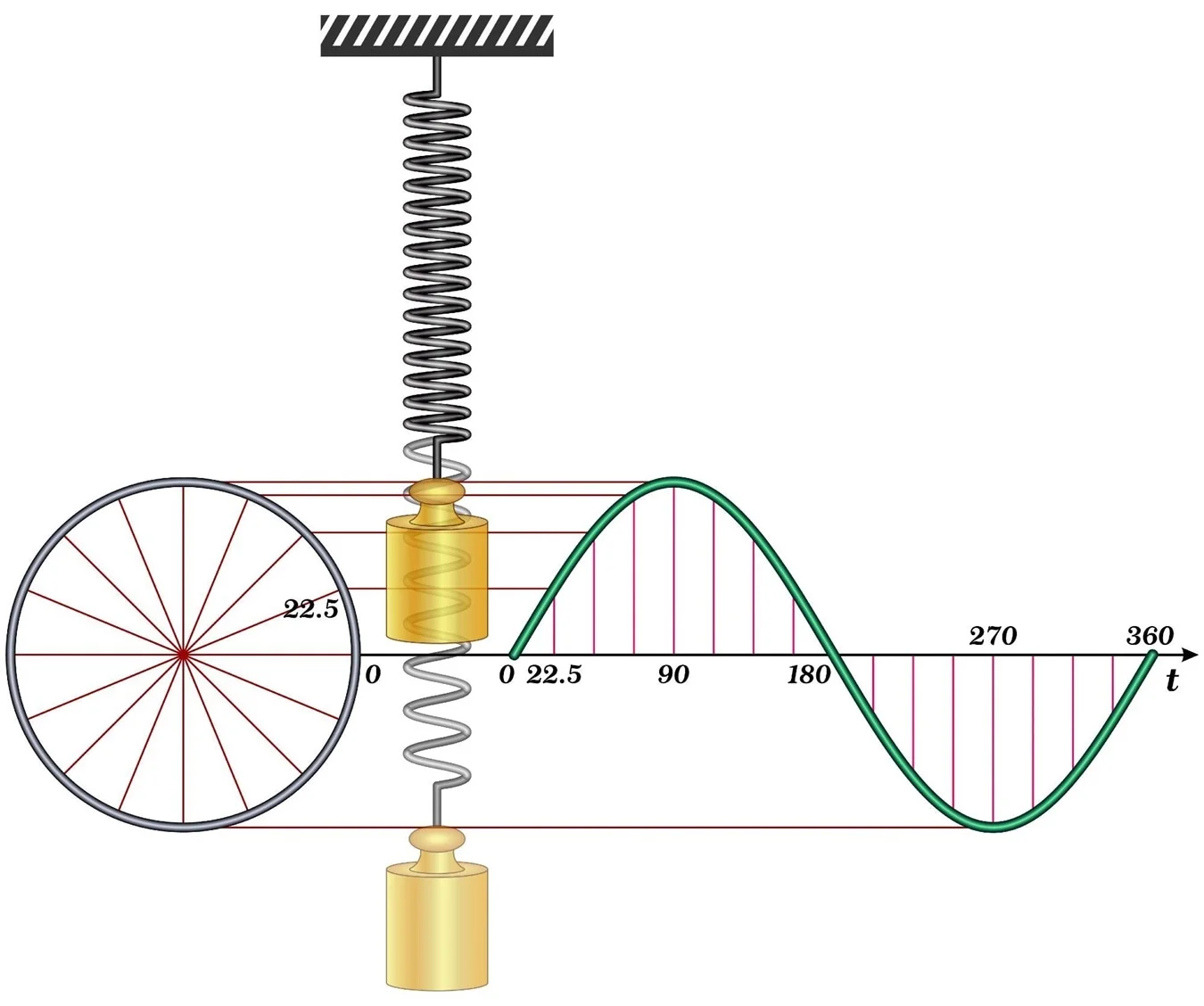
Physical realism needs five fields to create fifteen or more particles to partly explain the matter that is less than five percent of our universe, but quantum realism explains that and more with just one field. The founders of quantum theory envisaged the quantum field as a network of oscillating points, each like a mass on a spring (Figure 1) but vibrating in three dimensions not one. Schrödinger then developed quantum mechanics by assuming a network of quantum harmonic oscillators. It worked brilliantly, but there was a catch.

Figure 5.1. A mass on a spring oscillates.

Quantum harmonic oscillations occur outside our space, in a complex dimension that has no physical base. They explain light waves, but nothing physically moves so they are called virtual, meaning they don’t actually exist. However in quantum realism, they not only exist but also cause the physical events we see. The quantum field can then be imagined as a vibrating surface that supports waves of light and lumps of matter like electrons by harmonic oscillations that:

1. Vibrate in three dimensions. Our space is the 3D surface of a hypersphere (2.4.1).

2. Outside space. Quantum waves like light vibrate outside our space (3.2.2).

3. As processes. What oscillates isn’t a particle but a process that sets values (3.2.3).

4. Are passed on. Quantum processing waves are passed on each cycle (2.1.5).

5. Represent probabilities. The quantum field value at each point is probability that a physical event will occur there (3.9.3).

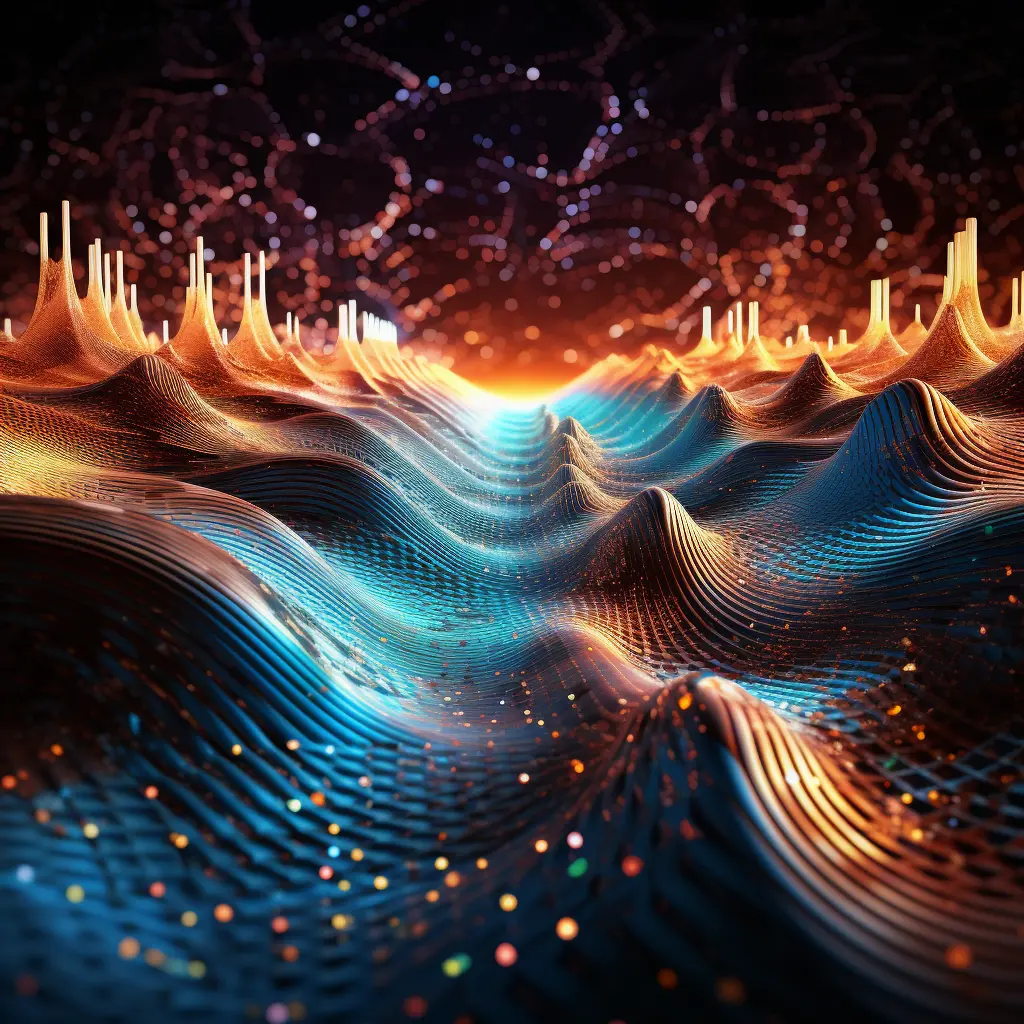
Figure 2 shows the quantum field as a constantly changing surface that oscillates, but that the non-physical generates the physical is hard for us to accept. However this shimmering surface explains the facts of physics better than anything else.

Figure 5.2. The quantum field oscillates.

The last chapter attributed electromagnetic, strong, and weak effects to the quantum field, but how then does gravity arise? 

QR5.1.  Gravity Rules

QR5.2.  Special Relativity

QR5.3.  Matter Trembles

QR5.4.  General Relativity

QR5.5.  Electricity and Magnetism

QR5.6.  Creating Order

QR5.7.  Why Does The Universe Exist?

Discussion Questions

References

Next

QR2.5.4 A Quantum Model

Last century, physics invented a tale of quantum waves that spread at light speed then collapse instantly into physical events that begin the waves again. It made no sense, because physical waves can’t restart like that, but these strange waves predicted atomic events amazingly. The result was modern technologies like (Jenner, 2014):

  • Transistors that run devices like smartphones work thanks to quantum laws.
  • Medical devices like MRI (Magnetic Resonance Imaging) look within the body without surgery thanks to quantum laws.
  • Global Positioning Systems (GPS) let us navigate the world thanks to quantum laws.
  • Lasers scan barcodes at supermarkets thanks to quantum laws.
  • Solar panels convert sunlight into electricity thanks to quantum laws.
  • LEDs (light-emitting diodes) run the sensor lights on TVs thanks to quantum laws.

Without quantum laws, these technologies wouldn’t exist, but last century physics made the theory behind them imaginary because it was physically impossible. But if the technologies are real, how can their theory be imaginary? One possibility, not recognized initially, is that quantum theory describes processing waves spreading on a network, because such waves can:

  • Evolve stepwise. Quantum waves evolve one step at a time. Physical waves don’t do this, but waves on a network pass from one point to the next in a stepwise fashion. Quantum waves could then evolve step-by-step because each step is a network cycle.
  • Superpose to a limit. Quantum waves superpose probabilities up to a limit of one. Physical waves don’t do this, as they can be any height, but waves on a network can’t exceed the capacity of a network point. Quantum waves could then have a size limit because each network point has a bandwidth, beyond which it overloads and reboots.
  • Collapse instantly. Quantum waves collapse instantly to restart at a point. Physical waves can’t do this, but a wave run by a server can restart at a point. A quantum wave could then collapse instantly because a network point reboots to restart its server.
  • Entangle at a restart point. When quantum waves restart at the same point in a physical event, they entangle to become one. Physical waves don’t do this, as they just pass through each other, but two processes restarting at the same point could merge into one. Quantum waves could then entangle at a point because their servers merge their processing.

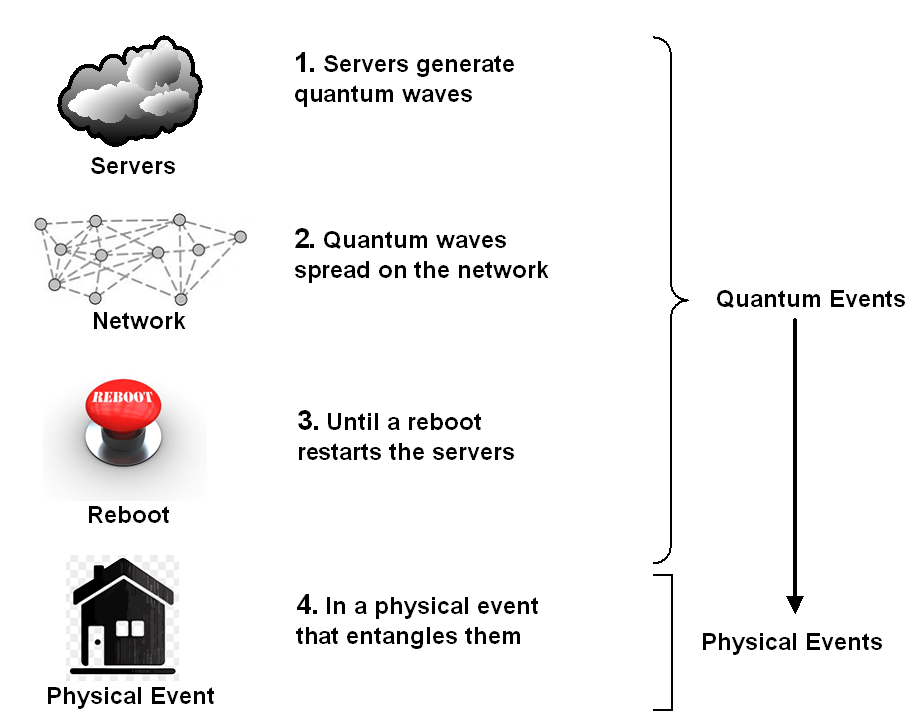
Later chapters give more details, but essentially quantum weirdness isn’t weird in computer terms. Processing waves on a network can evolve stepwise, superpose to a limit, collapse instantly, and entangle by the nature of processing. The resulting model of how quantum events cause physical events has these aspects (Figure 2.15):

  • Servers. Servers generate and restart quantum waves.
  • Network. Quantum waves spread and superpose on the network.
  • Reboot. Until a point overloads and reboots, to request server restarts.
  • Physical Event. A physical event restarts the waves at the same point, which entangles them.
Figure 2.15. Quantum events create physical events

A photon is a processing wave that spreads on a network until it overloads a point, in a physical event that restarts it again, so quantum waves are never lost. If quantum waves evolve stepwise when passed on, superpose when they overlap, collide when they overload a point, collapse when they restart, and entangle when their servers merge, then quantum theory is literally true.

The only strange thing about this model now is that the last step is an observed physical event. According to quantum theory, we observe a photon by interacting with its quantum wave in a physical event. This is an action, so we create our observation of the photon. The quantum waves around us only become physical events when “touched”, like a painting that appears only when painted, one brushstroke at a time, and we aren’t the only painters, as atoms also paint events. The surface painted on, which we call space, can curve, and the clock counting the strokes, which we call time, can slow down, as Einstein deduced. Relativity gives each painter their own canvas and clock, so space and time are generated locally, along with each physical event.

If time and space began when our universe did, before that they didn’t exist. Hawking concluded the same, arguing that nothing existed before our universe (Hertog, 2024), but how can nothing create a universe? The alternative is that what began our universe also began its space and time. Physical realism doesn’t say how time and space began, let alone matter, but quantum realism lets space and time begin with the first physical event.

To think the first event was just about light or matter is to underestimate it, as it needed space and time as well. We can picture making objects but making time and space is hard to imagine Scientists expected the first event to be about matter, and theologists expected their divinity to create a perfect world, but the evidence is that our universe didn’t begin with humans, animals, sky, or earth as they are now, but with what led to them. Our universe then began as a primal seed that after fifteen billion years has grown into galaxies, stars, planets, life, and us. The first event made not only things but also space and time, and not only then but also now, so the rabbit-hole of quantum reality runs deeper than even its advocates suppose

Table 2.1 compares quantum realism with physical realism for space and time, so the reader can decide which explains the evidence better. The following chapters use the above model to explain the behavior of light (Chapter 3), matter (Chapter 4), and relativity (Chapter 5). They also make a testable prediction that current theory denies – that pure light can collide (4.5.9). Chapter 5 ends Part I, on the observed world, and Part II applies the same model to the observer.

Next

QR2.5.3 Reality Is Quantum

Reverse engineering is grounded theory for computing, as it deduces what causes screen events. When we observe a screen, what changes it is unseen but we can deduce the cause, then refine that deduction by further observations until it reliably predicts what happens next.

Reverse engineering, a part of design science, can apply to physical events produced by quantum processing waves. These waves can’t be observed physically, but if unseen wi-fi waves can fill our screens with images, unseen quantum waves could do a similar thing for the screen of space. Reverse engineering then explains physical events based on quantum events, given that quantum reality is:

1. A network. So physical events are discrete not continuous.

2. That transmits waves. So entities move as waves not particles.

3. That vibrate at right angles to space. So space isn’t complete in itself but contained.

4. Until they interact in physical events. So physical events aren’t fundamental but derived.

These features of quantum reality suggest that our world isn’t as physics expected. Materialism assumes particle entities that move on single paths through empty space, but wave entities on a network spread on many paths. Which view is right then, particles or waves? For most empiricists, the answer is obviously particles, because the laws of physics work, but those who made those laws also imagined methods that assumed the opposite. These methods were accepted because they worked, and because mathematics doesn’t make claims about reality, but the result is that physics uses methods based on quantum features that contradict materialism. For example:

1. Calculus. The calculus used throughout physics began as a thought experiment, that infinitesimals predict physical events in the limit. It worked brilliantly, but that space and time change in tiny steps contradicted the assumption of continuity, so it became just a mathematical tool that is used but not believed in. Calculus was rejected as a reality description because it denied a canon of materialism, but if space and time really do change in quantum pixels and cycles [Note 1], then physical events are discrete not continuous.

 2. Sum over paths. Feynman’s sum over paths theory also began as a thought experiment, that quantum particles take every path to a destination then pick the best one. Again, it worked brilliantly, but that entities move as waves contradicted the assumption that they are particles, so it also became a mathematical tool that is used but not believed in. Feynman’s theory was rejected as a reality description because it denied a canon of materialism, but if quantum entities really do move as waves, then physical entities must also move as waves not particles.

3. Complex numbers. Complex number theory was another thought experiment, that electromagnetic waves like light rotate in a plane outside our space. Again, it worked brilliantly, but having a plane outside space contradicted the assumption that space is complete, so it also became a mathematical tool that is used but not believed in. Complex number theory was rejected as a reality description because it denied a canon of materialism, but if there really is a dimension outside our space, then space isn’t complete but contained.

4. Quantum mechanics. Quantum mechanics was yet another thought experiment, that unseeable quantum waves interact to cause physical events. Again, it worked brilliantly, but that quantum waves cause physical events contradicted the assumption that those events are fundamental, so it also became a mathematical tool that is used but not believed in. Quantum mechanics was rejected as a reality description because it denied a canon of materialism, but if quantum events really do cause physical events, then physical events aren’t fundamental but derived.

All the above methods, of calculus, sum over paths, complex numbers, and quantum mechanics, are used in physics because they work, but what they imply is ignored because they are called imaginary. But if these methods are good enough to use, why aren’t they good enough to believe? The answer it seems is that they deny materialism, an ancient belief of Aristotle. For if the method of calculus is true, then our world isn’t continuous. If the sum over paths method is true, then entities don’t move as particles. If complex numbers are true, then our space isn’t complete. And if quantum theory is true, then physical events aren’t fundamental. This leaves physics caught between what it believes and what works, like a sailor who says the earth is flat but has to use global coordinates to navigate.

Yet when evidence contradicts belief in science, isn’t the latter supposed to win? If global coordinates work, doesn’t that mean that the earth isn’t flat? Based on the evidence, it isn’t quantum theory that is imaginary but materialism, and the other methods suggest the same. Why then don’t physicists want their equations to be true, as they would be if quantum waves exist? Wouldn’t that make physics simpler?

The answer seems to be a dread that accepting quantum reality will open the door to magical thinking, where quantum powers allow psychic healing, telepathy, psychokinesis, and other miracles (Chopra, 1989). Physics doesn’t want to go back to a dark age of God theories, that explain everything but predict nothing.

Yet this fear is unjustified because reverse engineering doesn’t work that way. For example, quantum computers are powerful but not magical because quantum waves spread, collapse, restart, and entangle based on quantum laws, not an all-powerful being. They act in physically impossible ways but they are lawful, so they aren’t miracles. That reality is quantum then doesn’t allow miracles, any more than that it is physical does. Quantum realism is no more a God theory than a quantum computer is a God computer.

Using reverse engineering to develop a model of how quantum processing works doesn’t open a door to quantum mysticism, but it may explain what materialism can’t, which why quantum theory works in the first place.

Note 1. For any calculus involving time, replace dt by dp, a small number of processing cycles. Now dp can indeed tend to zero because there cannot be less than one processing cycle.

Next

QR2.5.2 Grounded Physics

When Europeans first visited China, its society made no sense to the colonial mindset, as the constant bowing seemed unnecessary and they didn’t understood the importance of  face. Only later was it realized that in China, groups create individuals not the other way round, so being excluded from one’s family, clan, or society was worse than a death sentence, while bowing and keeping face avoided this. Social scientists called the method that led to this discovery grounded theory, which as the name implies, is to first gather data, then theorize about it. Scientists studying new cultures learned to first watch, listen, and record, then form theories to test the next day. Repeating this method daily then produced a grounded theory, based on the data not bias.

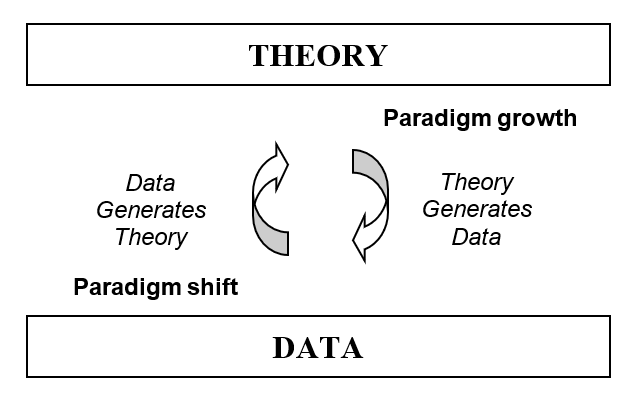
Grounded theory avoids colonial bias but seemed at first to reverse normal science, until Kuhn noted that science has always advanced by paradigm shifts (Kuhn, 1970). Testing theory prediction against data is then normal science, that grows a paradigm, and using the data to generate a new theory by a paradigm shift is also science. Science then includes:

1. Paradigm growth: Theory generates data predictions (normal).

2. Paradigm shift: Data generates a new theory (revolutionary).

In paradigm growth, theory generates new data, while in a paradigm shift, data generates new theories (Figure 2.14). Normal science progresses gradually, as sediment builds up a rock, but paradigm shifts change the theory landscape suddenly, as an earthquake does. For example, the paradigm shift from Galen’s theory of miasma to a germ theory of disease was an intellectual earthquake that sunk one theory and raised another. Grounded theory is the scientific method that supports paradigm shifts.

Kuhn further suggested that in the history of science, paradigm shifts are needed when traditional theories stagnate, to raise a new theory from the data ground up. In Figure 2.14, science connects data and theory either way, to generate data from theory, or to generate theory from data. Both ways are science because both connect data and theory to increase understanding.

Figure 2.14 The relation of theory and data in science

It follows that physics could be approaching quantum reality as the colonials did China, with a bias. The bias is materialism not colonialism but the problem is the same. Physics sees only particles not waves, but quantum theory is based on waves not particles, so it made quantum waves imaginary, but what if they aren’t? If a paradigm fails to predict year after year, as particle theory has, is the answer more of the same? Throwing ideas at a wall to see what sticks doesn’t work, so it’s time to revisit the data ground, based on grounded physics.

Grounded physics applies grounded theory to physics by looking at the data from a quantum wave perspective, not a matter particle perspective. It aims to explain quantum reality on its own terms not ours. As will be seen, taking off the blinkers of materialism suggests a universe based on waves not particles, that pulsates with energy not emptiness. A grounded theory of physics would then be based on data not bias.

Next

QR2.5.1 The End of Physics?

Modern physics has been stagnant for so long that some physicists predict the end of physics, as maybe:

“… for the first time in the history of science, we could be facing questions that we cannot answer, not because we don’t have the brains or technology, but because the laws of physics themselves forbid it.” (Cliff, 2015).

Yet in the history of science, it wasn’t the laws of nature that forbade questions but the laws of people, their dogmas. The main dogma of modern physics is materialism, the idea that everything is physical. No-one has ever proved it, so it’s just an assumption, but it is said to be self-evident. Even so, the world of transistors, satellites, and cellphones we have today is based on equations about waves that aren’t physical. According to materialism, quantum waves don’t exist, but how then does light travel? And if empty space can have a physical effect, why not quantum waves? Relativity and quantum theory began with causes that aren’t physical, like curved space and quantum waves, so why don’t we study them further? It isn’t nature that is stopping us, but our own dogmas.

Last century, physics left the safe haven of classical mechanics, hoping to discover how light moves in a vacuum, and how gravity acts from afar. Wandering in the desert of materialism, instead of finding a promised land, they found the quantum jungle, a weird place that seemed to ignore the laws of matter. Those who entered it returned with strange stories, like that it guided matter (Bohm, 1980), so the expedition leaders fenced it off with equations, calling it mythical, and banned all discussion of it. With nothing else to do, their followers built a great castle in the desert, called the standard model. Today, it dominates a barren landscape because nothing grows around it.

Sitting in their castle, physicists invented theories like supersymmetry that predicted new particles, so they built a great machine to produce them, called the large hadron collider, but it didn’t find any of them. Theories weren’t working so they were altered to fit the data, but they still didn’t produce anything. As one physicist concluded, the trouble with fundamental physics is that it isn’t producing any new knowledge (Smolin, 2006). For example, string theory makes no predictions at all, and the multiverse is an untestable speculation that isn’t even wrong (Woit, 2007). It seems that even the weeds of error don’t grow in the desert of materialism. Today, the fizz has gone out of physics because what baffled Einstein and Feynman seventy years ago still baffles physicists today.

Speculating based on bad theories is bad but it still tells us what doesn’t work. In contrast, speculating with no theory at all is worse because nothing is learned. Just as people stuck in a desert start to see mirages after a while, physicists are now just imagining things, as these paper titles illustrate:

  • We may have spotted a parallel universe going backwards in time. (Cartwright, 2020).
  • Neutrinos may explain why we don’t live in an antimatter universe. (Crane, 2020).

The key word in the above titles is “may”. Fifty years of physics can be described as maybe WIMPS, maybe strings, maybe time travel, maybe supersymmetry, maybe a multiverse, and so on, one mirage after another. There are papers on white holes, large extra dimensions, time travel, closed time loops, wormholes, heavy sterile neutrinos, and super-particles, all hoping to be the next revolution in physics, but they weren’t. In 2018, a New Scientist cover story speculated about axiflavons from a hypothetical flavon field and concluded:

“It’s thrilling stuff, if for the moment it is only conjecture”, New Scientist, August, 2018, p31.

It was a thrilling conjecture but years later, nothing has changed! Physicists sitting in a semantic desert are dreaming theories and if they stay there, the next fifty years will be as barren as the last. Trying to explain quantum theory based on materialism is like looking for the keys you lost in a jungle in the desert around it because it is easier to look there. When physics quarantined the quantum jungle, it turned its back on the greatest discovery of humanity, that quantum events really do cause physical events.

The way out of this stagnation is to change the methods of physics, as Hossenfelder says:

The major cause of this stagnation is that physics has changed, but physicists have not changed their methods…  Instead of examining the way that they propose hypotheses and revising their methods, theoretical physicists have developed a habit of putting forward entirely baseless speculations.

Speculating without theory is like throwing mud at a wall and hoping for a portrait, and speculating without theory is like drawing castles the air that have no foundations. For example, string theory has 10500 rooms based on no data, despite thousands of papers. So, is physics helpless before what makes no physical sense? How then can physics study the quantum mystery if materialism can’t?

Luckily, science has a precedent. When other disciplines face what their conventions can’t explain, they use grounded theory. It works when other methods fail because it isn’t based on any assumptions at all, just the data. To use it, physics would have to abandon its assumptions about matter, but they are going nowhere, so what is the loss? That matter can’t explain everything isn’t the end of physics, but a new beginning.

Next