QR6.1.8 Neutral Monism

Chalmer’s last option is neutral monism, that something more primal than matter or mind is the cause of both, as suggested by Russell in 1921:

“The stuff of which the world of our experience is composed is, in my belief, neither mind nor matter, but something more primitive than either. Both mind and matter seem to be composite, and the stuff of which they are compounded lies in a sense between the two, in a sense above them both, like a common ancestor.” (Russell, 2005)

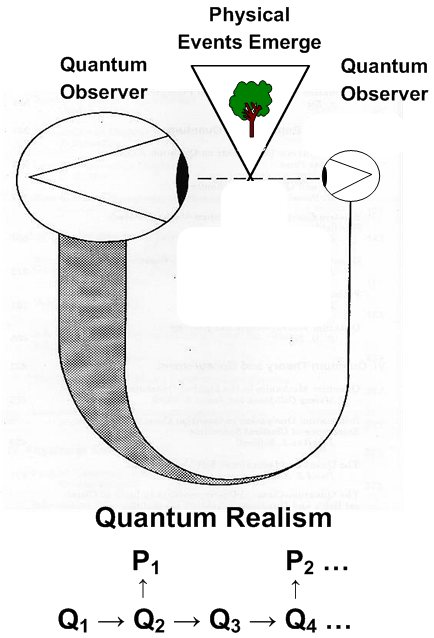
Russell didn’t specify a common ancestor for mind and matter, but if quantum reality creates the observer as well as physical events, quantum realism is a neutral monism as Russell proposed.

Consider the premise that every physical event must have an observer. Virtual worlds exist by being observed so if our physical reality is virtual, it should be the same. Quantum theory confirms that physical events require observation, as spreading quantum waves only collapse to a physical event when observed. It follows that an observer is needed for physical events to occur.

We also know that our universe began at a moment in time so without observation, it would have stayed in a quantum superposition. The initial physical events had to be observed to occur. If our universe began as a light plasma that physically collided into basic matter (Chapter 3), the only entities that could observe were photons. The simplest conclusion that lets observation cause the initial physical events is that photons observed.

It isn’t claimed that photons observe as we do, but that they observe quantum scale events of 10-35 meters and 10-43 seconds. Such events are incredibly short and brief to us, as they occur more times per second than there have been seconds in our universe. That photons observe seems preposterous but the alternative, that only we observe the universe, is equally so.

To observe so little so briefly seems hardly worth it to us, but smallism, that facts about big things come from facts about small things (Coleman, 2006), can apply to observation too. If the observer experience began small, like everything else, then macro-consciousness can derive from micro-consciousness (Chalmers, 1996) (p305). It is possible that photons observe, so who are we to say that they don’t when we claim that we do? By Conway’s free will theorem, either everything is conscious or nothing is (Koch, 2014), so it is simpler to say that observation always existed than to explain how it began with no precedent.

If observation existed from the start, then photons observe on their scale, but not as we do. To avoid confusion, let us call quantum-scale observations proto-consciousness, as Penrose proposed in 1944 (Penrose, 1994), and more recently:

… the elements of proto-consciousness would be intimately tied in with the most primitive Planck level ingredients of space-time geometry, these presumed ‘ingredients’ being taken to be at the absurdly tiny level of 10-35m and 10-43s, a distance and time some 20 orders of magnitude smaller than those of normal particle-physics scales and their most rapid processes.(Penrose & Hameroff, 2017) p21.

That consciousness began small answers another question, that if everything is a player in our virtual universe, isn’t it boring for some? If one asked for players in a virtual universe like ours, who wants to be a rock on mars, that just sits there for a million years? But a rock is an aggregate of molecules, so it observes on a molecular scale, not a rock scale. On this scale, something new happens every nanosecond, so it isn’t boring at all.

This isn’t panpsychism, that matter is conscious, because in quantum realism, matter doesn’t exist except as a view. Panpsychism assumes that matter exists to have a consciousness property, but if matter itself doesn’t exist, it can’t have that property. This is possible because previous chapters derived matter properties, like mass, charge, and spin, from quantum reality.

Quantum realism changes the question from how dead matter became able to observe to how proto-observations became human observations. It replaces the explanatory gap between matter and consciousness with an evolutionary gap, between what atoms observe and what we do. The conclusion, developed later, is that the ability to observe had to exist from the beginning to cause physical events. Hence, instead of asking how matter acquired consciousness, we now ask how matter observations evolved, which raises the question of how brains evolved?

Next

QR6.1.7 Social Causes

Another cognitive theory of consciousness attributes the mind to complexity, by claiming that brains become conscious in the same way that ants form colonies, because:

“… ant colonies are no different from brains in many respects.” (Hofstadter & Dennett, 1981), p181.

The brain is then just a colony of nerves that communicate electrically instead of chemically, as ants do. By this logic, the chemical trails ants lay down are the colony’s “language” just as neuron wiring causes our language. Dumb neurons then create consciousness as dumb ants create a colony, so it remains as neurons come and go, just as a colony remains as ants come and go. Crick’s “pack of neurons” theory is now that we are nothing but a colony of nerves.

The evidence that ant colonies are conscious is weak, as if an ant colony is a being that can communicate, why haven’t we learned its language by now, as we did that of the bees? It doesn’t help to suggest the same logic applies to countries like Russia or America:

“… let us think a bit right now about whether it makes sense to think of ‘being’ a country. Does a country have thoughts or beliefs?” (Hofstadter & Dennett, 1981) p192

To say that consciousness is private so countries might be conscious is just a smoke-screen, as no evidence at all suggests that countries are beings. Scientists don’t ask others to disprove their speculations but go where the evidence leads. To argue that what appears as a unity might be a being is an appeal to naivety. If that were true, tornadoes might be conscious beings, but they aren’t, and neither are ant colonies or countries. When we connect physical parts into a bicycle, it becomes an entity to us but not to itself.

After presenting paradoxical Gestalt patterns and speculating that ant colonies are conscious, the underwhelming conclusion of this theory is that:

“Mind is a pattern perceived by a mind.” (Hofstadter & Dennett, 1981) p200.

It isn’t hard to see that this statement is circular, because a mind is assumed to perceive a pattern that is then equated to the mind that perceived it. This theory, that mind is a creation of mind, is just another miracle thrown up to maintain physical realism.

Next

QR6.1.6 Information Causes

If matter can’t explain consciousness, it is unclear why its information derivative should do better, but integrated information theory argues that “consciousness is integrated information(Tononi, 2008), generalizing an earlier theory that brain senses like vision, hearing, and smell store data in a global workspace (Baars, 1988).

Nerves from the eye go to the back of the brain, from the ears to its sides, and smell to its center, so how do sizzling sausages whose smell, sight, and sound are analyzed in distant brain areas appear as one object? The global workspace answer is that sense data is analyzed then put into a common area that higher functions like memory and language can act upon because:

“… the information has entered into a specific storage area that makes it available to the rest of the brain.” (Dehaene, 2014), p163.

Integrated information theory equates this unification to consciousness, but clinical studies deny that a specific brain data-center causes consciousness (Block, 1995), as does information theory. To exchange information, sender and receiver must agree on what physical signals mean. If they don’t, the result is gibberish, like a foreign language, so the auditory area of the brain can no more read visual data than I can read Chinese. Unless a global workspace had a sight, sound, and smell translator that the brain doesn’t seem to have, brain functions couldn’t use it.

The same logic applies to apps on a computer. For example, Windows Notepad reads text data and Paint reads picture data, but loading text into Paint, or a picture into Notepad, gives nonsense, so even if both put their data into a common area, neither could read what the other posted. Programs like Word that read text and pictures need a lot of code to do that, so they become very big, and still can’t read zip files for example. In general, for one application to read all data denies the benefits of specialization, and brain functions are specialized not centralized. One can’t plug the optic nerve into the auditory cortex and expect information to flow like water. 

Nonetheless, workspace theory goes on to suggest that neural systems chat like little people:

“… neural systems do not merely report to their superiors; they also chat among themselves.” (Dehaene, 2014), p176.

The brain then uses neuron sociology (Nunez, 2016) p18 as the Internet uses crowd control:

“… it is helpful to think metaphorically of a theater of mind. In the conscious spotlight on stage – the global workspace – an actor speaks, and his words and gestures are distributed to many unconscious audience members, sitting in the darkened hall. Different listeners understand the performance in different ways. But as the audience claps or boos in response, the actor can change his words, or walk off to yield to the next performer.(Baars & Laureys, 2004), p672.

The analogy is seductive but that neural areas chat like little people over nerve phone lines, or clap and boo each other as we do online, contradicts information theory. Electrical signals going down a wire don’t exchange information unless designed to do so. For example, the Internet needs data, network, transport, and application protocols to work, namely ethernet, internet protocol (IP),  transmission control program (TCP), and hypertext transfer (http) respectively. The Internet’s TCP/IP/Http protocols took decades to develop from the original Arpanet, and it was done by a central group the brain doesn’t have. And if the Internet integrates data, shouldn’t it also be conscious? Information integration theorists expect it be so soon (Koch, 2014), despite no evidence.

Theories of brain consciousness must respect information science, but information integration theory doesn’t, and what doesn’t work for computer networks won’t work for brains either. The cartoonish concept that neural areas chat like little people, by a common language the brain doesn’t have, merging claps or boos they can’t make, on a central stage that doesn’t exist, is a fantasy. If integrated information caused consciousness, the Internet would have had it long ago, but it hasn’t.

Next

QR6.1.5 Mind Causes

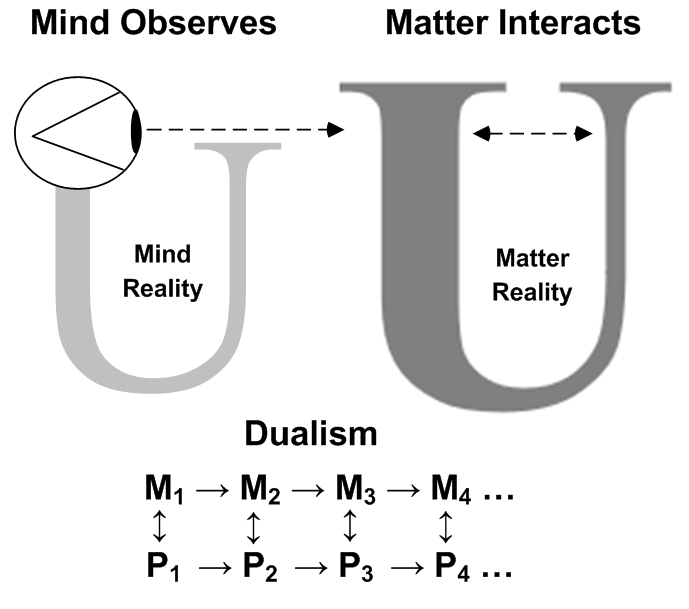
In 1637, Descartes concluded that mind is real because a thinker can doubt what he sees but not that he sees, so our sensory experiences could be a dream but the experience of them is real. The physicalism of science (Figure 6.1) then required a mind reality to consciously experience it (Figure 6.2). In this Dualism-A, mind and matter exist in different realms that interact, to provide both the machine of science and the immaterial observer of religion.

Figure 6.2 Dualism: Mind observes Matter

This view held for centuries until in 1814, Laplace argued that physical causes alone sufficed:

We may regard the present state of the universe as the effect of its past and the cause of its future. An intellect which at a certain moment would know all forces that set nature in motion, and all positions of all items of which nature is composed, if this intellect were also vast enough to submit these data to analysis, it would embrace in a single formula the movements of the greatest bodies of the universe and those of the tiniest atom; for such an intellect nothing would be uncertain and the future just like the past would be present before its eyes.” Laplace, in (Truscott & Emory, 1951), p4.

In this causal determinism, science not only doesn’t need religion, but is better off without it, because the physical world is causally closed. It is a causal chain with no gaps, like a tube of balls where pushing one end makes a ball pop out the other end, with no mind needed to make it happen. If physical events follow a predetermined path, there is no room for mental causes.

Dualism couldn’t counter this because it can’t explain how mind affects matter (1.2.2), and logic confirms that causal closure means that if the mind has a physical cause, it must also be physical and so not mind, and if not, it has no physical effect (Kim, 1999). Physicalism doesn’t let the mind affect the body as we think, so Dualism-B, that mind exists but does nothing, is essentially physicalism.

Supporters of mental causation then sought to demonstrate it by paranormal events like telekinesis (mentally moving objects), or extra-sensory perception (seeing what is physically unseeable), but these results haven’t replicated reliably (Kelly at al., 2007).

Then just as physicalism was destroying the foundations of dualism, quantum theory destroyed its foundations, by stating that no physical event is 100% certain. For example, in the Stern-Gerlach experiment, silver atoms fired into a magnetic field move up or down based on a perfectly random spin that is set when they enter the field. We can’t pre-sort the atoms into those that will go up or down as they are initially identical, and according to quantum theory, the spin that decides their movement is defined when they enter the field, not before. In a causally closed universe, the physical past causes the physical future, but in our universe it doesn’t, and physicalism can’t explain this.

Physicalism then can’t explain the experiential fact of consciousness or the physical facts, and dualism can’t explain how an immaterial observer can exist alongside a material world, but this didn’t stop its supporters from proposing causes that derive from matter.

Next

QR6.1.4 Physical Causes

Materialism is the premise that only matter exists but it has no known ability to experience the events it causes, so the consciousness we experience is unexpected. No law or equation needs it, as the matter that causes physical events has no need for extra-physical experiential events. As science developed other causes to explain physical events, materialism morphed into physicalism, the premise that only physical events exist, caused not only by matter but also energy, space, and time. 

Yet physical causes can’t experience physical events either, so physicalism has to reject consciousness entirely (Materialism-A), which denies common experience, claim that it equates to a physical state (Materialism-B), despite the evidence that consciousness doesn’t reside in any brain region, or promise to explain it eventually (Materialism-C). It isn’t easy to deny what everyone accepts, or claim what the evidence denies, so all that reasonably remains is the promise to explain consciousness one day because it has explained everything else so far.

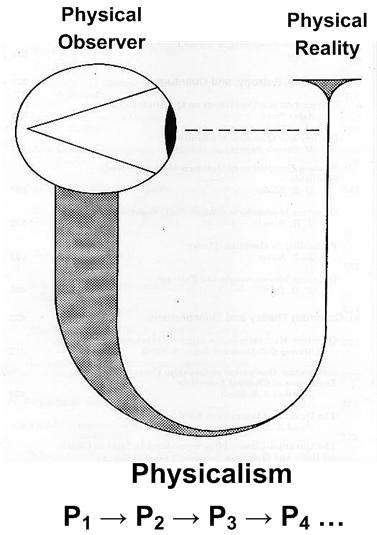
Wheeler described this option by a physical universe (U) with an eye that observes matter (Figure 6.1). But if one set of physical events (P) produces the next, in an endless chain with no gaps, one link can’t be an observing eye and another not as shown in Figure 6.1, so it also implies that either nothing observes or physical states do. 

Figure 6.1 A physical reality observes itself

Yet the logic that what best explains matter will also best explain consciousness is sound, but physicalism can’t explain the dark matter that is 85% of all matter (4.7.6), or dark energy that is 68% of all matter-energy (4.7.7). The standard model, based on physicalism, then explains about 5% of our universe, the ordinary matter we see, so why should it explain consciousness? 

But isn’t a model based on real matter at least realistic? Again it isn’t so, as the standard model needs unverifiable virtual particles and miracles like wave-particle duality to work. Is it realistic that matter particles with no physical size spin (4.7.1)? Or that massless gluons create most of an atom’s mass (4.7.3)? What is realistic about thinking that matter can be infinitely dense (5.4.6), or that the future can affect the past (3.8.3), or that massive particles from empty space decay neutrons (4.4.6)? The standard model is many things but its claims aren’t realistic at all.

Even worse, using virtual particles to explain physical events denies science because they can’t be verified. Science is based on empiricism, verifying facts by physical tests, but virtual particles appear and disappear in a way that isn’t testable, giving a fairytale physics that predicts what doesn’t occur and can’t explain what does (Baggot, 2013). The standard model assumption that equations alone satisfy science is false, as its current stagnation shows. 

Why then is physicalism still widely accepted? The answer seems to be that everyone thinks it is needed. Physicists think that science needs physical causes but actually science verifies theories by physical results, so quantum theory is a science despite its non-physical causes because it is testable. Scientists also think that the equations of physics need physical causes but actually the laws of gravity work whether it is physical or not. The following story illustrates the situation:

A father and son would meet to discuss the meaning of life over a meal. Each time they were joined by a third man who ate most of the food and dominated the conversation but left when the bill arrived, so he paid nothing. One day the son said “Your friend eats a lot and never pays!” to which the father replied “He’s not my friend, I thought he was yours!”.

Father and son accepted the third man because he was the other’s friend, but he wasn’t, just as science and physics accept physicalism thinking the other does, but they don’t. Physicalism sits at the table of science proclaiming that particles cause everything, but when the bill of evidence comes it can’t pay because its virtual particles have no scientific value. It is an impostor that pontificates but doesn’t deliver when the reality check arrives, so physics and science are better off without it.

In conclusion, consciousness is just one of many facts of our world that physicalism can’t explain, from the two-slit experiment (3.1.3) to non-physical detection (3.8.4), so the hard problem is just another of its failures. What then of dualism (1.2.2), its main opponent?

Next

QR6.1.3 What Causes Consciousness?

If consciousness is a scientific fact, science should be able to discover what causes it. The scientific approach to a fact is to explain it, not to ignore or dismiss it, so the question raised is:

“Why does conscious experience exist?” (Chalmers, 1996), (p5).

A major review of theories on consciousness divides them exhaustively into the following categories labelled A-F (Chalmers, 2003):

A.  Materialism-A. Consciousness doesn’t exist, except as imagined by the physical brain (Dennett, 1991). Physical causes explain everything but the physical brain just invents an observer, so the hard problem doesn’t exist.

B.  Materialism-B. Consciousness does exist, but is identical to certain physical brain states for all practical purposes (Block & Stalnaker, 1999). Again if physical causes explain everything, consciousness must equate to a brain state, so the hard problem is solved.

C.  Materialism-C. Consciousness does exist, but is in theory a physical brain effect (Nagel, 1974) (Edelman, 2003). That physical causes explain everything then just means they will one day explain consciousness, so the hard problem will be solved eventually.

Materialism then concludes that either consciousness doesn’t exist (A), or if it does, it is just a physical brain state (B), or some other physical cause that the future will find (C). Others however suggest various non-physical causes, including:

D. Dualism-D. Consciousness exists by itself in a non-physical realm, where it affects matter which in turn also affects it (Stapp, 1993). Consciousness is then independent of matter, but interacts with it, so the hard problem is solved.

E.  Dualism-E. Consciousness is a brain by-product that helps us survive but doesn’t affect matter (Zizzi, 2003). Consciousness is then an epiphenomenon, like a train whistle that exists but doesn’t affect the physical train, so the hard problem is solved.

F.   Neutral Monism-F. Both consciousness and matter derive from a primal cause that is neither, as a common ancestor causes both (Russell, 2005). Consciousness and matter then both exist but are generated, and neither causes the other, so the hard problem is solved.

In these theories, consciousness exists as matter does in another realm (D), or it exists there but unlike matter affects nothing (E), or something else entirely causes both it and matter (F).

The proposed causes of consciousness then divide into those that attribute it to physical states and those that imply a non-physical cause. How science assesses these theories is now reviewed, starting with physical causes.

QR6.1.2 The Hard Problem

The hard problem (Chalmers, 1996) is a conflict between current science and our experience, so one or the other must be wrong. That we consciously experience the world is hard for science to explain, but for most people it is simply self-evident, so why is it hard for science?

We see one light frequency as red and another as blue because neurons in our retina respond to them differently, but why is red this experience, and blue that one? Nothing in neuroscience requires the brain to produce experiences, so what creates redness and blueness? This problem is hard for science because in physical terms, there is no red or blue, just different light frequencies.

Imagine a scientist who knew all the facts known about blue from a monochrome screen, such as how neurons analyze blue light frequencies (Jackson, 1982). Yet if she then sees blue for the first time, it’s a new experience, so what does she now know that she didn’t before? This question is also hard for science because the facts of blueness don’t explain the experience of seeing blue.

Equally hard is that the experience of consciousness isn’t based on any specific brain function, of sense, thought or feeling (Block, 1995). For example, a person who can’t speak or move except to blink can still be conscious, as shown by locked in syndrome. Consider the thought experiment of the Islamic scientist Avicenna, of a man floating in a void with no awareness of his arms, legs, heart, or any body part, but he still knows that I Am, that I exist, even with no sensations. It is then hard for science to explain why the observer experience remains despite sensory-deprivation.

Visual cortex damage causes blindness but doesn’t stop consciousness, and even those born with no cortex evidence consciousness (Merker, 2007), so it can’t depend on a cortical area. No brain area has been identified as the seat of consciousness, as it persists even when the cerebellum, amygdala, hippocampi or cortex fail. Consciousness seems to be just there, in a way that can apply to any sense, memory, or feeling, so James concluded in 1892 that it is a fundamental fact:

The first and foremost concrete fact which everyone will affirm to belongs to his inner experience is the fact that consciousness of some sort goes on.” (James, 2019).

Consciousness is the first fact because it precedes all other facts. As Kant concluded, a posteriori facts occur after the observer experience, and a priori facts before it (Kant, 2002), so I know that I observe but what I see is just a premise, or as science says, a theory. It follows that consciousness isn’t an a posteriori observational fact but an a priori experiential fact.

The hard problem assumes that science can’t accept experiential facts but actually it does, as fields like psychology and sociology accept them based on observer reports in questionnaires and surveys. Consciousness then is valid fact because subjects report it, and it is reliable because others report the same, so science can study it. Yet after centuries of discussion, the hard problem remains, as “The question of how matter gives rise to felt experience is one of the most vexing problems we know of.” (Brooks, 2020).

Why then are we conscious in a body made of matter?

Next

QR6.1.1 Do We Exist?

Most people call themselves I not we, as one self observes things, but if what observes is the body, it is a collective of cells that constantly die and are replaced. For example, colon cells live only a few days, skin cells a few weeks, red blood cells a few months, and white blood cells a year or so, so where is the “I” unity in a bunch of cells that come and go? Yet some nerves may last a lifetime, so one biologist concluded that we are really just a pack of neurons:

“The Astonishing Hypothesis is that ‘You’, your joys and your sorrows, your memories and your ambitions, your sense of identity and free will, are in fact no more than the behavior of a vast assembly of nerve cells and their associated molecules. As Lewis Carroll’s Alice might have phrased it: ‘You’re nothing but a pack of neurons’.” (Crick, 1995).

This astonishing hypothesis is of course inevitable for materialism, because if the body is particles of matter, there is no unity that can be a self. And if these particles cause everything, we are just a machine, as is the universe. The idea that we are a machine driven by atoms, genes, or neurons then recurs in academic fashion, but is actually as old as materialism itself.  

Materialistic science must conclude that “I” is a medieval error, like that the earth is flat, so it is more correct to say We or It saw, rather than I saw. But if the matter of physics can’t experience its actions, not only is there no single observer, there is no observer experience at all. Materialism, as will be seen, then ends up denying the basic fact that we experience physical events. 

The reader can decide, but if you still think you have a self that observes, welcome to the hard problem of consciousness, that a physical aggregate of cells experiences life as a self.

Next

QR6.1 What Is Consciousness?

Whether consciousness exists or not, it can be defined as the ability to experience a physical event. It implies an observer that experiences the event which we call the self, so a theory that denies consciousness also denies that this self exists. 

QR6.1.1 Do We Exist?

QR6.1.2 The Hard Problem

QR6.1.3 Why Are We Conscious?

QR6.1.4 Physicalism

QR6.1.5 Dualism

QR6.1.6 Information Theories

QR6.1.7 Cognitive Theories

QR6.1.8 Neutral Monism

Next

Chapter 6

Quantum Realism Part II: The Observer Reality

CHAPTER 6. THE MYSTERY OF CONSCIOUSNESS

Brian Whitworth, New Zealand

I regard consciousness as fundamental. I regard matter as derivative from consciousness. We cannot get behind consciousness. Everything that we talk about, everything that we regard as existing, postulates consciousness.   Max Planck, (Sullivan, 1931).

Download Whole Chapter

This chapter examines the observer rather than the observed of previous chapters. In science, to observe is just to acquire information, as a camera taking a picture does, but it doesn’t experience that image as we do. We say “I see”, where I is the observer, and so conclude that we observe consciously but cameras don’t because they don’t experience as we do. Yet if our eyes are just biological cameras, with a retina instead of film, why don’t we observe impersonally as cameras do? No law of physics requires matter to observe, so if we are just matter, why do we have conscious experiences? The mystery of consciousness is that a purely physical universe doesn’t imply, or even allow, the observer experience that we all report having.

QR6.1 What Is Consciousness?

QR6.2 Evolving A Brain

QR6.3 Evolving Consciousness

QR6.4 Discussion Questions

QR6.5 References

Next