QR5.7.1 The Simulation Hypothesis

A simulation is a representation of something else, like a model of the Empire State building that represents it. An information simulation is a model made of information, as computers simulate the weather to predict it, and flight simulators let pilots experience a plane before they fly it. An information simulation then represents something physical but is itself just information.

The simulation hypothesis, that our world is a simulation created by a physical computer in another  world, was portrayed in the film The Matrix, where Morpheus says:

What is real? How do you define ‘real’? If you’re talking about what you can feel, what you can smell, what you can taste and see, then ‘real’ is simply electrical signals interpreted by your brain.”

The hero Neo then discovers that his reality is actually a simulation of New York in 1999, fed into his brain as electrical signals, by machines in the future that are using him as a battery, but is that possible? Can physical machines simulate the world we see?

The classical processing needed to simulate a system increases exponentially with the particles in it, because they interact, so our computers can only calculate the behavior of a few photons (Eck, 2017). To simulate even a few hundred electrons requires more atoms than exist in our universe (Kendra, 2017), let alone simulating New York city. These calculations aren’t just implausible but logically impossible (Faizal et al., 2025), so physics concludes that we aren’t living in a computer simulation.

Undeterred, simulation theory advocates note that simulations are fake, so that logic fails. For example, why simulate the billions of years of history before humans, or galaxies and stars we can’t visit, or quantum events we can’t see? Instead, just show a far-off galaxy as a dot of light that appears real, as movies do, so simulation theory predicts holes in our reality because it is fake.

The big computer of simulation theory (Campbell, 2003) can’t calculate quantum events, so quantum theory must be flawed (Campbell, Owhadi, Sauvageau, & Watkinson, 2017), but critics have failed to falsify it for over a century now, so this is unlikely to succeed. And even if it did, finding a flaw in quantum theory would just result in its revision, not simulation theory support.

Current physics finds simulation theory impossible, so machines, aliens, or our future-selves aren’t simulating our world from another, but this isn’t the only version of virtualism. Annex 1 reviews the various ways a virtual reality can be generated, and concludes that a virtual world like ours can’t have a physical base. This excludes not only physical virtualism (the Matrix option), but also information virtualism (Wheeler’s It from Bit), and even mind virtualism (Kastrup, 2019), as  nothing based on physical events can generate a world like ours.

Yet this still leaves quantum virtualism, that quantum events cause physical events, because unlike classical processing, quantum processing increases exponentially with size. It scales up with size as particle interactions do, so a quantum network the size of our universe can generate it. Processing costs aren’t now an issue, as every point of space is a processor, so every moment of the past fourteen billion years happened, every far-away galaxy in our telescopes exists, and quantum events actually happen. However hard we look, in the past, far away, or microscopically, we see no cracks or rifts in our world.

Quantum reality can only generate physical reality if it isn’t limited by physical laws, so if our world is virtual, it isn’t a copy of what causes it. It isn’t then a simulation but if it isn’t simulating something, why does it exist? Our universe is on a scale we can’t imagine, so we don’t need to know what is going on any more than all the animals that have lived and died knew that they were part of an evolution. It took billions of years to evolve sentience, but why?

Next

QR5.7 Why Does Anything Exist?

Why something exists rather than nothing is a fundamental question of metaphysics because it doesn’t assume anything about matter, God, or the laws of physics. Russell’s answer, in a radio debate in 1948, was that the existence of our universe is just a brute fact:

I should say that the universe is just there, and that’s all.” (see Copleston vs. Russell).

In his view, the universe just is and that’s it, so science at the time assumed it always was, until the evidence showed that it actually began about fourteen billion years ago, in a big bang. This re-raised the question of why it exists, because while what always was can be a brute fact, what began needs a cause, as nothing can come from nothing. 

Science now accepts that at some point in the past, an enormous amount of energy was injected into a small space, that not only expanded into our universe but also created our space and time. It was as if a switch clicked and a world began, leading to the idea popularized by the Matrix movie, that our reality is a simulation.

QR5.7.1. The Simulation Hypothesis

QR5.7.2. Why Evolution?

QR5.7.3. Why Virtual?

Next

QR5.6.6 Armageddon

Armageddon, the biblical end of days, describes how our world ends but in physics, how the universe will end depends on how space is curved overall. Relativity lets space curve but doesn’t specify how. A positively curved space will eventually stop expanding and contract in a big crunch, but a negatively curved space will expand faster and faster because its mass can’t stop it, ending in a big freeze. The latter was expected until cosmology found that space is expanding faster not slower, so space is negatively curved (Cowen, 2013).

This model describes our space as the inner surface of an expanding hyper-bubble (2.4.1), so it expects the negative curvature that was found, but that doesn’t mean it will expand forever. If our universe is just a bubble in a quantum bulk, there are probably others, so what happens when one pocket universe, as Guth calls them, meets another?

The result depends on whether they are made of matter or antimatter. If one matter universe meets another, they just merge into a bigger bubble, so if our universe has already done this, it will be bigger than its expansion allows. The alternative, that our universe meets an antimatter universe, is the Armageddon option.

When matter meets antimatter, they essentially destroy each other, so if a matter universe met an anti-matter universe, both would be destroyed to some degree. Antimatter is rare in our universe but is produced in tiny amounts by cosmic rays in thunderstorms. It soon vanishes when it meets matter, taking some of it with it, so if our bubble universe met its antimatter equal, both could annihilate back into the quantum bulk from whence they came.

This Armageddon would spread at light speed, but it could take a while, as our galaxy is an estimated 100,000 light years across, and the observable universe is 90 billion light years across. Even so, could our telescopes see it coming? Unfortunately no, as we see galaxies as they were millions of years ago. Our earth would just be there one moment and gone the next, so when our piece of the universal game is packed away, it will be at the speed of light, with no possible warning.

Next

QR5.6.5 Evolution Creates Order

The thermodynamic law that devolution rules was based on steam engines that don’t evolve, but our universe is evolving, and quantum theory is why. The same quantum law that drives the second law also allows evolution, because exploring every option discovers ordered combinations that survive. For example, when electrons found stable orbits around protons in atoms, order increased. A lead atom is 82 protons, 125 neutrons, and 82 electrons in a highly ordered state that has a half-life of millions of years, which is essentially permanent.

A cool fridge on a hot day needs a power supply to stay cold, but lead atoms don’t need any energy to stay ordered, just an unlikely sequence of past events, and eggs are the same. Matter evolves by finding unlikely combinations that survive, not by maintaining a heat imbalance. For example, that extreme light collided head-on (4.3.1) is by any standard a very unlikely event, but the resulting electron is stable. Order increased when light entangled into an electron, but no energy maintains it, so the evolution of matter increases order without an ongoing energy cost.

This doesn’t contradict the second law, that energy is needed to create order, because the search for stable combinations needs energy. Evolution lets atoms form ordered molecules like water, then super-molecules like RNA that copy themselves, leading to the cells that made us. The biological evolution of life just followed on from the physical evolution of matter, as a natural extension.

The quantum flux that underlies the second law of thermodynamics also underpins evolution, so one can’t exist without the other. Evolution needs constant change to discover highly-ordered possibilities like us, but that same change inevitably causes decay, so order is possible for the same reason that disorder is probable. Evolution increases order by finding possible states and devolution increases disorder by finding probable states, but both have the same cause so they are linked.

In current physics, everything is falling apart, but it is also coming together, as the evolution of matter is an anti-entropy process that occurs in stars and supernovas. If evolution was just limited to biology, the second law might reign supreme, but matter also evolves so it is also universal. Evolution was built into our universe at its inception, so it is as fundamental as heat flows, and can explain what the second law can’t, that life exists because order evolved. For a universe to possibly evolve it must also probably decay, so devolution is the inevitable shadow of evolution, just as neutrinos are the inevitable byproduct of electrons.

Next

QR5.6.4 Order Is Possible

Entropy always increases, and its opposite is an unlikely state like an egg, so why is order all around us? For example, day follows night, seasons cycle, plants produce food to eat, and air to breathe, in a synergistic, self-regulating system that some call Gaiea. Is life on earth then just a local anomaly that bucks the universal trend?

A fridge that keeps beer cold on a hot day is an anomaly, but it doesn’t deny the second law because it uses electrical energy, so is the earth the same? It has the sun to power it, but earth isn’t the only planet that orbits a star, they all do, so it may be lucky but it isn’t an anomaly. It also needs order above it, as the sun has to keep its planets in order for the earth to evolve life, and that requires the galaxy to keep its stars in order, so if life depends on a cosmic order, it isn’t an anomaly.

The other possibility that physics allows is that the big bang was highly ordered, so life can still occur because the universe is only half-way through its devolution:

“The ultimate source of order, of low entropy, must be the big bang itself. … The egg splatters rather than unsplatters because it is … the drive toward higher entropy … initiated by the extraordinarily low entropy state with which the universe began.” (Greene, 2004), p173-174.

In this reverse logic, our universe had to begin very ordered because the second law rules, but that the initial chaos was highly ordered makes no sense at all. How is the white-hot plasma that came before atoms and molecules formed, let alone stars, highly ordered? If there was a prize for backward thinking (Note 1), this would surely be a top contender.

How then did ordered life begin? Our earth is over four billion years old, but for most of that time hosted only single-cell organisms like bacteria. Then about two billion years ago, as continents formed and volcanoes erupted, these bacteria caused the great oxidation event that produced an atmosphere suitable for higher life. Even so, another billion years passed before somehow, somewhere, the seemingly impossible occurred. Two primal cells with quite different architectures, archaea and bacteria, merged into one complex cell, that led to plants, animals, and us (Lane, 2015). Then about half a billion years ago, modern life began, leading to human beings about three million years ago, which is like the blink of eye in the earth’s timeline. The chances of life arising on earth are more than a trillion to one, so to call it a devolution based on a heat engine law is ridiculous.

Bacteria are still here because they know how to survive. Bacteria in boxes placed outside the International Space Station for a year revived when back on earth because under harsh conditions, they can form spores that are dead metabolically but recover when conditions are right, even after many years, so they could hitch a ride on a meteor to travel between planets. The panspermia hypothesis, that life can evolve on one planet and spread to another, means that bacteria from mars could have colonized the earth.

Whether this happened or not we don’t know but bacteria exist on earth, so it is likely that many of the mind-boggling 160 billion planets in our galaxy host them too. If so, a galaxy full of life isn’t what the second law predicts after 14 billion years of decay! Life arose on earth by a highly improbable sequence of events that defied seemingly impossible odds, so what caused it?

Note 1. Backward thinking explains an already known answer by tweaking it to fit the facts, or the facts to fit it, so it produces no new knowledge. In contrast, forward thinking begins with a question and lets the evidence provide an answer, so it does produce new knowledge. Science is based on forward thinking not backward thinking (see Research Roadmap).

Next

QR5.6.3 Disorder is Probable

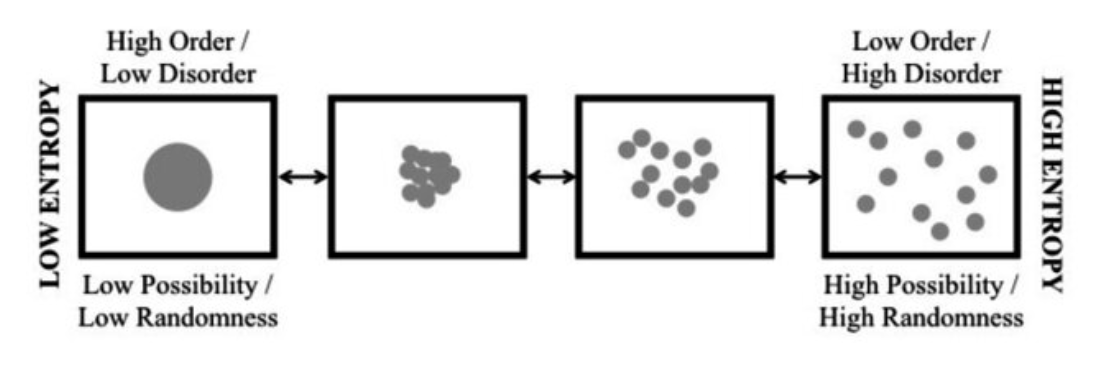
Figure 5.17. Eggs break but don’t unbreak

The second law of thermodynamics explains what the first law can’t, that what is in theory reversible, in practice isn’t. For example, running a video of the earth orbiting the sun looks much the same, but playing a video of an egg breaking in reverse evokes laughter. Yet by the first law, the events of egg breaking are as reversible as the earth’s orbit, so why doesn’t it happen? The second law answer is that order never increases in a closed system, so eggs can’t unbreak (Figure 5.17).

Entropy is how physics describes disorder or randomness, and Boltzmann defined it as the number of possible microscopic states that can produce a macroscopic state. By this definition, when a colored gas injected into an empty bottle spreads, entropy increases. The gas molecules begin concentrated at a point, but not many molecule combinations allow that, so entropy is low. Many more molecule combinations support the dispersed state, so it spreads out to increase entropy. Entropy then always increases or stays constant because disorder is more likely (Figure 5.18).

Figure 5.18. Entropy increases as disorder increases

In general, entropy increases because it is more probable, so gas injected into a bottle will probably spread over time, but its molecules could by chance all move back to a point. This is unlikely but possible, so the second law is a statistical law, based on probability, not a causal law based on a force. Objects don’t have to become more disordered, but in a constantly changing world they probably will. 

Disorder increases for the same reason that constantly shaking a bottle disperses its contents. Heraclitus compared our world to a river that is never the same from one moment to the next, as it is always changing. This Heraclitean flux arises from the quantum law of all action (3.6.3), that anything that can happen eventually does because quantum events explore every possibility, so nothing is static. The second law of thermodynamics then derives from the first law of quantum theory, so it is a universal law, but how then does order arise?

Next

QR5.6.2 What is Conserved?

We conclude that energy isn’t created or destroyed because we see it take other forms. For example, when road friction slows down a car, its tires become hot and radiate heat, so kinetic energy is seen to become heat energy, just as steam engines convert heat energy into kinetic energy. Energy is then observed to take different forms, but with one notable exception.

Lifting an object takes energy that dropping it releases, but where does it go to or come from? There is no heat flow so it is said to have potential energy based on its position in a gravitational field. This balances the energy books to conserve energy, but where is potential energy stored?

For example, if a rocket blasts off into an earth orbit, where did the liftoff energy go? If it then floats off into space forever, what stores that energy? Or if it crashes into Jupiter to release more energy than it took to leave earth, where did the extra energy come from? The current answer, that gravity gives and takes potential energy, assumes an unknown mechanism that invisibly stores and releases energy as needed. 

In this model, energy is the rate of transfer of processing by the quantum network. Light then has radiant energy because it is a process spreading, and high frequencies that spread at a faster rate have more energy. Radiant energy is conserved because photons always restart, as processing can.  

This approach can also explain kinetic energy. When light shining on a solar sail makes it move, radiant energy is converted into kinetic energy. If the sail moves by acquiring photons that bias its distribution, kinetic energy is also based on photons. When objects collide, kinetic energy is conserved because the photons exchanged are constant, and nuclear energy is also based on photons if matter is condensed light. Physical events then restart photons in various forms, as light or matter, but photons are conserved because they are immortal.

What then is potential energy? Potential energy is based on gravity, which Einstein concluded isn’t a force at all, so no energy is involved. Potential energy isn’t a form of energy but a way to allow energy to be conserved when actually, it isn’t. 

Current physics has many conservation laws, of matter, charge, momentum, isospin, and quark flavor, but each is partial, as nuclear reactions don’t conserve matter, and weak interactions don’t conserve quark flavor. The conservation of energy is now also a partial law because the expansion of space doesn’t conserve it, and it needs an invented (potential) energy to work. However the conservation of photons still works, as when a rocket leaves earth, no photons are lost, and when it crashes on Jupiter, no photons are created.  

Note that the expansion of space doesn’t affect the conservation of photons. When our universe began as a little rip in the quantum fabric (2.4.2), it created space and light by what physics calls inflation, until the expansion of space healed it. Since then, the number of photons that exist hasn’t changed because they never die, and space expanding doesn’t change that. Our universe conserves the light it came from but not energy, because it is still expanding. The first law of thermodynamics then isn’t universal, so is the second law the same?

Next

QR5.6.1 Is Energy Conserved?

Thermodynamics began as the study of heat machines like steam engines to increase their efficiency. The observation that the total energy of the machine remained constant gave the first law of thermodynamics, that energy is always conserved, and that energy always flows from hot to cold gave the second law, that energy always disperses. It followed that if our universe is a big machine, it will have a constant energy that constantly disperses.

The second law predicts that the energy of the universe will always disperse, to end up as maybe one atom per cubic light year, in a big freeze that will last forever, because:

“… eventually all these over densities will be ironed out and the Universe will be left featureless and lifeless forever, it seems” (Barrow, 2007), p191.

Yet according to big bang theory, our universe was once about the size of a tennis ball, that then expanded into what it is today, but this requires energy, just as blowing up a balloon cools the gas inside it, so our expanding universe must be cooling down. This cooling effect is illustrated by cosmic microwave background, which is early light that was once white hot but is now freezing cold. Space is still expanding, so every photon in the universe has a slightly longer wavelength today than it did yesterday, which means less energy. Expanding space is constantly taking the energy of light and not giving it back, so the total energy of our universe isn’t conserved.

Does this deny the principle of conservation of energy? Not necessarily, as if the universe isn’t a closed system, the laws of heat machines don’t apply. Our universe doesn’t conserve energy because it is expanding, so what is conserved? 

Next

QR5.6 Order And Disorder

Current science predicts that disorder always increases because thermodynamics requires it, so our universe should be pretty chaotic by now, but as Strogatz points out:

Scientists have often been baffled by the existence of spontaneous order in the universe. The laws of thermodynamics seem to dictate the opposite, that nature should inexorably degenerate toward a state of greater disorder, greater entropy. Yet all around us we see magnificent structures—galaxies, cells, ecosystems, human beings—that have all somehow managed to assemble themselves.” (Strogatz, 2003).

If disorder always increases, how did billions of years of increasing chaos produce the present order? If you woke up in a warm bed with an electric blanket, would you believe that mankind has been devolving since we lived in caves? It doesn’t make sense, so either the prediction is wrong or something else is operating.

QR5.6.1. Is Energy Conserved?

QR5.6.2. What Is Conserved?

QR5.6.3. Disorder is Probable

QR5.6.4. Order is Possible

QR5.6.5. Evolution Creates Order

QR5.6.6. Armageddon

Next

QR5.5.4 One Field For All

The unification of gravity, electricity, and magnetism has long been a dream of physics, but while virtual photons unified electricity and magnetism, virtual gravitons couldn’t explain gravity. Then, as the standard model invented particles to explain forces, the dream was lost, because one field couldn’t generate all its particles. 

But if the strong, weak, and Higgs fields are unnecessary inventions (4.5.3), the dream of a unified field theory re-emerges, as the fields to unify are again just gravity and electro-magnetism. This unification could be called the gravito-electro-magnetic field, but the quantum field is simpler.

What then is the quantum field? In simple terms, it is the quantum values that explain light and matter in quantum theory. Schrödinger’s equation describes how these values spread, but not why they collapse to a point in a physical event, however processing that overloads a network can do just that (restart at a point). This allows matter to be a standing wave overload that constantly restarts (4.5.8), with three different properties:

1. Mass. The net process value from +1 to -1 in one or more dimensions.

2. Charge. The net process remainder from +1 to -1 in one or more dimensions.

3. Spin. The process spin direction, which can be up or down for an axis.

Matter then spreads its existence around itself, like ripples in a bucket (Figure 5.15), because on this network, processing is always passed on. This affects the quantum field that sets these values throughout space and generates the physical world we see. For example, if its values are null, we see empty space, but if they are mass +1, charge -1, and spin ±1, we see an electron, and so on.  

Figure 5.15. A point standing wave spreads

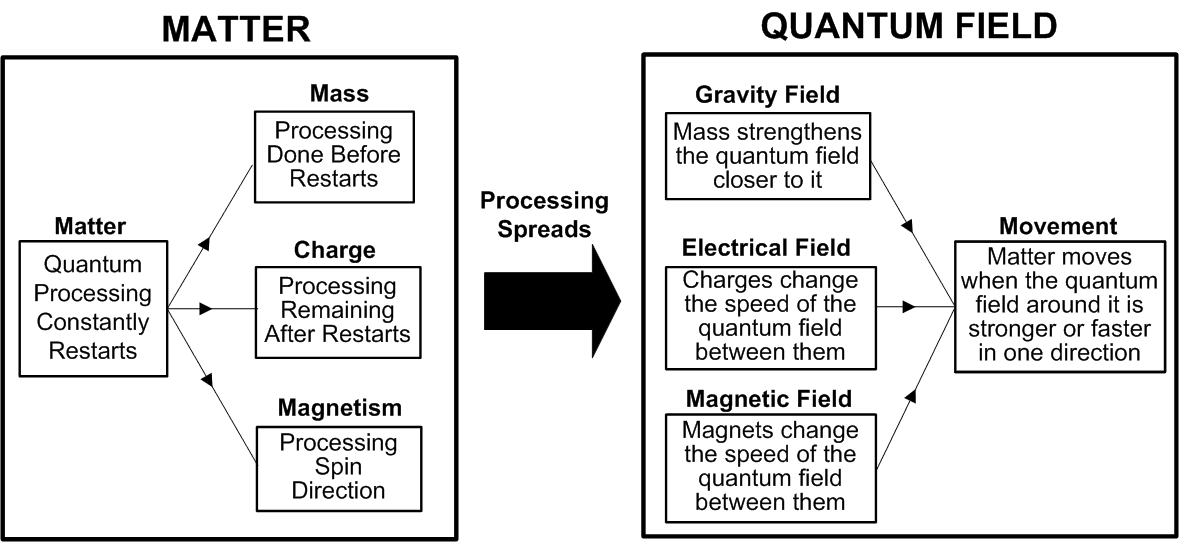
In Figure 5.16, the mass, charge, and magnetism of matter then spread into the quantum field around it. Mass strengthens the field closer to it, to cause a gravity field, charges speed up or slow down the field between them as remainders cancel or add, to cause an electrical field, and magnets also speed up or slow down the field between them, as spins make space deeper or shallower. 

The effect in all cases is that matter moves one way when the quantum field around it is stronger or faster that way, as even a small bias can give movement in our time. 

Figure 5.16 Gravity and electro-magnetism are one field

Matter doesn’t just sit there, but also spreads its mass, charge, and spin into the space around it, to cause the fields of gravity, electricity, and magnetism. These fields then all arise from one quantum field with three aspects, namely a net strength (mass), a net remainder (charge), and a spin direction (magnetism). One fundamental quantum activity causes all the fields of physics, including the strong and weak fields of the standard model (4.5.8), so matter can act at a distance despite Newton’s belief.

The above assumes that quantum theory is valid, as experiments confirm it is, while making it imaginary leads to the standard model’s many fields, so there can be field unification or particles but not both. The next section explores how the quantum field creates order as well as disorder.

Next