QR6.2.9 The Binding Problem

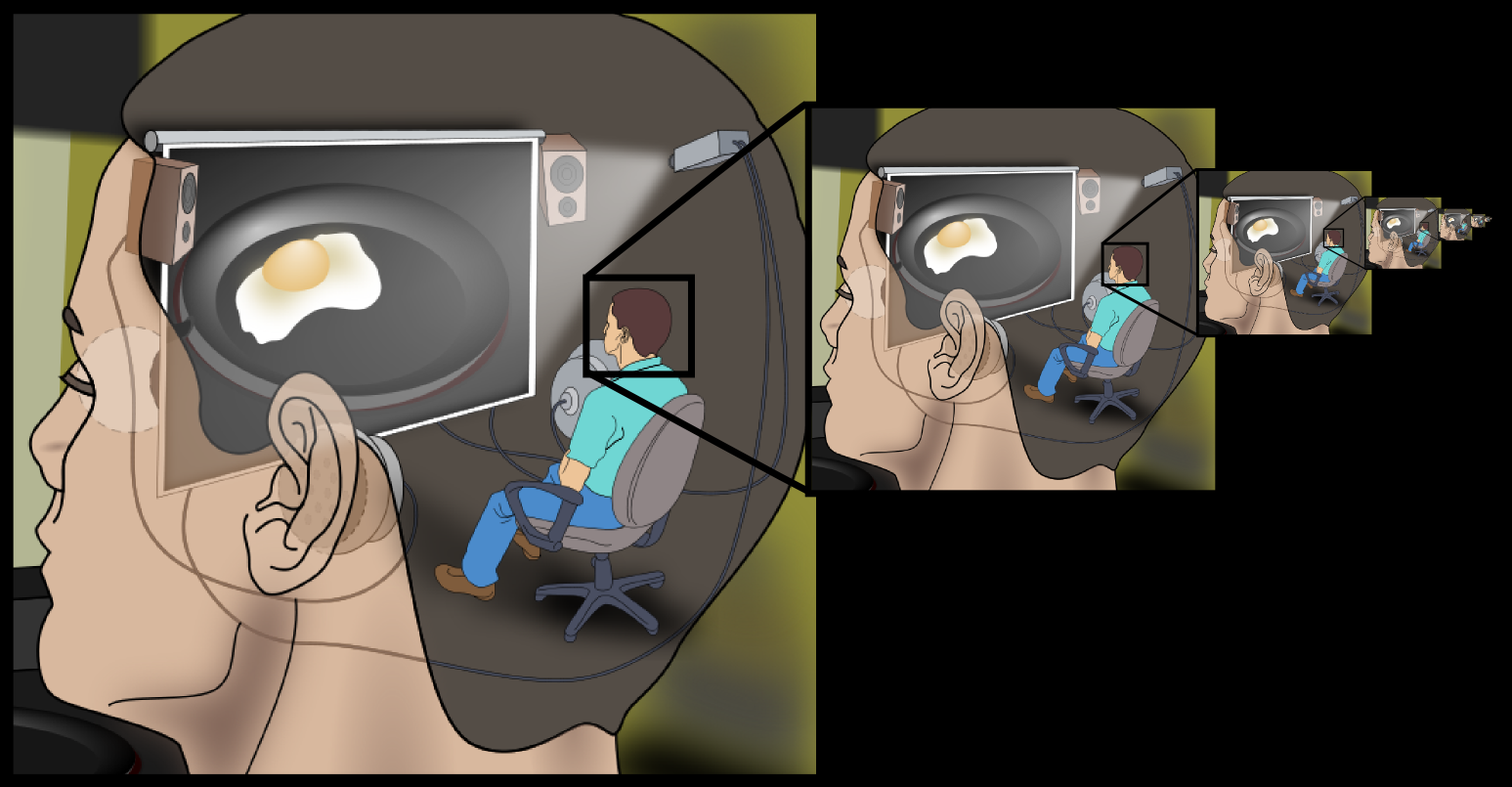
Figure 6.34 The idea of an “internal viewer” generates an infinite regress of internal viewers

Different brain areas analyze sight, sound, and smell data that other areas use in thoughts, feelings, and actions but how does all this activity bind together in one experience? Descartes explanation was that all sense data clears through the pituitary gland, that passes it to the mind, which is like a little man in the brain watching a movie. Yet by that logic, that little man would need another little man inside his head to also observe, and so on, in an infinite regress (Dennett, 1991) (Figure 6.34). That there is a little man in the brain is illogical, but physical realism isn’t much better, as it concludes that each neuron in the brain:

“… doesn’t ‘know’ it is creating you in the process, but there you are, emerging from its frantic activity almost magically.” (Hofstadter & Dennett, 1981) p352.

That nerves that can’t observe magically act and “there you are” is weaker than dualism. The mind-body problem of centuries ago lives on in neuroscience today as the binding problem:

One of the most famous continuing questions in computational neuroscience is called ‘The Binding Problem’. In its most general form, ‘The Binding Problem’ concerns how items that are encoded by distinct brain circuits can be combined for perception, decision, and action.(Feldman, 2013) p1.

The binding problem arises because distant processing hierarchies can’t just exchange data. They can’t “talk”, as global workspace theory claims (6.1.6), because when a visual cortex nerve fires to register a line, it doesn’t say “I saw a line” like a little person. It just fires a yes-no response like any other neuron. To bind that response to another feature like redness needs higher processing in the same hierarchy. At each step in the hierarchy, a nerve can fire to trigger a motor response, but it isn’t an experience because the nerve doesn’t know why it fired. The six-layered visual cortex can process lines, shapes, colors, and textures but the last nerve to fire in a sequence knows no more than the first. To integrate vision and smell needs a higher area to process both outputs but according to brain studies, this doesn’t happen.

Different areas evolved to process sight, smell, sound, thoughts, feelings, touch, and memory but no area evolved to integrate them all. If it had, the brain would be wired like a computer motherboard, with many lines to a central processor, but it isn’t. Each brain area is encapsulated, so smell, sight and sound brain areas can’t exchange any experiences they have with each other:

Because of the principle of encapsulation, conscious contents cannot influence each other either at the same time nor across time, which counters the everyday notion that one conscious thought can lead to another conscious thought … content generators cannot communicate the content they generate to another content generator. For example, the generator charged with generating the color orange cannot communicate ‘orange’ to any other content generator because only this generator (a perceptual module) can, in a sense, understand and instantiate ‘orange’.(Morsella et al., 2016) p12.

And even if higher processing tried to integrate all brain areas, it would be too slow, just as complex thought usually comes up with a witty retort after a conversation is over. Our brain can integrate perceptions with memory to drive motor acts in less than a second but if one hierarchy did this, it would take much longer. The binding problem is that brain activities combine in a way that its wiring doesn’t support, so our unified experience of senses, feelings, thoughts, and actions should be impossible.

Encapsulation predicts that the hemispheres can’t exchange data, so each only sees half the visual field. Yet cutting the nerves between the hemispheres doesn’t give a sense of loss:

“… despite the dramatic effects of callosotomy, W.J. and other patients never reported feeling anything less than whole. As Gazzaniga wrote many times: the hemispheres didn’t miss each other.” (Wolman, 2012).

   Why don’t split-brain patients know that the corpus callosum is cut? If the optic nerve is cut, we know we are blind, as no data comes from the eyes. If an injury cuts the spinal cord, we know we are paralyzed, as no data comes from the legs. But when the millions of nerves joining the hemispheres are cut, both carry on as before! Why doesn’t the verbal hemisphere report a loss of data? If it normally sees the entire field using the other hemisphere, it should report being half blind, but it doesn’t. It follows that it doesn’t report any missing data because there is none.

Instead of data loss, dividing the hemispheres just divides consciousness. One patient couldn’t smoke because when the right hand put a lit cigarette in his mouth, the left hand removed it, and another found her left hand slapping her awake if she overslept (Dimond, 1980) p434. Conflicts made simple tasks take longer – one patient found his left hand unbuttoning a shirt as the right tried to button it. Another found that when shopping, one hand put back on the shelf items the other had put in the basket. One patient struggled to walk home as one half of his body tried to visit his ex-wife while the other wanted to walk home. These extraordinary but well documented cases show that cutting the corpus callosum gives two hemispheres with different experiences and opinions about what the body should do.

   If the left hemisphere only analyzes data from the left visual field, our experience of a single visual field must arise in some other way. It is now proposed that the hemispheres synchronize their electromagnetic fields into one consciousness by means of the eight million nerves linking them (Pockett, 2017). The answer to the binding problem is then that consciousness causes integration not the reverse, where consciousness is the ability to integrate information to yield adaptive action (Morsella, 2005). 

QR6.2.8 Sharing Control

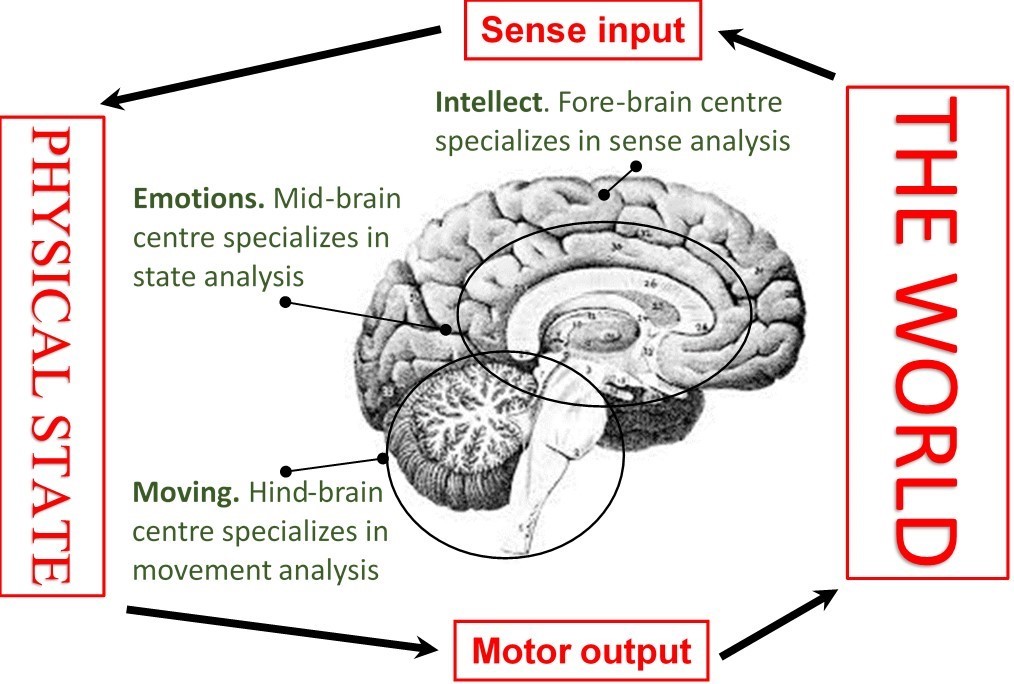
Figure 6.33 Three brain control centers

The human brain doesn’t have an instruction manual but if it did, it might stress that having many ways to control the feedback loop is a feature not a bug. Brains have to analyze sense input, body state and muscle output anyway, so three specialists survive better than one (Figure 6.33). If the brain had only one control center, it would be the hindbrain that matured first not the cortex that came later. This division lets the movement center manage movement details, the emotional center manage feelings, and the intellectual center manage thoughts. But our brains must use the right specialist for the job to succeed.

In Figure 6.33, the forebrain that receives muscle input is next to the motor nerves for those muscles, like a single input-output gate. In fish, the cerebellum used this gate to run the brain-world feedback loop, with data from the still evolving forebrain and midbrain. In birds and mammals, limbic control can override the cerebellum, which still managed fine motor control. In later mammals like us, the neocortex became independent, but its control of emotions and instincts is often quite limited.

The result is a brain with not one control-center but three. Each center monitors body and sense input with its own neural connections, and does what it decides is best. Evolution has given us a brain with super-fast movement, powerful emotions, and complex thoughts, because different situations need all three. This isn’t easy because the centers can’t “talk” to each other as people do. They all speak different “languages” because millions of years of evolution separate them.

For example, people with a spider phobia can discuss their fear intellectually and accept that a little harmless spider isn’t a threat. They have all the data needed for a non-fear response, but putting that spider on the table still makes them jump up in fear! The emotional center ignores talk but an actual spider makes it press the red danger button. And if during the conversation an object fell from a shelf above, the moving center might catch it before the intellect can recognize it. Different brain centers are too busy constantly analyzing external events to talk internally.

Each center must learn independently. For example, falling on a hard surface is a common cause of injury in old people. It happens so fast that what the brain does in a fraction of second decides whether we end up injured or just get back up. The intellect is too slow to act in time and an emotional center panic isn’t much use, as a muscle spasm can injure bones or joints more than the fall itself. In most cases, its best to relax and let the movement center manage the fall, as parachutists do. This is easy to say but it takes a lot of practice to learn. 

The three-in-one answer that evolved from the early forebrain-midbrain-hindbrain division gives us fast responses, powerful emotions, and complex thoughts. The traditional idea of human nature as intellect, emotions and will derives from this early neural division of labor. The three-center approach to the brain can be illustrated by a story:

Once upon a time there were three brothers who flew a tiny plane. Elder brother handled the flight controls, middle brother monitored the cockpit knobs, and baby brother looked out the window to see what was out there. Eventually, by delivering goods in the city to earn money, they managed to buy a jet plane for intercity travel that had knobs to automate landing, takeoff, and flight among other things. This meant that middle brother was more often in charge but elder brother still monitored the controls to make fine adjustments and took over in emergencies. Middle brother had a thrust button for more power but he had to use it at the right time. As little brother grew older, he used what he called ‘symbols’ to record events on bits of paper but the others just used his spotting ability.

Intercity travel made more money, so one day they bought an intercontinental jet with state-of-the-art computer controls. Elder brother preferred his manual controls and middle brother liked his dials and knobs but younger brother preferred the computer screen to paper. It took longer but he could control the plane with it and even send messages to other planes. His older brothers were too busy to talk in flight, so he would demo a new flight technique by computer control and they picked it up if useful. 

Their plane was constantly being upgraded. At first, elder brother used a simple dot radar to avoid colliding with other planes. When a radar with pictures instead of dots was installed, he found it too complex for manual flying but middle brother used it to identify friend from foe. When computer radar arrived, the first two found it complex and slow but little brother used it to analyze trends and causes. Over time, the brother’s plane dominated the airways because three pilots are better than one if each does what they are good at.

Our brain has three centers just as cars have different gears for different situations, but why do we experience one driver? All that neuroscience knows about the brain, from blindsight to the split-brain, suggests many “I”s not one. Our sense of “I” implies that nerve input goes to a center that then directs all motor nerves, but neuroscience assures us that this isn’t so:

In contrast to this first-person experience of a unified self, modern neuroscience reveals that each brain has hundreds of parts, each of which has evolved to do specific jobs – some recognize faces, others tell muscles to execute actions, some formulate goals and plans, and yet others store memories for later integration with sensory input and subsequent action.(Nunez, 2016) p55.

This issue, of how different brain areas work together, is called the binding problem.

Next

QR6.2.7 The Intellectual Center

The human cortex handles higher abilities like language that set us apart from other species. While the cerebellum packs 80% of the brain’s neurons into 10% of its mass, the cortex needs 80% of the brain’s mass to support 20% of its neurons, because they are larger and have more support cells. It is a folded sheet, 2-5mm thick, with six layers, while the midbrain hippocampus only has three layers. It was the last part of the brain to evolve and is the last to mature in children. If other centers ran the feedback loop before it, how can it take control? The answer, it seems, is with difficulty.

Piaget concluded that the human intellect develops in four distinct stages:

1.               Sensorimotor (0 to 2): Babies and toddlers think in sensorimotor terms.

2.               Preoperational (2 to 7): Children begin to think symbolically and learn language.

3.               Concrete operations (7 to 11): Children think logically about concrete events.

4.               Formal operations (12+): Abstract thought emerges.

The cortex can’t act independently until over 12 years old and it continues to mature into the mid-twenties, as the ability to think increases.

In the sensorimotor stage (0 to 2), the moving center controls activities like reaching so it also tries to speak. Hence, language begins as babbling, as babies form sounds to match the speech that they hear in the first year. Babble can sound just like speech, although no words are known yet. The moving center tries to talk as it learns to walk – by just doing it. Before an infant says its first word, at about one year, it knows all the phonemes needed for speech, including intonations. The midbrain isn’t mature enough to lay down memories until two or later, so before that we have childhood amnesia, a period we can’t remember because the midbrain couldn’t lay down long-term memories. The same occurs in animals for the same reason (Feigley & Spear, 1970).

In the preoperational stage (2 to 7), the emotional center increases control of behavior, to make us emotional beings who think everyone sees the world as we do. A five-year-old asked what is in a chocolate box will say “chocolates” until shown it contains pencils. If then asked what another child will think is in the box, they say pencils not chocolates. They can’t imagine how others see the world yet and so have no empathy.

While the emotional center is in charge, the developing intellect produces egocentric speech, where the child keeps up a running commentary on what they do, even when alone. At first they comment after an action, so a four-year-old child may stroke a teddy bear then say “Good boy”, but at five the same child says “Good boy” as they stroke it, and at six they say it first then stroke it. It is as if a part of the brain is first observing what is happening and making after-the-fact comments, then making current comments, and finally predicting what will happen. Egocentric speech is the child’s growing intellect expressing itself out-loud to the rest:

One area of the brain and mind may initiate a behavior, which is witnessed or experienced by other (disconnected) brain areas, only as it occurs outside the brain and body.(Joseph, 2017a) p442.

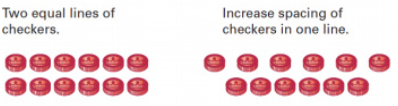
Figure 6.30 Conservation of number

In the concrete operations stage (7 to 11), the intellect learns to apply thought to concrete things. A child under 7 may think that spacing out checkers in a line increases their number, but by 9 they know that number is still conserved (Figure 6.30). Yet they still struggle to reason abstractly.

Not until the formal operations stage at about twelve does the intellect manage to think abstract ideas. Prior to this, we learn in a formatory way, by memory associations not logic. Children under 12 can rote learn dates for a history exam but struggle with abstract mathematics. As the intellect matures, it can change from backward thinking to forward thinking, from finding reasons to justify conclusions already held to forming new conclusions by analyzing agreed facts.

Backward thinking is people cherry-picking the Internet for facts to confirm preconceptions while forward thinking is the scientific method. Formal operations let children think scientifically, but it still takes another decade to do it routinely. Western science began when Socrates started to think forwards but two thousand years later, we still struggle to follow his example because thought hurts! For example:

Bob rides his bicycle to pick up his motorbike from the repair shop at 10 mph. How fast must he ride his motorbike back to average 20 mph for the whole trip?

Emotional thinking suggests 30mph but using the intellect shows that is impossible.

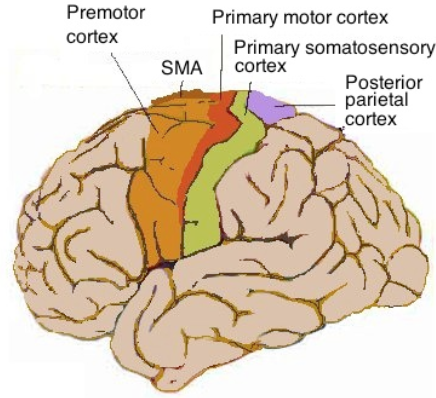
Figure 6.31 The Motor Cortex

Does the cortex control the feedback loop as it matures? It has the nerve links to do so as the sensorimotor cortex (Figure 6.31) maps to body muscles based on importance (Figure 6.32)

A voluntary act, like raising the hand, occurs when the frontal lobe directs the supplementary motor area (SMA) to prepare the movement and tell the motor cortex to do it. The SMA activates even at the thought of moving, long before muscles move (Nachev et al., 2008), suggesting to some that:

… the “will” to move begins in the SMA and medial frontal lobes and exerts executive control over the secondary, primary and subcortical motor areas which then perform these “willed” actions.” (Joseph, 2017b) p151

The author concludes that: “The frontal lobes serve as the ‘Senior Executive’ of the brain …(Joseph, 2017b) p138, but how can two frontal lobes have one will? The brutal fact of neural science is that multiple systems drive bodily actions:

 Figuratively speaking, the skeletomotor output system is akin to a single steering wheel that is controlled by multiple drivers …” (Morsella et al., 2016) p6.

Figure 6.32 The motor cortex map

The frontal lobes can initiate muscle movement but so can other brain centers. The cortex has voluntary muscle control but its ability to coordinate a successful golf swing is close to zero. It also struggles with emotional urges, as when we plan to eat less by dieting, we can deny one cake but to always do so takes more than intellectual “will”. Like the triumvirate of Rome, at least two of the three control centers must agree for a long-term plan to work. The ideal for our brain isn’t some sort of neural dictatorship but for its centers to share control in a balanced way.

Next

QR6.2.6 The Emotional Center

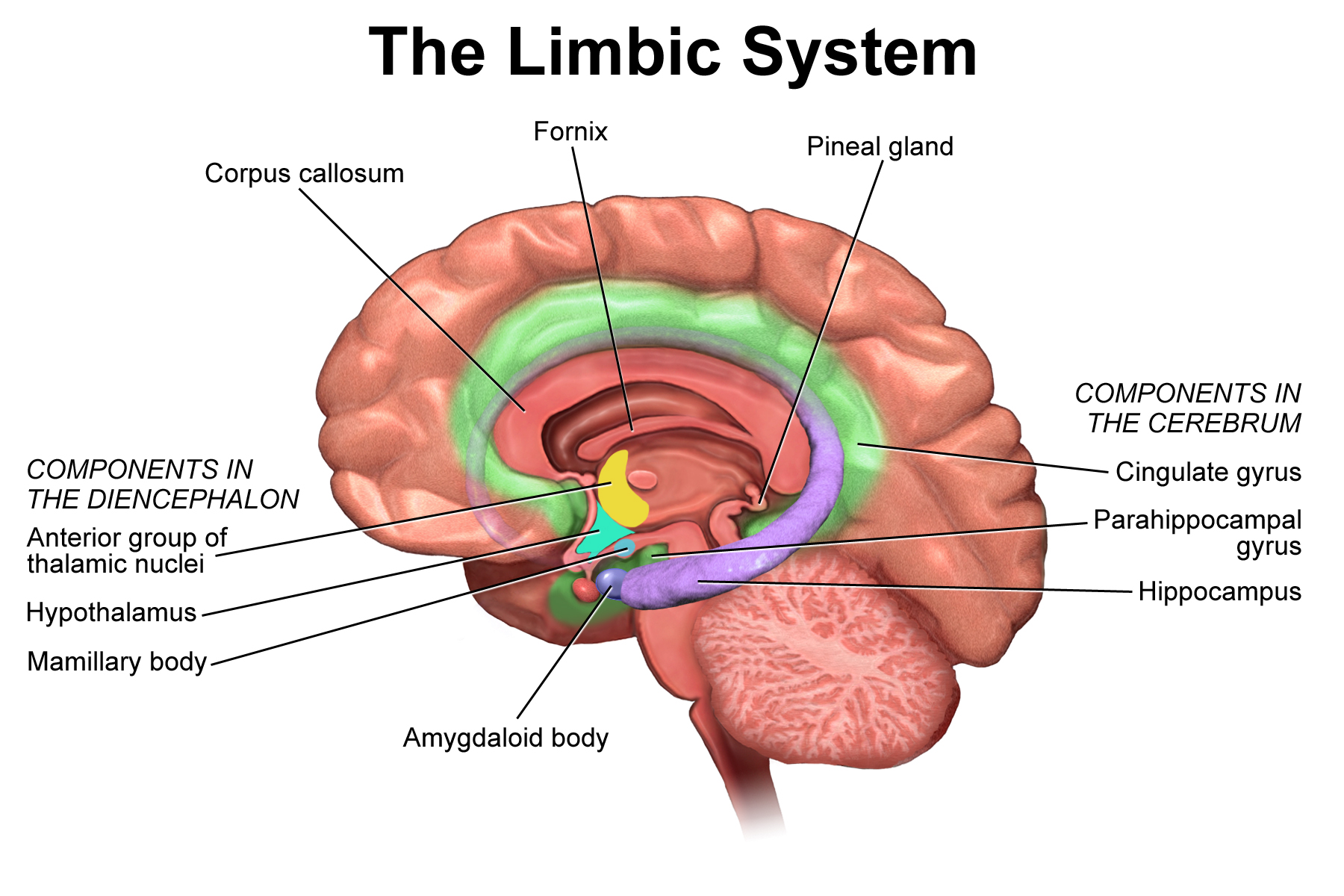
Figure 6.28 The Limbic System (Blausen.com staff, 2014)

The midbrain section of the neural tube that human brains develop from grows to become what has been called the limbic system (Figure 6.28), which is generally described as including the:

·      Thalamus. A sensory relay station for sight, sound, and touch input.

·      Hypothalamus. Connects to the peripheral nervous system that controls body states.

·      Hippocampus. Acts to lay down memories.

·      Amygdala. Analyzes sense and body state input to generate emotions.

·      Cingulate gyrus. Links to the cerebral cortex.

These structures handle emotions, motivation, and memory in humans and other animals in ways that are still being understood but clinical studies give some clues. Hippocampus damage can result in amnesia, the inability to recall memories or lay down new ones. Cingulate gyrus damage is involved in depression and schizophrenia. Amygdala damage reduces the ability to process emotions based on facial and other signals, and is a neural marker of autism. The hypothalamus links to the peripheral nervous system, a second brain of a 100 million nerves outside the head that handles body hormones and digestion. The limbic system then relates body states to sensory situations, lays down memories of them, and generates emotions that motivate behavior, so it can be called a feedback control center in its own right.

Figure 6.29 Short and long emotion routes

Locus of control theory expects the midbrain to be a state control center, with its own sensory-visceral input, learning, and memories, that can initiate emotions to affect behavior. Thus while hindbrain muscle memory remembers motor tasks like riding a bicycle, midbrain memories can consciously recall past events like whether we left a stove on. This episodic memory includes time and space tags and our feelings at the time, so remembering a funeral can re-experience its sadness. The past event timeline of midbrain memories allows emotional learning that links situations to good or bad consequences, to allow cause and effect conclusions. 

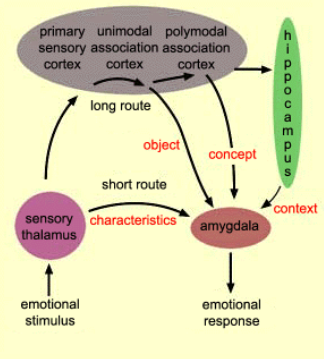
Like the hindbrain, the midbrain limbic system has its own dedicated nerve paths, so it can react to facial data in less than a tenth of a second by a subcortical visual path before the cortex can respond (Adolphs, 2008). Sense data from the thalamus goes direct to the amygdala by a short route, as well as taking a longer route to the cortex (Figure 6.29), so the amygdala can initiate emotional responses like sweaty hands, dry mouth, and tense muscles before the visual cortex can identify seen objects. The thalamus still passes data to the cortex for a more complex but slower decision, but the two paths are separate. Like the hindbrain, the midbrain has its own neural links, that evolved long before the cortex developed the ability to think, which it can use to initiate responses.

The limbic system also has its own space, different from the cerebellum. The hindbrain provides a navigational map based on vector directions and distances between key points, but the midbrain map provides a visual record of location details, including what is there, when it was accessed, and the likely benefits or dangers. Two maps are better than one, so navigation maps help hunters in featureless terrains like deserts and oceans, while location maps help food gatherers remember what is where, and when it is available. This midbrain map provides the details needed to return to a point in space (O’Keefe & Nadel, 1978), to let birds like nutcrackers hide about 30,000 seeds at locations over a 200 square mile area and still recover them six months later.

The limbic system then isn’t a brain that takes over but an emotional control center, just as the cerebellum is a movement control center, so they operate in parallel rather than overlay. For example, the hindbrain can initiate a fight response that the midbrain prepares the body for, or the midbrain can initiate a desire to flee, which the hindbrain then responds to. Each represents the world differently, as one reveals what we can do, based body position and its response options, while the other reveals what we want to do, based on past exeriences and what the body needs.  

However if the midbrain directs emotional responses, what then is an emotion? An emotion is a neural representation of reality in body terms generated by the limbic system. For example, fear is the experience of increased heart rate, breathing, adrenaline, blood pressure and blood sugar that accompanies a fight or flight response. Over millions of years, this response to threat was passed on because a body prepared for threat survives it better.

The amygdala interprets facial expressions like anger by emotional learning (Hooker et al., 2006) but also responds to any sensed danger, so an odd smell or an insect crawling on the skin can create a fear response that prepares the body for action. Just as the hindbrain represents reality by schema, and the cortex by thoughts, so the midbrain represents reality by emotions.

Fear isn’t the only emotion, as limbic states support survival in general. Emotions like lust, anger and greed are now primitive urges to be avoided but even today, anger is useful to fight an enemy, lust helps continue the species and greed ensures that surplus food isn’t wasted. Dependence is inappropriate for an adult but it keeps a child by its parents for protection and even laziness has value, as an injured animal should rest and recover. All emotions have survival value in the right situations, as they relate to biological needs.

Emotions, a body-state tool kit that can be tailored to situations based on experience, were a big evolutionary advance at the time. All the emotions we now call negative were useful in evolution and still are, if used correctly. A toolkit is only negative if the wrong tool is used, as if a carpenter uses a hammer to shorten a plank not a saw, it isn’t the toolkit’s fault. 

Movement center memory knits sensations into a motor schema but emotional memory lets us base present acts on past experience to allow projection, assessing another’s intent based on what I would do. Many birds cache their food to hide it for use later, but when they see another bird watching them hide food, they return later to re-hide it (Clayton et al., 2007). This ability to understand another’s intent allows empathy, the ability to feel what another feels, a vital component of the emotion we call love.

Doing something is usually better than doing nothing but if a predator is nearby, it’s often better to stay still. For the emotional center to respond to threat by keeping still, it must override the tendency to move, so if a mammal sees a predator, the instinct to run away is stopped by the emotion of fear. When fear freezes an animal in its tracks, the amygdala activates its connections to the brainstem and cerebellum (Ressler, 2010). Mammals have this paralysis by fright response but fish don’t. An emotional center that can suppress hindbrain movement sets the stage for the evolution of cortical control, in the next section.

Next

QR6.2.5 Locus of Control Theory

Figure 6.24 Embryo brain divisions

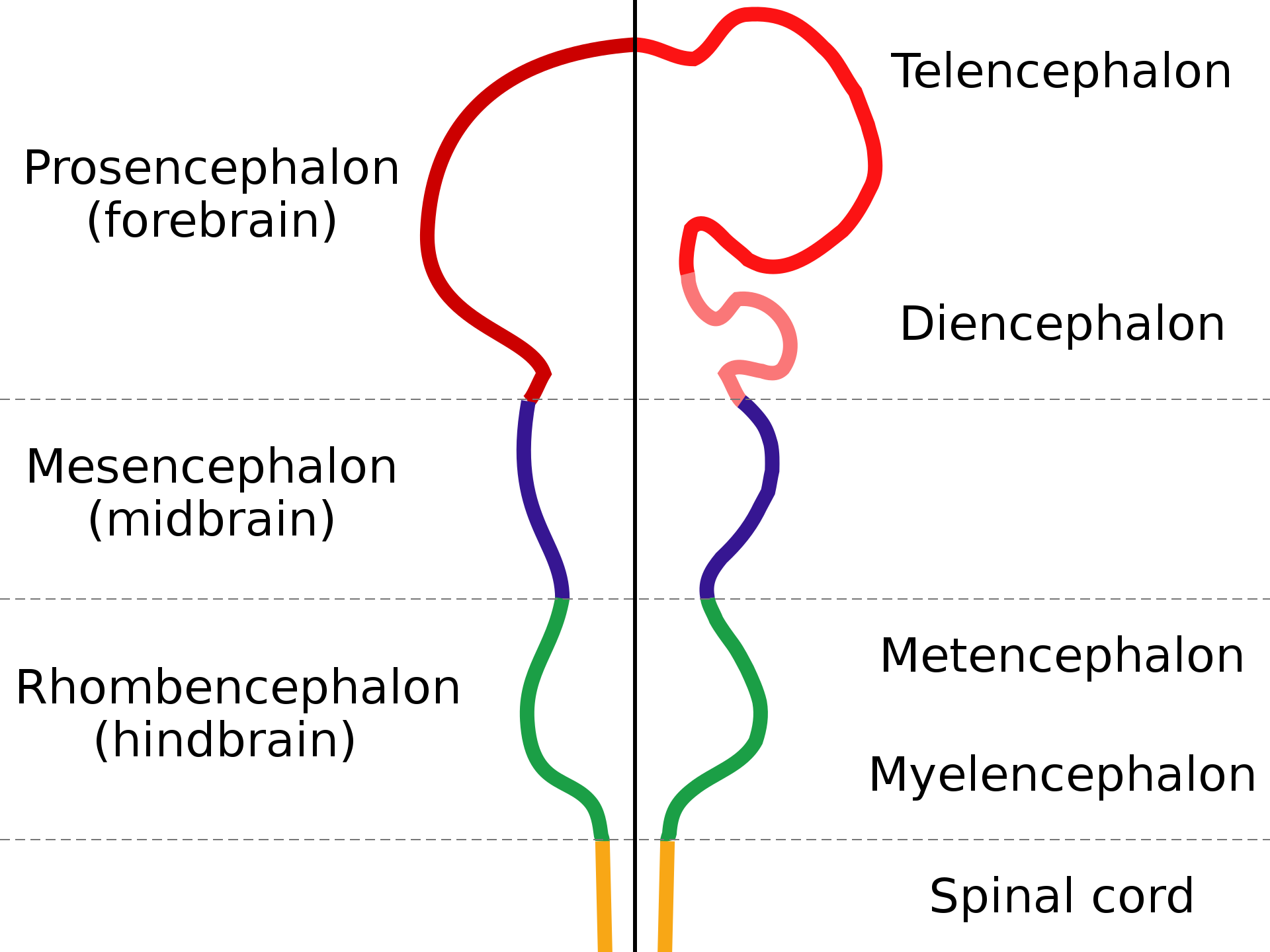
The human brain grows from a neural tube whose top, middle, and rear areas become the forebrain, midbrain, and hindbrain respectively (Figure 6.24). They then specialize in three basic brain functions:

       1. Input. What is out there? (forebrain)

       2. State. What is the body state? (midbrain)

       3. Output. What actions can be done? (hindbrain)

Life requires all three, as animals must sense food or danger, know if the body is hungry or tired, and direct actions like biting or chewing, to survive. If early growth follows the same path as evolution, brains began as simple neural tubes that then specialized in analyzing sense input, evaluating body state, and directing muscle activity, so our brain has a cerebrospinal hindbrain, a limbic midbrain, and a cortical forebrain.

Figure 6.25 Brain processing centers

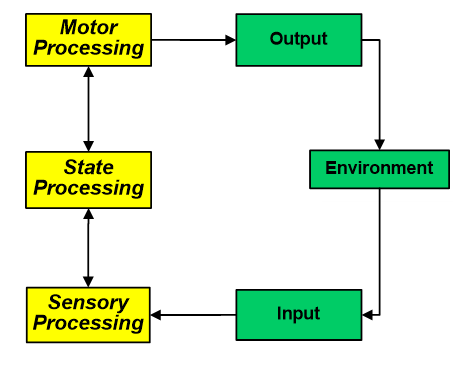
An engineer might design a feedback system to analyze input, assess internal state, and direct responses then add a control center but evolution doesn’t design ahead, so it just evolved three functions in parallel and didn’t bother with a control center. The basic brain-environment feedback loop then runs through three processing centers that specialized in sensory, state, and motor processing, as shown in Figure 6.25, any of which can drive the loop.

Locus of control theory is that the hindbrain, midbrain, and forebrain all evolved to control the feedback loop, so its locus of control can change as individuals evolve, grow, or live. The evolutionary advantage is flexibility, as what directs the body can shift as circumstances require to allow:

1. Sensory control: Based on sense input patterns.

2. State control: Based on body state feelings.

3. Movement control: Based on sensorimotor patterns.

Hence in life, an animal can respond differently according to the feedback locus of control. For example, given a chance to bite, it might do so under movement control, or it might freeze in place from fear under state control, or it might ignore the situation because sensory analysis suggests that there is no danger. Our brain then isn’t three overlaid sub-brains as Triune theory proposed, but three feedback-control centers, any of which can control behavior by itself alone. 

Figure 6.26 The fish brain 

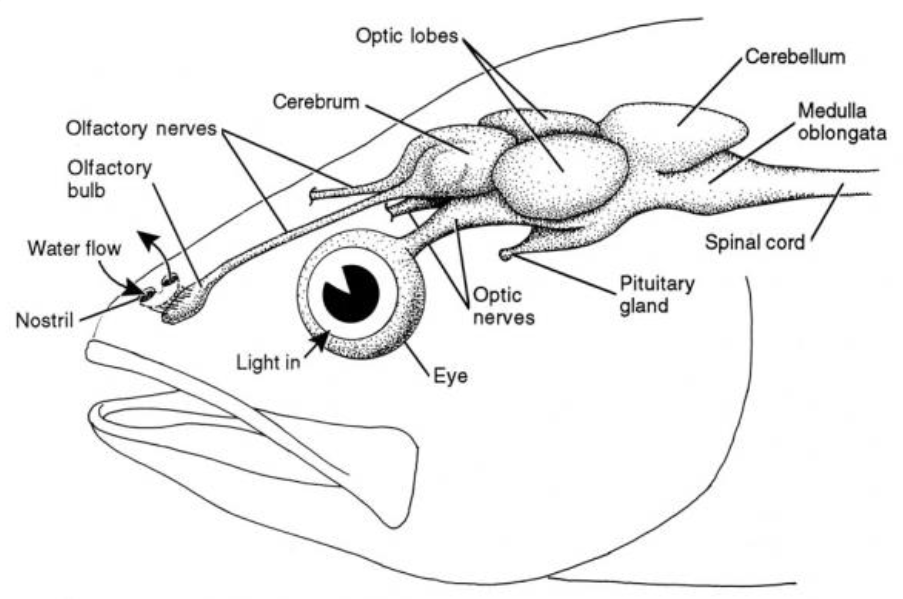
Fish brains are then partitioned as ours are, as they have forebrain optical and olfactory areas to process sense data, a midbrain amygdala and pituitary to manage endocrine tasks, and a hindbrain cerebellum to direct movement (Figure 6.26). All three functions exist, but the fish cerebellum is far more evolved than its cortex (Montgomery et al., 2012), so it can control the feedback loop using data from the more primitive forebrain and midbrain. This is possible because the cerebellum projects excitatory and inhibitory nerves to the motor cortex, even in humans (Daskalakis et al., 2004).

The hindbrain control center then advanced before the other two because in evolution, actions are more critical to survival than sensations. It is better to act blindly than to see but be unable to act, so single-celled protozoa evolved the ability to move before they could see. Human embryo growth supports this conclusion, as motor nerves develop before sensory ones, so babies in the womb kick long before their eyes start working.

Figure 6.27 The hindbrain

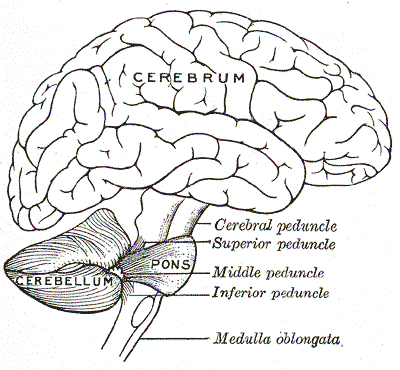
Locus of control theory suggests that as brains evolve or grow, the hindbrain runs the feedback loop while the midbrain and forebrain develop. In humans, the hindbrain bulges out from the base of brain as the cerebellum (Figure 6.27). The cerebellum doesn’t look big but it actually contains more nerves than the rest of the brain put together! Its two cross-linked hemispheres are about 80% of all nerves, so some call it the little brain. People with cerebellum damage struggle with walking, reaching, speaking, gaze, and balance, and their staggered walk, poor eye-control, slurred speech, and other features makes them appear drunk. They lose the hindbrain ability to handle fast sensorimotor sequences, so when a gymnast does a back-flip on a balance beam, it is managed by the super-fast processing of the hindbrain, not the slower motor cortex.

Our brains then contain a movement control center that once ran the body entirely, so can it still do so today? When we sleep, parts of our brain shut down to allow recovery but in parasomnia, people sleepwalk, to get up, walk, eat, and even cook a meal. In one case, a sleepwalker got up, rode her motorbike for 20 minutes, returned and parked it, then went to bed to wake up later with no memory of it at all. How then can sleepwalkers carry out complex tasks while still being largely asleep? Locus of control theory proposes that while the cortical and midbrain systems that govern rational thought and memory were dormant, the hindbrain woke up to control the body using sensorimotor connections that it evolved long ago. Clearly sleepwalking isn’t just reflexes, as cooking a meal and riding a motorbike are purposeful acts that use tools and navigation. 

But how can the brain navigate if the visual cortex is dormant? Monkeys with no visual cortex can’t discern a circle from a triangle, as expected, but still move around like normal monkeys using vision (Humphrey, 1992). Humans also exhibit this blindsight, as people with visual cortex damage report seeing nothing but can still catch a ball, or insert a coin into a tilted slot whose angle they say they can’t see (Goodale & Milner, 2004). Hence if cortical vision fails, the hindbrain can still navigate in space by what is called implicit perception (Hannula et al., 2005), so the hindbrain has its own sensory input paths distinct from the midbrain and forebrain.

If advanced systems fail, older ones take over, so subjects who can’t speak due to cortical damage can still swear and sing! Amnesic patients given the same jigsaw every day say: “I have never seen this before” but still solve it faster each day, so these older systems can also learn. For example, tasks like riding a bike are done badly by the voluntary motor cortex become until they automatic, and then they are easy. Essentially, the cerebellum learns a sensorimotor schema to ride a bike and remembers it, so when you get on a bike, it triggers to control movement and balance, like a sort of autopilot.

Note that the cortex doesn’t control the cerebellum but just lets it act, just as when driving we let a car’s automatic transmission monitor events and change gear as needed. How then do we know if we remember how to ride a bike if it is unconscious? The only way is to get on one and push off, and let the cerebellum take over to handle the body and balance as only it can. The hindbrain is then a movement control center with its own dedicated sensorimotor input-output, learning, and memories, that can act independently if needed because long ago, it was the senior brain system. Other parts of the brain can interfere with it, but they can’t do what it does, and have no need to.

We tend to forget that the evolutionary path to our brains was long and arduous. For example, in infant swimming, babies instinctively hold their breath underwater thanks to a diving reflex, and move their arms and legs to propel them through the water by an amphibian reflex that flexes same-side hip and knee kicks. These instinctive actions disappear later, as the child learns to swim as people do, by moving limbs alternately. That babies swim like frogs but lose the ability after four months suggests that our brain retraces its evolutionary ancestry as it grows.    

   To call the hindbrain primitive because it isn’t conscious is like calling a jet engine primitive because it has no video feed, when given what it does, that’s unlikely. Just as modern jets have the latest engines, our brain has the latest movement control that evolution can provide, so we don’t have an old reptile brain but a state-of-the-art movement center. It acts implicitly without fuss, so it’s easy to ignore, but the midbrain emotions of the next section are anything but unseen.

Next

QR6.2.4 Feedback Loops

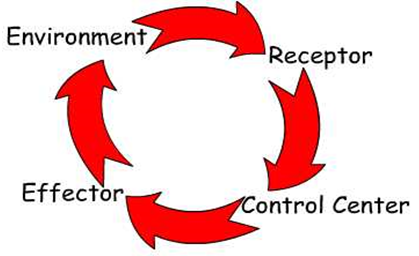
Figure 6.20 The Basic Feedback Loop

A brain that analyzes input but can’t affect output doesn’t help survival, as an eye seeing danger isn’t useful if the muscles don’t move the body away from it. Given that every creature is in a basic feedback loop with its environment (Figure 6.20), the brain must control this loop to survive. but last century psychology split into two camps on the issue of what controls the feedback loop:

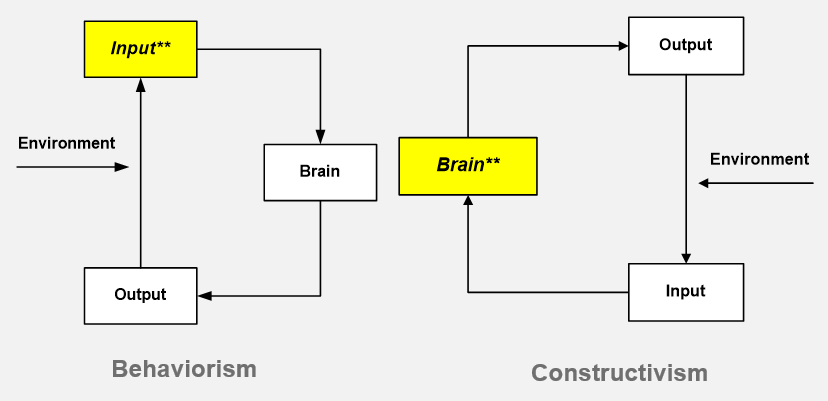
a. Behaviorism argued that people are machines driven by outside events, so stimuli and responses entirely define the loop and what the brain does.

b. Constructivism argued that the brain controls the loop by actively constructing reality, hence it can produce more sentences than we could ever learn from stimulus-response associations (Chomsky, 2006).

Figure 6.21 Behaviorism vs Constructivism

They differed on what controls the basic feedback loop, as in behaviorism it was driven by input but in constructivism, it was driven by the brain (Figure 6.21). Since a circular process can be initiated by a choice at any point, logic lets both be true, so the loop can be driven by external events or by brain events. Behaviorism then just reinvents Newton’s mechanistic universe, as did Dawkin’s selfish gene (5.7.2), and Crick’s pack of neurons (6.1.1). However biological evolution requires choice, and in psychology learning requires it, so brains must control the feedback loop to learn or evolve.

The brain isn’t input-driven as computers are but both face similar problems when they update. For example, when Microsoft upgraded the DOS operating system to Windows, it just replaced it, so decades of user learning suddenly became obsolete, as copying files by complex commands like xcopy now just needed a simple mouse drag and drop. If nature worked like this, the mammal brain would have replaced the reptile brain, making it obsolete, along with hundreds of millions of years of evolutionary experience!  

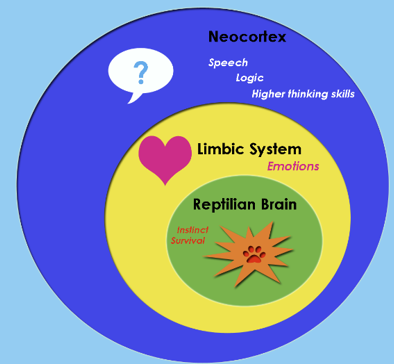
Figure 6.21 The Triune Brain Model

That nature doesn’t discard advances but builds on them led an American Institute of Mental Health physician to propose Triune theory, that our brain is a reptile brain overlaid by a mammal brain overlaid by a human brain (MacLean, 1990) (Figure 6.22). He linked the reptile brain to the hind-brain cerebellum, the mammal brain to the mid-brain limbic system, and the human brain to the neocortex of higher thought. Autism was then just the reptile brain taking over, and anxiety was the mammal brain taking charge. In this view, evolution first evolved a reptile brain to handle movement, then a mammal brain to handle emotions, and finally a neocortex for human thought, so our brain was three brains in one, each overlaying the last.

The triune brain explained autism and animals, so Temple Grandin, an authority on animal psychology who is also autistic, wrote:

To understand why animals seem so different from normal human beings, yet so familiar at the same time, you need to know that the human brain is really three different brains, each one built on top of the previous at three different times in evolutionary history. And here’s the really interesting part: each one of those brains has its own kind of intelligence, its own sense of time and space, its own memory, and its own subjectivity. It’s almost as if we have three different identities inside our heads, not just one.” (Johnson & Grandin, 2006).

However the triune model was rejected by biologists because evolution doesn’t deposit layers like geological strata, so as one critic put it: Your brain isn’t an onion with a tiny reptile inside. Evolution didn’t build a reptile brain, then a mammal brain, then a human cortex because it isn’t a linear production line. Nor did it add new brains without precedent, as bat wings are modified forelimbs that existed before, so even reptiles have a primitive cortex that lets them care for their young and solve problems (Patton, 2008).

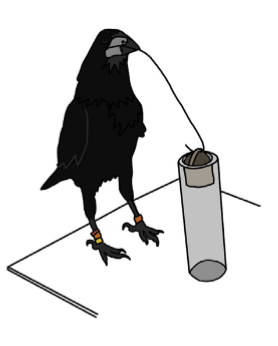
Figure 6.22 Crow tool use

Triune theory also didn’t explain how warm-blooded birds evolved from reptilian dinosaurs over millions of years. Birdbrain is a term of ridicule but they aren’t dumb, as crows can bend a wire into a hook to get food their beak can’t reach (Weir et al., 2002) (Figure 6.23), while children can’t use tools like this until about eight, and even then only half succeed (Cutting et al., 2014). Birds then are more like feathered apes than reptiles. For example:

 On a university campus in Japan, crows and humans line up patiently, waiting for the traffic to halt. When the lights change, the birds hop in front of the cars and place walnuts, which they picked from the adjoining trees, on the road. After the lights turn green again, the birds fly away and vehicles drive over the nuts, cracking them open. The birds wait patiently with human pedestrians for a red light before retrieving their prize. If the cars miss the nuts, the birds sometimes hop back and put them somewhere else on the road.” (Earthfire Institute).

Birds then are smart, but while the mammal cortex is folded, their cortex is smooth because it evolved differently (Jarvis & et al., 2005). Evolution then wasn’t just building a human brain, but rather bird and mammal brains evolved from the basic reptile design by different paths, that later converged to achieve equivalent functional benefits (Lefebvre et al., 2004). Triune theory doesn’t allow this, as it proposes that the hind, mid and forebrains evolved in sequence, so an alternative that allows them to evolve simultaneously is now explored.

Next

QR6.2.3 Hierarchies

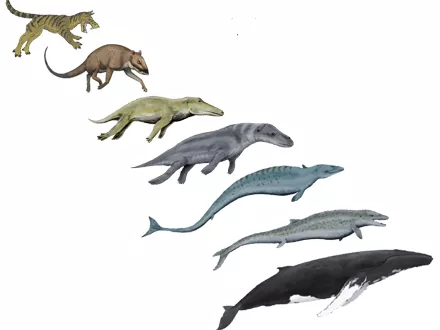
Figure 6.9 Evolution is Gradual

Evolution develops forms gradually over time, in a step-by-step fashion (Figure 6.9), so brains had to evolve by a long series of modifications pruned by natural selection. This descent with modification is known to produce modular hierarchies (Gao, 2025), as regions of the brain fine-tune to a function by increasing their internal connections, and older structures aren’t discarded but become the foundation for later developments. 

Motherboards are first designed then built, but nature had to in effect design as it built, so it produced one module, tested it for a few million years, then added another on top of it. The evolutionary advantage was less risk of functional failure, as adapted modules could operate while others evolved. Module hierarchies let evolution make brain design decisions one at a time, giving common ancestors that led to the next step.

A transistor can’t grow into a motherboard, but a cell can grow into a brain because evolution found the way, and embryos follow that path as they grow. In growth and evolution, the brain hierarchy started with one cell, the neuron, so we begin there. 

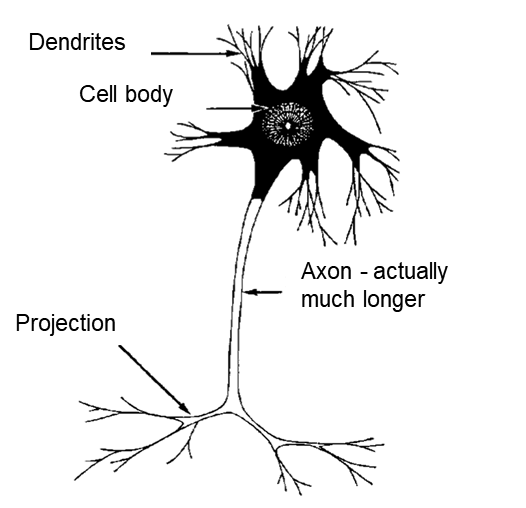
Figure 6.10 A Nerve

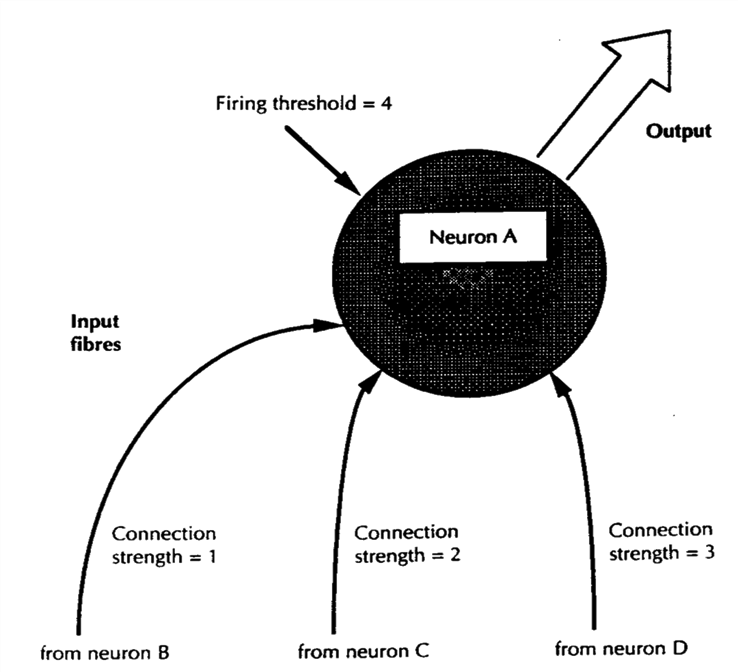
A nerve is a cell whose body receives electrical input from dendrites and projects electric pulses down an axon to other nerves (Figure 6.10). When the dendrite strength passes an input threshold, the nerve fires, to trigger other nerves. For example in Figure 6.11, inputs B and D are strong enough to fire neuron A, but B and C aren’t, as they don’t reach its threshold of four. Nerves are then devices that selectively pass on electrical impulses.

Embryonic nerves grow from the brain to form the retina, so light entering the eye touches the brain directly. It is estimated that each eye inputs about 8.75 Megabits a second, and the brain total is over 20 Mbps, so a baby’s first impression of the world is probably information overload:

Figure 6.11 Neuron Threshold

““The baby, assailed by eyes, ears, nose, skin, and entrails at once, feels it all as one great blooming, buzzing confusion” (James, 1890).

The baby’s brain has to transform the data from millions of optic nerves into objects, like a cup, to interact with the world, but how? Computers do it by identifying features like shape, so videos can be compressed by keeping key features and discarding the rest, and the brain the does the same. Essentially, it handles information overload by reducing the incoming sense data to key features, like borders and shapes, that let us recognize objects.

.

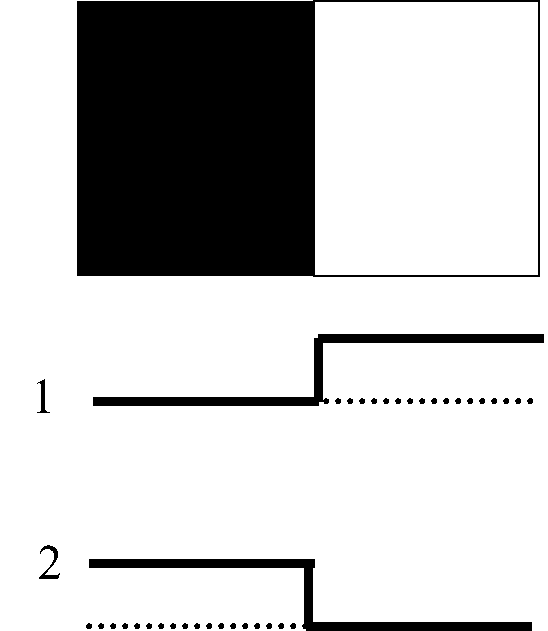
Figure 6.12 Retinal cells respond to black and white

The first step of vision then is to differentiate black from white. Photo-electric cells do this by firing when there is light, so in information terms, black is 0 and white is 1, as set by its designer. But brains had no designer so evolution, as it always does, took both options, as one type of retinal cell responds to light and another to light (Figure 6.12). Instead of defining data absolutely, the retina responds to both light and dark, which lets it identify the next key feature, of borders. 

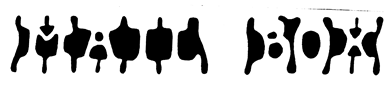
Retinal cells then interact, to excite or inhibit each other, to enhance the borders that define object shapes. The next step in object recognition is to make one side of the border the object, and the other its background, but which? The visual data is ambiguous, so vision assumes as best it can which side is figure and which is ground. For example, in Figure 6.13, making white the background just gives black blobs, but making black the background lets you read MAIL BOX.

Figure 6.13 Background context defines vision

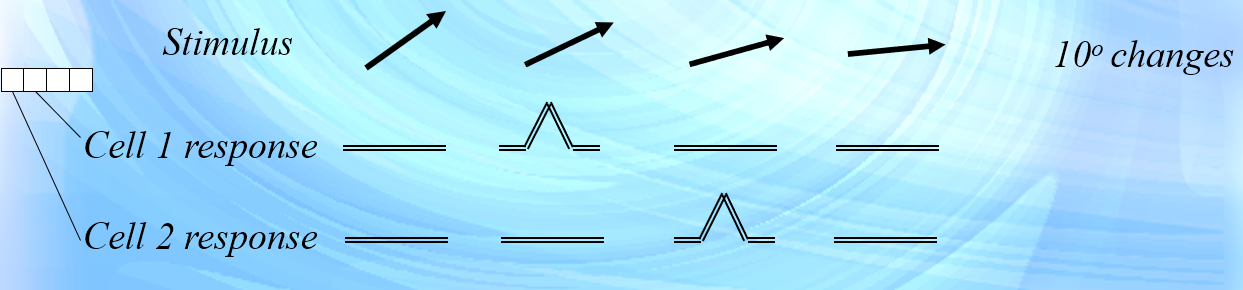
Vision then isn’t a simple input-output process because it must make assumptions that could be wrong. Visual processing begins when the eye detects light, and this data is then subject to layer upon layer of processing modules that detect relevant key features. For example, some visual cortex nerves fire for different line angles (Figure 6.14) and others detect other features.

Figure 6.14 Nerves fire for different angles

Computer processing tends to be a simple one-way flow, but brain nerves have bottom-up, lateral, and top-down links, so processing can be top-down and sideways as well as bottom-up. Bottom-up paths analyze data as computers do, but lateral paths enhance results, and top-down paths prime, interrogate, and check the result for consistency or errors (Dehaene, 2014) p139. Higher modules of the hierarchy can then re-run the process with different assumptions to get an entirely different result. 

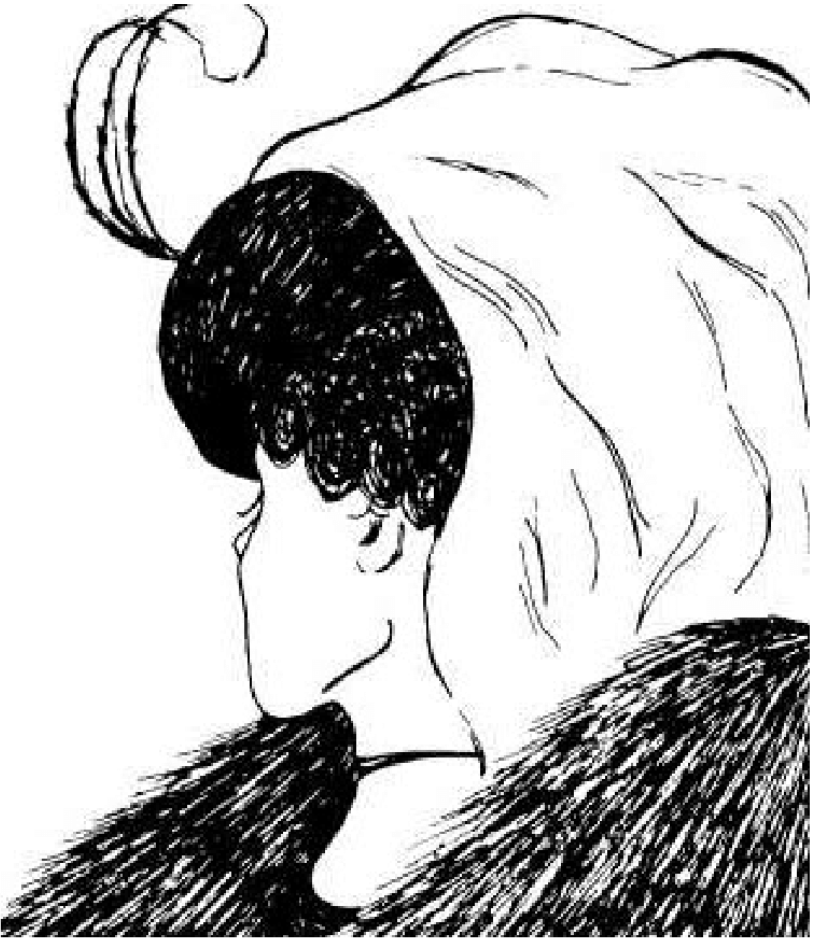
Figure 6.15 Old or Young?

For example, is Figure 6.15 a young lady or an old one? If you see a young lady, can you see an old one? To do this you must rerun your visual processing, to make the ear of the young lady the eye of an old one. The visual system makes a best guess, but you can ask for a redo because nerves in the visual hierarchy project down as well as up. Note that the change in what you see is sudden, and you can see one or the other but not both at once. Lower processing may be out of sight and out of mind, but it can still be redone by top-down control. This is necessary because all perception is just a hypothesis of an ambiguous world.

   Subconscious processing is often assumed to be primitive but the spinning ballerina illusion (Figure 6.16) suggests otherwise. Click on the link to see a ballerina spinning but the rotation is ambiguous, so you might see her spin clockwise or anti-clockwise. Try to see her spin the other way. If you can’t, pause the video and if you see an extended leg at the front, imagine it at the back, or vice-versa. Restart the video and if she spins the other way, you just reprogrammed some very complex unconscious visual processing. This ability lets higher conscious modules reconfigure lower ones to see the world in a new way.

Figure 6.16 Spinning ballerina

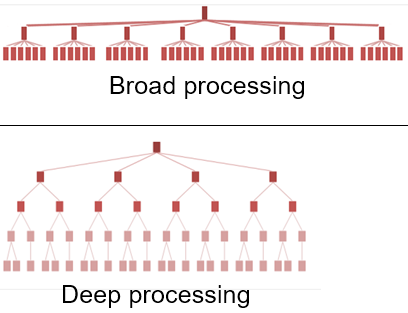
The cortex is then a nested hierarchy of nerve modules that evolved to process sense data in various ways. But while the optic nerve has about a million neurons, the auditory nerve only has about 50,000, so the visual hierarchy base is much broader. As shown in Figure 6.19, for the same processing capacity, a broad input base has less processing depth, while a narrow base has more. The narrow base of sound allows deeper processing than vision, so language began with speech because sound allows the deep analysis that language needs. Given the trade-off between processing breadth and depth, the hemisphere better adapted to deep processing specialized in language, and the other specialized in the broad processing of spatial analysis.

Sensory hierarchies let lower modules process their data to identify key features that pass on to higher ones, but how the results combine into the unified experience we call consciousness is unclear. What is clear is that this unified view can be checked and rerun, as illusions show, so consciousness lets us revise our reality assumptions to see it in a new way. For example, this book challenges the assumption that objects exist by pointing out the factual inconsistencies that follow, so we see quantum-generated events not self-existing particles. But if nested module hierarchies run the brain, how does it maintain control?

Figure 6.19 Broad vs. deep processing

Next

QR6.2.2 Decentralization

Our computer networks were centrally controlled until we discovered that decentralized networks like Ethernet are ten times faster, and degrade gracefully under load instead of crashing suddenly. Yet when the Internet was first proposed, pundits still expected it to collapse in chaos without central control but it didn’t, because decentralization allowed it to survive.

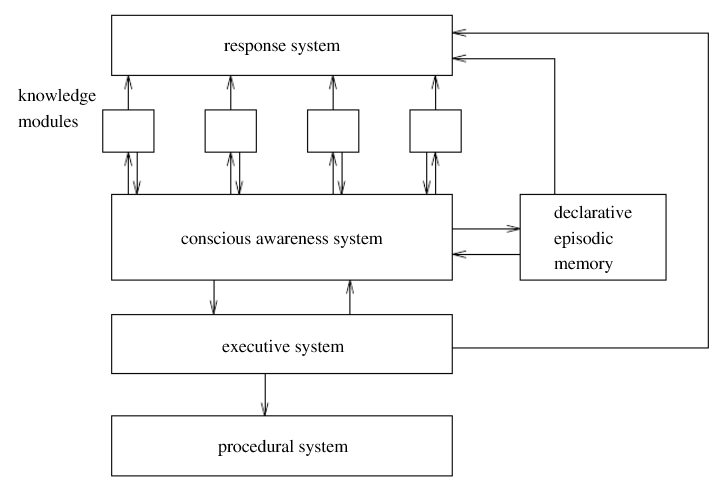
Figure 6.3 Schacter’s Brain Model

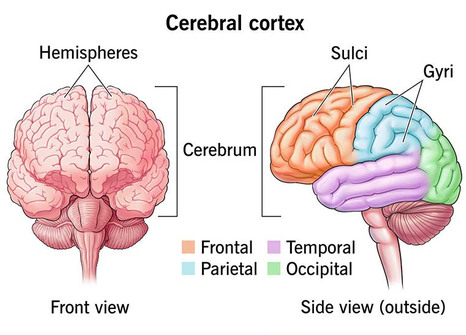
Likewise, early brain theories still expected central control, like Schacter’s model (Figure 6.3) where a central executive inputs conscious awareness of sense data, memory, and thought to respond (Schacter, 1989). It was then assumed that the cerebral cortex, the folded outer layer of the brain (Figure 6.4) that handles thought and language, contained the executive unit.

Figure 6.4. The Cortex

Yet the cortex, the most advanced part of the brain, is divided into hemispheres that share the work between them. The left hemisphere controls the right side of the body and the right directs the left, but which then is the executive?

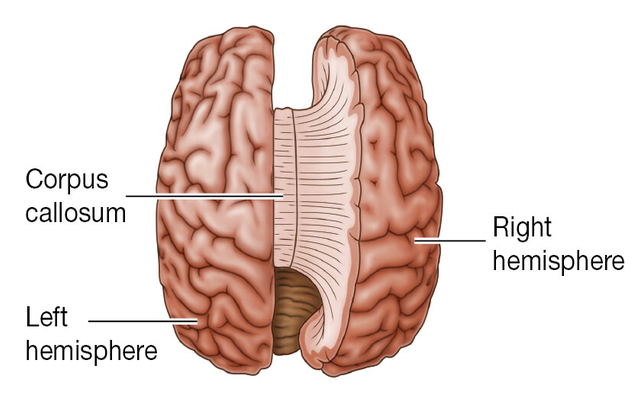
One hemisphere was assumed to dominate the other via the corpus callosum, the 800 million nerve bridge that connects them (Figure 6.5). But then surgeons treating epilepsy, an electrical malfunction that spreads from one hemisphere to the other, tried cutting the corpus callosum as doing this in animals didn’t seem to harm them. The treatment worked, but while serious side-effects were expected, the patients seemed to speak and act normally, so some even wondered if the corpus callosum was just a structural support!

Figure 6.5. The Corpus Callosum

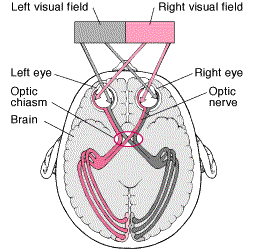
To investigate further, researchers devised the split-brain experiment. They knew that the left hemisphere controls the right side of the body and the right controls the left, and for vision, the left hemisphere receives nerves from the right side of both eyes while the right receives from the left side (Figure 6.6). Hence, the left hemisphere processes the right visual field and controls the right hand, while the right hemisphere processes the left visual field and controls the left hand. 

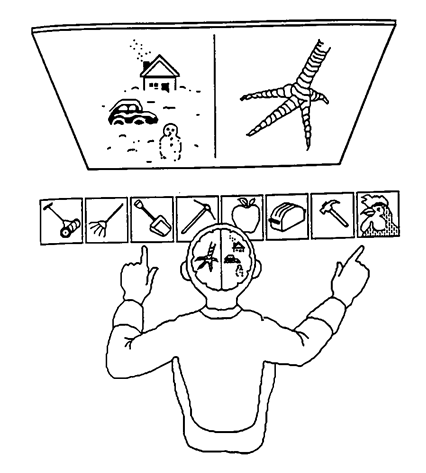
The split-brain experiment shown in Figure 6.7 then worked as follows.

Figure 6.6 How Visual Data is Shared

Subjects were asked to point to the picture that matched what they saw on the screen, which unknown to them was split into two pictures. The result was that if the left of the screen showed snow and the right showed a claw, the left hand chose a shovel to match the snow, and the right chose a chicken to match the claw! Subjects asked what they saw just said a claw, because the left hemisphere that controls speech only saw that. With the corpus callosum cut, each hemisphere acted like a brain in itself, and neither seemed aware of the other’s choice, so there was no conflict. Rather than one hemisphere dominating the other, both just analyzed their visual data and responded, so no central executive was needed.

.

Figure 6.7  The split-brain experiment

If a subject was specifically asked why his left hand chose a shovel, the reply might be “you need a shovel to clean up after chickens”. Yet researchers knew that the verbal left hemisphere didn’t know why the shovel was chosen because it didn’t see the snow, so it invented a reason! They concluded that it was just trying to explain events as best it could:

These findings all suggest that the interpretive mechanism of the left hemisphere is always hard at work, seeking the meaning of events. It is constantly looking for order and reason, even when there is none – which leads it continually to make mistakes. It tends to overgeneralize, frequently constructing a potential past as opposed to a true one.(Gazzaniga, 2002), p30.

In interpreter theory, the left hemisphere’s language and thought are more servant than master, so if the brain is a federation of agents (Minsky, 1986), it is like a diplomat whose job is to explain the decisions of others, not the CEO as some suggest (Kaku, 2014). Given that the animal most likely to harm a human is another human, perhaps our intellect grew as our societies did because those who can justify their actions survive. Science then, probably isn’t what our intellect originally evolved to do.

But is the right hemisphere really conscious if it can’t speak? It doesn’t specialize in language but that doesn’t make it illiterate. In one study, a split-brain boy was asked “Who is your favorite?” but the left of the screen showed “Who is your favorite girlfriend?” (Wolman, 2012). There was no verbal reply, as the left hemisphere didn’t see the word girlfriend, but a nervous giggle revealed that his right hemisphere understood fully what it saw. The boy was then able to use his left hand to select scrabble tiles to spell out L-I-Z, a cute girl in his class. It followed that the right hemisphere could read and spell, so it was conscious in any way you care to define it:

Everything we have seen indicates that that the surgery has left these people with two separate minds, that is, two separate spheres of consciousness. What is experienced in the right hemisphere seems to lie entirely outside the realm of awareness of the left hemisphere. This mental division has been demonstrated in regard to perception, volition, learning and memory.” (Sperry, 1966), p299.

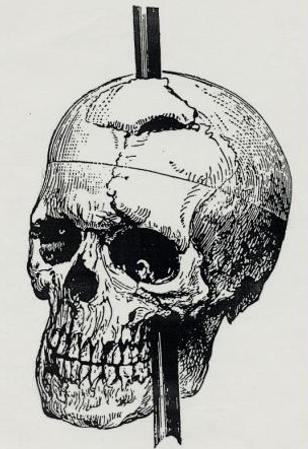
Figure 6.8 Phineas Gage

This discovery, that dividing our brains at the highest level produces in effect two people, was surprising. Yet in evolutionary terms, it favors survival, because if one hemisphere is damaged, the other can carry on. For example, take the case where an iron rod pierced the middle and left cortical lobes (Figure 6.8) of a railway worker called Phineas Gage, who soon after walked off, conscious and speaking. He showed disturbed behavior but lived for 13 more years and died of unknown causes. If you bang a nail through a mother-board, it stops working, but brains aren’t that fragile, as Von Neumann observed:

How could a mechanism composed of some ten billion unreliable components function reliably while computers with ten thousand components regularly fail?” (von Neumann, 1948).

The answer is that the brain duplicated functions and decentralized control to survive, so if the body is a ship, the brain crew that runs it has no captain, even at the highest level:

Studies of the structural and functional organization of the brain have shown that this organ is, to a large extent, decentralized, and processes information in parallel in countless sensory and motor subsystems. In short, there is no single homunculus in our brains that controls and manages all these distributed processes.(Singer, 2007).

We experience the world as observed sense input that we respond to, so why not peel away the brain layers to find the observer? Unfortunately, doing this is like searching the Internet for a center that it doesn’t have. Neuroscience is clear, that the brain is a decentralized collective with no center:

In contrast to this first-person experience of a unified self, modern neuroscience reveals that each brain has hundreds of parts, each of which has evolved to do specific jobs – some recognize faces, others tell muscles to execute actions, some formulate goals and plans, and yet others store memories for later integration with sensory input and subsequent action.(Nunez, 2016), p55.

There are then two facts, that we experience one observer, and that our brain is a decentralized collective with no central processing unit (CPU). Some conclude that a brain with no center can’t experience one, so conscious states must be delusions (Dennett, 1991), but delusions vary while our experience of being one observer runs across all cultures. Given two contradictory facts, science doesn’t cherry-pick one and explain away the other but tries to reconcile them. The question of how decentralized brains produce a unified consciousness is addressed later (6.3) but for now, the conclusion is that brains are decentralized because evolution required it, so what else did it require? 

Next

QR6.2.1 Is The Brain A Computer?

Superficially, brains are like computers as both use electricity to run on/off units, and neuron logic gates process data as transistors do (McCulloch & Pitts, 1943). Also, sensorimotor nerves mirror computer input-output channels, so it was proposed that the brain processes the senses to give motor output as computers process input to give output (Churchland & Sejnowski, 1992). Yet the comparison ends there because building a processor and evolving one present different challenges (Whitworth, 2008).

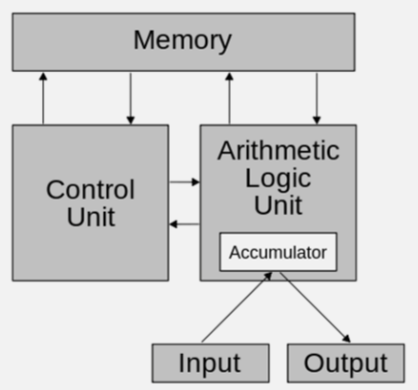
Figure 6.2. Von Neumann Architecture

For example, we build computers to be efficient but brains evolved to be reliable. Most modern computers use the Von Neumann design shown in Figure 6.2, with a central processing unit (CPU) controlling everything, but if it fails, so does the whole system. However this design doesn’t work for evolution because biological parts fail regularly, so a brain that stops when one part does is too fragile to survive. Evolution needed a better way, so our brain doesn’t have a central processing unit.

We build computers at leisure then switch them on but evolution couldn’t do that because life never stops. It is like building a computer where the first part has to work or you don’t get to add the second! The bee’s neuron sliver then has to work for it just as our brain works for us. We don’t work on live computers because it is too dangerous but evolution had to, because brains are always plugged into life. The answer was a hierarchy of layers, where one layer runs things while another is evolving, and it was also a backup if the new one failed.

Finally, to survive, brains must add value, say by moving a creature towards light, as a sense like light detection is useless if it doesn’t cause action. Hence evolution let the brain direct the feedback loop between sensory input and muscle output in a way that computers don’t.

Our computers are centralized, single-layered (on a motherboard), and input-driven, but brains are decentralized, multi-layered, and direct feedback. Hence, decentralization, hierarchies, and feedback are evolutionary principles that explain the brain better than any computer design.

Next

QR6.2 Evolving a Brain

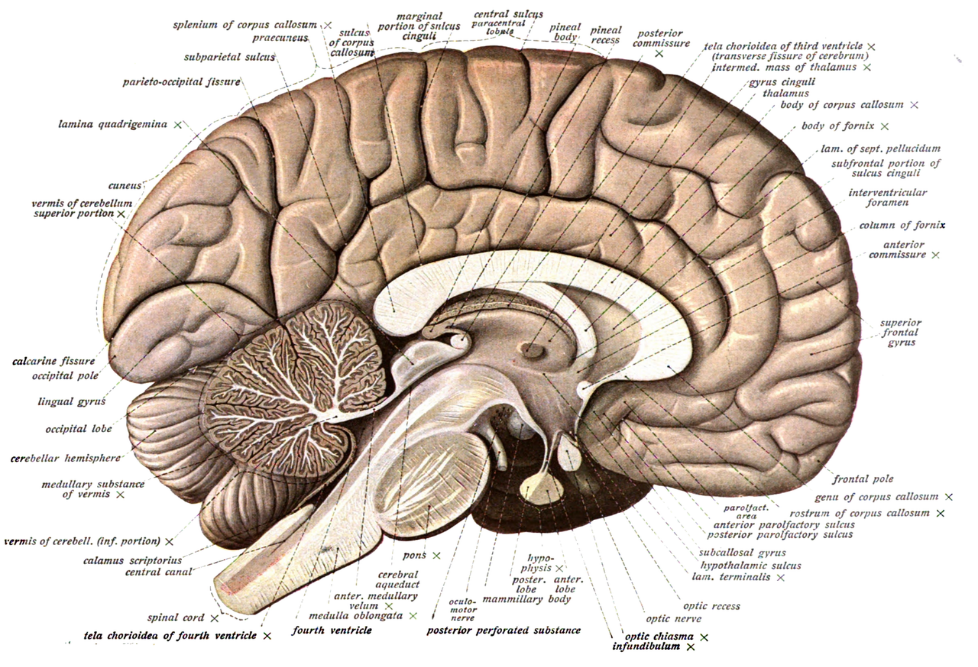
The human brain seems to be the most complex structure in the known universe for its size (Figure 6.1). It has more nerves than there are people in the world (or devices on the Internet), but it took hundreds of millions years to evolve.

Figure 6.1 The Human Brain

The brain of a bee is just a sliver of neurons, but it lets them fly, form colonies, and communicate with each other better than any robot of that size. Yet nature didn’t stop there because our brains came from brains like theirs, so what is difference between evolving a brain and building a computer? 

QR6.2.1 Is The Brain A Computer?

QR6.2.2 Decentralization

QR6.2.3 Hierarchies

QR6.2.4 Feedback

QR6.2.5 Three-Center Theory

QR6.2.6 The Emotional Center

QR6.2.7 The Intellectual Center

QR6.2.8 Sharing Control

QR6.2.9 The Binding Problem

Next