QR6.3.9 Consciousness Scales

The multiscale conjecture is that consciousness builds up at many temporal and spatial scales in the brain (Nunez, 2016) p326, so:

“Consciousness does not work like a light switch that just goes on and off. Rather it is more like a light with variable brightness controlled by a dimmer switch.” (Nunez, 2016) p98.

The electromagnetic field of a nerve is extremely local so it fades after a millimeter or so, but tubulins could synchronize a microcolumn 1/300thmm wide to give P1 waves that occur 50ms after stimulus. This scale of observation might be a fleeting registration of borders.

Synchronizing a microcolumn amplifies its electromagnetic field, increasing its strength and range. This lets cortico-cortical columns of about 10,000 neurons synchronize, perhaps using thalamic beats and cortico-cortical links, to give N1 waves about 130ms after stimulus (John, 2005) p159. An observation at this scale might be a brief registration of features like shape.

Synchronized macrocolumns of about a million neurons can arise in the same way, to give P2 waves about 210ms after stimulus. The observation at this scale might be of a visual object.

The synchrony cascade doesn’t stop there, as macrocolumns can form into areas. The primary visual area V1 at the back of the brain maps shapes in space, then shares its results with nearby V2, V3, V4, V5 and V6 areas that handle relative movement.

Finally, the distant brain areas responsible for memory and planning join the synchrony to form a global observation, based on the same principles. The evidence that synchrony enables consciousness is strong.

When subjects were asked to recognize images, electrodes in the occipitotemporal cortex, hippocampus and prefrontal cortex showed a steady beta synchrony, significantly higher than when they didn’t recognize it (Sehatpour et al., 2008). When input reaches higher visual areas, a remarkable thing happens: sub-millisecond synchronies link distant brain areas as the image is recognized. Distant areas use re-entrant circuits and self-perpetuating loops to set up rhythmic synchronies of amazing precision, that integrate information in some way:

“We believe that the brain integrates functional modules by bringing neural oscillations in those modules into synchrony. Neurons oscillating in synchrony can communicate their information and influence each other’s activities much more effectively than can those oscillating asynchronously.”(Ward, 2007) p325.

In a study of monkeys presented with two stimuli, one of which was relevant, both stimuli produced a V1 response, but only the attended one gave a V4 area gamma synchrony (Bosman et al., 2012). A similar result was found for auditory streams presented simultaneously – only the attended stream synchronized the higher auditory area, leading the authors to suggest a top-down synchrony filter for auditory attention (Lakatos et al., 2013). Human studies of binocular rivalry give each eye a different image but the brain sees one or the other, not a mix of both. Neuromagnetic measurements of rivalry find the hemisphere with better local synchrony predicts the image that is consciously perceived (Tononi, 1998).

In masking studies, where a word is only seen half the time, long-distant gamma synchrony between occipital, parietal and frontal areas occur if the word is seen but not if it isn’t (Melloni et al., 2007). Both cases gave gamma oscillations but phase-locked synchrony between distant areas and the hemispheres only occurred for the visible case and shortly after this transient synchrony, the p300 correlate of consciousness occurred. Evidence from animal and human studies suggests that neural synchrony enables the conscious observation that binds areas:

“We propose that this transient synchronization might enhance the saliency of the activation patterns not only allowing the contents to get access to consciousness but also triggering a cascade of processes such as perceptual stabilization, maintenance in working memory, and generalizations of expectations, all aspects intimately related with conscious awareness.”  (Uhlhaas, 2009) p11.

Why do nerves send the same signal hundreds of times a second in synchronized volleys? It can’t be to exchange information, because we neither act nor perceive in hundredths of a second. However these constant pings could build larger synchronies from smaller ones, in a cascade of consciousness
Next

QR6.3.8 Consciousness Takes Time

Using electrodes to stimulate cortex locations in awake subjects having neurosurgery can give a body sensation, so a left-cortex point might give a brief right-hand tingle that subjects report about 500ms later (Libet, 2005), so is consciousness just an effect? In general:

“How are nerve cell activities in the brain related to conscious subjective experience and to unconscious mental functions?” (Libet, 2005) p32.

To find out, subjects were asked to flick a wrist when they felt like it. The EEG showed a movement readiness potential in the prefrontal cortex about 200ms before subjects reported their intention to act. Conventional science took this to mean that consciousness is like a king who thinks he rules but his advisors do everything. Thus, even if consciousness exists, it does nothing:

“A systematic exploration suggests that every cortical site holds its own knowledge. Consider the insula, a deep sheath of cortex that is buried beneath the frontal and temporal lobes. Stimulating it can have a diversity of unpleasant effects, including a sensation of suffocation, burning, stinging, tingling, warmth, nausea or falling. Move the electrode to a location farther below the surface of the cortex, the subthalamic nucleus, and the same electrical pulse may induce an immediate state of depression, complete with crying and sobbing, monotone voice, miserable body posture, and glum thoughts. Stimulating parts of the parietal lobe may cause a feeling of vertigo and even the bizarre out of body experience of levitating to the ceiling and looking down on one’s own body.

If you had any lingering doubts that your mental life arises entirely from the activity of the brain, these examples should lift them.” (Dehaene, 2014) p153.

These results don’t mean what Dehaene thinks they do, that our mental life arises entirely from the brain, because none of the nerve regions stimulated are capable of observing anything. Explaining how a movie gets onto a screen doesn’t explain how it is observed. It is true that:

“… a whole array of mental processes can be launched without consciousness…” (Ibid, p86)

But to say that global consciousness does nothing because some brain parts can act without it is like saying that the sun does nothing because I can switch on a light at night. It is true that parts of the brain can react to stimuli in 200ms, before the 500ms it takes to be fully conscious, but this just implies degrees of consciousness, not that global consciousness does nothing at all.

The relation between consciousness and the brain is like a viewer watching a TV. Nothing can be seen until the TV is turned on but even so, a TV can’t view itself. If physical realism (PR) is that TVs exist without viewers, then viewer realism (VR) is that viewers also exist. One can imagine a conversation between these two points of view as follows:

VR: A TV can’t view itself, so there must be a viewer out there.

PR: Not at all. When the TV is turned on, we just imagine that someone is viewing it.

VR: But a network of TVs that no-one watched would be pointless!

PR: Exactly! It’s all pointless, that’s why it doesn’t matter what we show.

VR: But we can talk to viewers watching TV by long-distance phone calls.

PR: Yes, but they are also imaginary. It’s all fake.

VR: How do TV channels change if there are no viewers?

PR: The remote control changes the channels randomly. Who knows, maybe a fly sits on it?

VR: So how do you know that viewers don’t change the channel?

PR: We did an experiment. We asked a “viewer” to call us when he changed channels and the remote control came out of standby a second before his call arrived. Hence, he didn’t do it.

VR: But how long does it take a long-range phone call to arrive?

PR: About a second.

VR: So that’s not really conclusive, is it?

PR: Its near enough. Machinery does everything, viewers don’t exist.

VR: But you watch TV so you’re a viewer too, does that mean you don’t exist?

PR: Don’t be ridiculous, of course I exist.    

Libet’s flawed experiment led many to think that the brain is merely a meat machine, just as nineteenth century science thought the universe was a clockwork machine, until quantum theory proved it isn’t. This desire of scientists to prove they have no choice should be a subject of study:

“… why are so many intellectuals so intent on proving that they have no free will? (As the philosopher Alfred North Whitehead pointed out ironically, ‘Scientists animated by the purpose of proving themselves purposeless constitute an interesting subject for study.’)(Taylor, 2019)

  Evolution doesn’t do pointless. The long and short-range nerve synchronies found in every brain wouldn’t have evolved if they did nothing. It takes effort to be conscious like us, as brain waves take time to form. That these synchronies correlate with consciousness suggests that the latter has an evolutionary benefit. It is now proposed that it is to unify observation, whether at the cell or human scale.

Next

QR6.3.7 The Entangled Observer

A quantum entity, like a photon or electron, is observed when something else, like a screen, interacts with it. Until then, it is a spreading wave that doesn’t observe itself or anything else. Only when another quantum wave interacts with it, can it collapse to restart at a point in a physical event. In quantum theory, a physical event is quantum entities observing each other. And the event location is chosen from the possibilities regardless of prior events. It follows that all physical events involve observation and choice.

When quantum entities restart in a physical event, something remarkable occurs: they entangle into a single ensemble that spreads from the event point.  When two photons entangle, the spreading ensemble instantly knows if it is involved in a physical event, regardless of  physical distance (QR3.8.5). When a physical event occurs to an entangled ensemble, all the entities involved observe it, even if they then disentangle. This isn’t information exchange but it has the same effect, that distant participants obtain the same physical information.

It follows that when synchrony entangles nerves into an ensemble that observes a data point in the brain’s electromagnetic field, they all get the same information, whether they created it or not. The same logic applies to the choice of the point observed. In simple terms, distant nerve areas can share data by forming a quantum entity that observes and chooses. Applying Penrose’s logic to nerves, if tubulins can synchronize cell molecules to observe as one, brains can synchronize nerves to do the same. A quantum effect therefore underlies the observer we call “I”.

It isn’t proposed that all brain nerves synchronize, but that some do, to solve local problems, followed by a cascade from microcolumns to macrocolumns and so on, up to a global observer. Nor do all nerves need to synchronize perfectly, as only some need to do so to achieve the effect. If nerves that wire together fire together, then nerves that fire together observe together. Consciousness then arises when nerve synchronies cascade into a global observer.

   When we watch a movie, sight and sound seem like one experience because entangled visual and auditory nerves make one observation. Bottom-up sensory analysis would process vision or sound alternatively but we observe both at once and can attend either. How attention occurs isn’t known but where observation occurs alters the observation. An electromagnetic field is stronger closer to its source, so attending the sound of a movie may be choosing to observe close to the auditory area. Or I could attend to a thought or feeling by choosing to observe closer to that brain function. The brain has no wiring switch to do what attention does, so this theory explains what others can’t.

If a single neuron opens a small observation window on physical reality, then many neurons entangled open a bigger window. The brain solved the binding problem by forming layer upon layer of neural synchronies to enable a global observation, hence:

a. Consciousness takes time. A global neural synchrony takes time to build up.

b. Consciousness scales. Synchrony enables consciousness at multiple scales of the brain.

c.  Consciousness cascades. Small-scale synchronies lead to large-scale synchronies.

The following sections give more details.

Next

QR6.3.6 Field Theories of Consciousness

A neuron is like a transistor that selectively passes on data, but it is also an electro-magnetic oscillator like a Wi-Fi device. Brain areas then aren’t just wired together but also resonate together, so could the brain’s electro-magnetic field underly consciousness? Conscious electromagnetic field information theory suggests that it does:

“… the brain’s EM (electromagnetic) field is the physical substrate of consciousness.” (McFadden, 2020), p5.

It argues that if neuron electro-magnetic fields contain their information, merging those fields integrates their information, as nerves affect the brain’s electro-magnetic field like pebbles dropped on a pond, whose ripples interfere or add into one result. This solves the binding problem because: 

“… EM fields are always unified, there is only ever one EM field in the brain.” (Ibid, p6).

In contrast, if the brain is just an information processor, some nerve must fire to recognize a face, the so-called Jennifer Aniston neuron (Quiroga et al., 2005), but that firing isn’t information integration, as it can:

“… only encode a single firing rate that cannot represent anything more than a tiny fraction of the information present in a conscious percept.” (McFadden, 2020), p3.

Data processing then can’t integrate information but the electro-magnetic field can. This theory also predicts that:

“… conventional computers, despite their undoubted computational skills, have not exhibited the slightest spark of consciousness, nor any signs of the general intelligence endowed by conscious minds.(McFadden, 2020), p9.

However that a brain’s electro-magnetic field causes consciousness faces two problems. The first is that different additions to the field interfere as well as add. For example, if different radio stations broadcast on the same frequency, we hear none of them not all of them, so if different brain regions broadcast overlapping fields, they will interfere not integrate.  

The second is that when an electro-magnetic field contains its data, something else has to observe it. For example, a Wi-Fi field can contain the data of a song, but a smartphone is still needed to download it. Data encoded by a field needs a receiver to download and decode it (Pockett, 2014), but the brain doesn’t have a central receiver, just as it doesn’t have a central processing unit. A field can’t be both the observer and the data observed.   

Pockett and McFadden disagree on what the brain’s electromagnetic field does, but both agree that it is physical:

“… matter is not the only kind of physical entity. Electromagnetism is also an undeniable part of the physical world.” (Pockett, 2017).

“… consciousness is rooted in an entirely physical, measurable and artificially malleable physical structure and is amenable to experimental testing.” (McFadden, 2020), p11.

    Yet light waves aren’t physical because they travel in a vacuum, which physical waves can’t do. And they vibrate in an imaginary plane that is outside physical space, which a physical wave also can’t do. The electromagnetic field of light is measurable, but it isn’t physical. Indeed, if it were, no observer would be possible because one physical event can’t observe another. Given these inconsistencies, another explanation for the relation between brain waves and consciousness is needed.

QR6.3.5 Synchrony And Consciousness

The neural binding hypothesis proposed decades ago (Crick & Kock, 1990) is that if some nerves represent a trunk and others its leaves, they represent a tree when they fire in synchrony, so synchrony combines information, but why isn’t clear as synchronizing physical oscillators doesn’t unify their information. Yet neural synchronies seem to unify cognitive outputs as they:

a. Accompany face recognition. Face recognition occurs when distant nerves synchronize with no phase lag (Rodriguez et al., 1999).

b. Accompany object recognition. In the visual cortex, the “… selection of responses for further processing is associated with enhanced synchronization rather than increased firing.(Singer, 1999), p62, so synchrony could let one object direct responses.

c.  Represent odors. Different smells produced odor-specific synchronies in locust olfactory nerves for different smells but not for the same smell (Laurent et al., 1996), so the observation of odors could depend on nerve synchrony.

d. Are transient. Neural synchronies are often brief and hard to detect (Singer et al., 1997), just as sensory experiences are often fleeting moments. 

e. Accompany cognitions. Beta/gamma brain waves correlate with cognitive functions like attention, recall, sense integration, and motor coordination (Uhlhaas, 2009), p8, so synchrony could provide the binding of neural functions they require.

Studies from insects, cats, monkeys, and humans support the theory that neural groups synchronize to combine their results (Fries, 2015), p220, giving a mood of optimism that the unity of consciousness is entering the realm of science:

Beliefs about the basis of subjective experience have slowly evolved, from mystical notions of the soul and a disembodied mind to acceptance of the proposal that consciousness must derive from neurobiological processes.(John, 2005), p143.

Yet if consciousness derives from neurobiological processes, it isn’t unique to us. Locust nerves synchronize, so if synchronies create our conscious experience, insects must be conscious to a degree, albeit on a diminished scale. Consciousness as the ability to unify brain observations then began in other animals, who dimly observe what we brightly do. Our brain also has many synchronies not one, so regions that bind locally but not globally provide a basis for subconscious effects. If the degree of consciousness depends on the number of nerves synchronizing, people under anesthetic, sleeping, or sleepwalking have less consciousness not none at all. 

Further evidence that neural synchronies create consciousness is that after a stimulus, they build-up in a time-frame that reflects our experience of it (John, 2005):

1. 50 milliseconds: P1 waves occur as nerve synchronies in primary sensory cortex areas that register input features.

2. 130 milliseconds: N1 wave synchronies link the cortex to the thalamus/limbic system.

3. 210 milliseconds: P2 waves link higher cortex layers to the thalamus/limbic system.

4. 300 milliseconds: Sustained P300 gamma oscillations synchronize the frontal and parietal lobes with zero-delay in what is considered to be a human perception.

Sense input seems to trigger local synchronies in sensory areas, then long-range synchronies add emotions, memory, and language giving a global conscious experience in under half a second. These stages are supported by the structure of the human cortex, a nested hierarchy that processes data in six layers labelled I to VI. The first unification after the nerve is a hundred or so nerves about the thickness of a hair called a microcolumn:

“… current data on the microcolumn indicate that the neurons within the microcolumn receive common inputs, have common outputs, are interconnected, and may well constitute a fundamental computational unit of the cerebral cortex …” (Cruz, 2005).

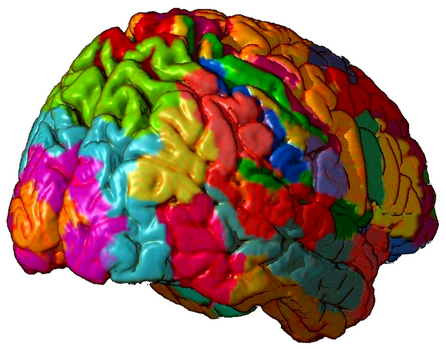
Figure 6.37 Brodmann areas

About a hundred microcolumns then form a cortico-cortical column that sends axons to nerves nearby. They in turn combine into a macrocolumn of about a million neurons about 3mm wide with more cortical links. Macrocolumns then combine into the 32 Brodmann areas (Figure 6.37), each with about a hundred million neurons, that specialize in different functions like language.

The cortical architecture is then (Nunez, 2016), p91:

1. Microcolumns. About a hundred neurons (∼.03mm).

2. Cortico-cortical columns. About a thousand neurons (∼.3mm).

3. Macrocolumns. About a million neurons (∼3mm).

4. Brodmann areas. About a hundred million neurons (various sizes)

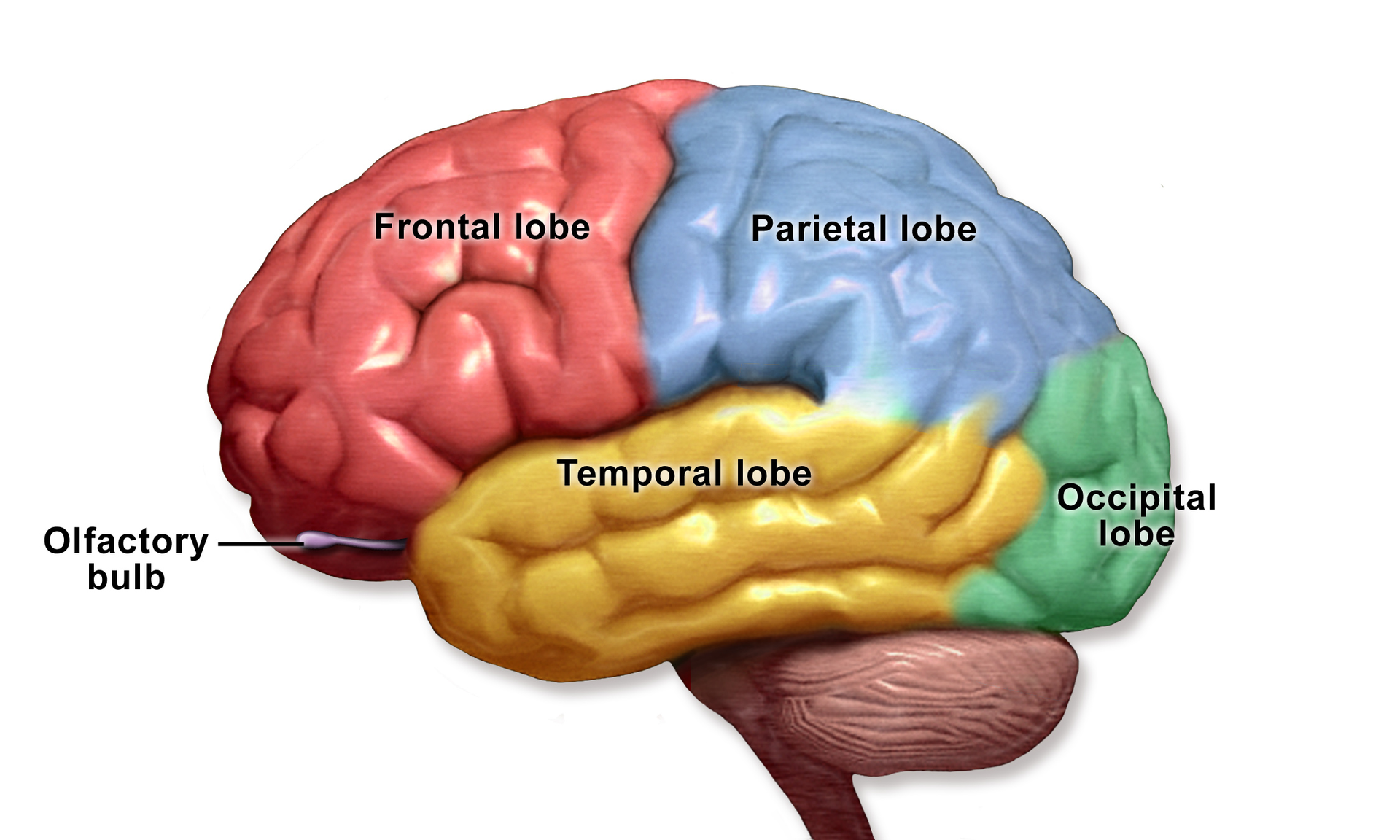
Brodmann areas then combine into five lobes separated by deep fissures (Figure 6.38). The occipital lobe handles visual data, the parietal lobe handles skin data like touch, pain, and temperature, the temporal lobe handles sound and memory data, and the frontal lobe handles plans and intentions, so a person with frontal lobe damage may know how to behave but can’t stop inappropriate acts like touching. These lobes together are one hemisphere, and two connected hemispheres are the cortex.

Figure 6.38 The cortex (Blausen.com staff, 2014)

The cortex divides the work of processing input among various regions, each specializing in its own data to produce results in parallel, and at the same time creates neural synchronies that bind them. Specialization and integration can then evolve together, as synchronizing a neural hierarchy doesn’t affect its information result. The only question then is how neural synchronies build up to produce the unified conscious experience that we report?

QR6.3.4 Brain Waves

It is an odd fact that out-of-phase metronomes synchronize overnight if left side-by-side on a wooden board. Huygens called this entrainment, and it occurs because out-of-phase vibrations exchange energy that drops to zero when they vibrate in phase. Playing a note on a violin also evokes the same note in the violin next to it without touching it by resonance. Hence when neuroscientists discovered that brain waves are ubiquitous in a wide variety of species, they attributed it to neuronal entrainment creating resonances (Lakatos, 2019).

For example, electrodes on the human scalp detect electromagnetic pulses, such as alpha-beta waves (8-38Hz), theta waves of sleep (3-8Hz), and gamma waves of intense focus (38-42Hz). These waves require nerves to synchronize their firing, so cortical neurons in a cat brain must synchronize their fire very precisely to produce beta waves (Gray, 1989).

Given nerve synapse, conductance, and propagation time lags, for distant cortical areas to beat almost perfectly together in zero-phase synchrony is an extraordinary feat:

“Early studies showed that zero-phase lag synchronization can occur even between distant neuronal assemblies,… This is particularly relevant as the conduction delays in the cortex make the occurrence of zero-phase lag synchronization difficult to accomplish.” (Uhlhaas, 2009), p3.

Neurons are then electro-magnetic oscillators that entrain to produce resonances, but how is unclear, and why is even less so. Regarding how, nerves connecting distant neural assemblies can’t exchange data by the encapsulation principle, so their purpose isn’t to transmit content. Computer networks use no-content signals called pings to measure the time taken for a web site to respond, so brains could do the same, as distant brain areas linked by reciprocal pings could establish the same pulse frequency to create a resonance. Note that if distant nerve signals are pings not chatter that exchanges data, there is no information to compete for consciousness (Baars, 1988), or to broadcast a global ignition that causes consciousness (Dehaene, 2014). The evidence for neural synchrony is compelling but it is unlikely to be an information exchange code (Uhlhaas, 2009).

The brain is then a neural oscillator network that explores a domain of resonances using pings. Models of oscillator networks with delayed links show that low frequency hubs can enable higher frequency synchronies (Vlasov & Bifone, 2017), so slow brain waves could keep fast ones in time.

But why might regions that respond to different features synchronize their neurons, then use neuron pings to other regions to also synchronize with them? Brains evolved many long-range and precise lag-free synchronies, so it must serve a key function, and the exquisite time sensitivity of neural spikes implies that timing is critical. Neuroscience concludes that these synchronies somehow solve the brain’s binding problem, as studies:

“… have demonstrated that response synchronization is a ubiquitous phenomenon in cortical networks and is likely to serve a variety of different functions in addition to feature binding at early levels of sensory processing.” (Uhlhaas, 2009), p1.

Neural synchronies are ubiquitous in animal and human brains, so it is possible that as regions specialized to observe different features, synchrony acted to bind them into a unified observation. This then has implications for the unity of observation experience we call consciousness, as:

The central issue is how coherent, informational activity in multiple cortical areas is welded into a seamless unity that becomes aware of itself.” (John, 2005), p160.

Next

QR6.3.3 Neuron Unity

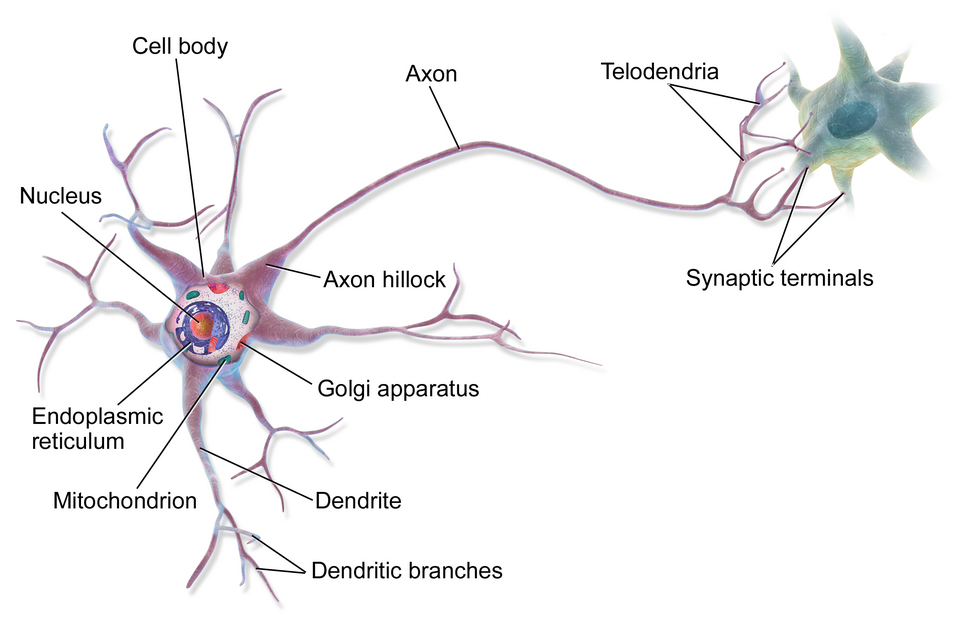
Figure 6.35 A neuron with synapses

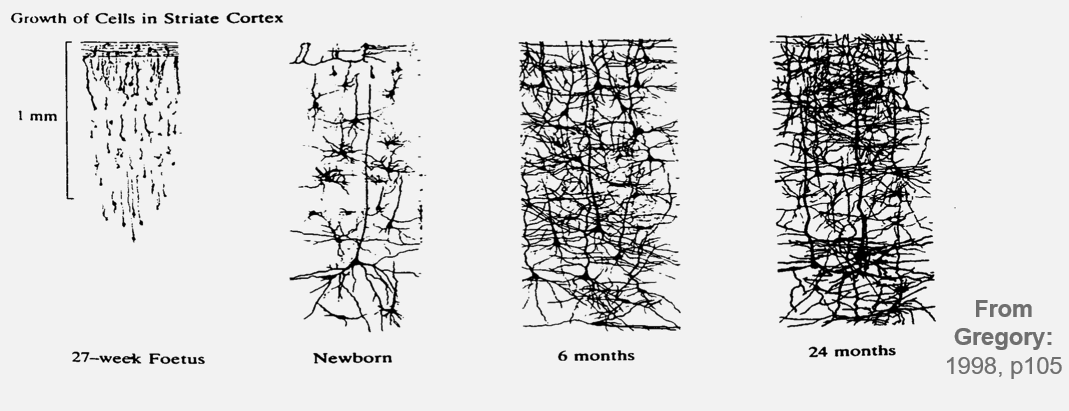
A neuron is a cell that receives electrical signals from other neurons and transmits a signal to neuron, gland, or muscle cells via synapse link sites (Figure 6.35). Each neuron has many input-output synapses, even thousands, while computer transistors need only one input and output because programs define their links. For example, moving a mouse left moves the screen cursor left because a program links them, but brains had no designer to pre-define their links so nature, as it always does, tries every option. Neurons in the embryo brain grow to connect in a dense mat, like plant roots, to explore every link (Figure 6.36). Synapses then stabilize with use or wither with disuse, to allow experience-driven brain plasticity.

Figure 6.36 Neurons grow synapses

To survive, animals respond to stimuli selectively, as brains activated by every change waste energy. Evolution then favors brains that ignore noise, defined as signal changes that carry no useful data. For neurons with thousands of input dendrites, random firing due noise is a significant problem that needs a solution.

The answer found is that pyramidal dendrites don’t spike if their inputs differ, even when either input alone gives a spike (Gidon, 2020). If nearby dendrites agree, they both fire but if not, neither does. In computing, this is an XOR gate (Note 1), a function that takes two steps in classical processing, not the expected AND/OR gate. Instead of a dumb transistor that just adds inputs, each nerve is a processing network whose dendrite layer purifies the data by inhibiting erratic input (Cepelwicz, 2020).

Yet dendrites grow outwards rather than interlace, giving no links between them, so how can adjacent dendrites compare results to fire only if they agree? One answer is that if cell structures vibrate to cohere photoreceptors, they can cohere adjacent dendrites into a unity that cancels opposite results. Quantum coherence lets nearby dendrites observe signals in a unified way, so they must fire together or not at all, in an XOR operation that reduces signal noise.. Nerves can then use quantum effects to enhance their function just as cells do:

“Physicists thought the bustle of living cells would blot out quantum phenomena. Now they find that cells can nurture these phenomena – and exploit them.” (Vedral, 2015).

These quantum phenomena can evolve gradually because even a small photosynthetic or dendritic contribution confers a benefit. Yet that cells evolved to be niches that allow local quantum effects doesn’t explain how nerves in distant regions combine their results into one observation.

Next

Note 1. An eXclusive OR operation compares two input bits and generates zero if the bits are the same and one if the bits are different. The XOR logic is widely used in cryptography.

QR6.3.2 Molecules Entangle

Quantum theory lets many entities unite into one entity that exists in all its possible physical states at once, as molecule superpositions do (3.8.1), so each time-cycle can explore all possible states simultaneously until a physical event stops the entanglement. This collapse should happen every quantum cycle for matter but if chromophore molecules re-entangled, a photon excitation could explore all possible paths to a reaction center concurrently, to quickly find the fastest path and allow the otherwise impossible efficiency of photosynthesis.

The quantum biology theory of photosynthesis is that molecules vibrating in synchrony maintain a coherence that the molecular bustle of a normal cell usually destroys. This seems unlikely, but entities created at the same time and place entangle (3.8.5), so their synchrony could make molecules entangle. The premise that adjacent molecules vibrating in near perfect synchrony can entangle lets coherence play a role not only in enzyme activity (Frohlich, 1970) but also in biological puzzles like smell, protein folding, ion channels, and bird navigation (Gauger, 2011).

The foundation of quantum biology may then lie the existence of life on earth. The earth is about 4.5 billion years old, and its crust and oceans settled about 4.1 billion years ago, yet evidence of the first life appears 300 million years later. This seems a long time, but that molecules a primeval swamp randomly produced life in this timeframe is beyond improbable, as the number of candidates for a successful self-replicating RNA molecule is over 10100. A lottery of six random numbers takes about three million tickets to win, but a lottery of over 100 numbers needs more tries than there have been molecular events in our universe, so life is implausible even on a cosmic scale.  

The quantum cradle hypothesis is that the first life molecule was discovered not by a random search but by the ultra-fast quantum exploration of entangled molecules, as nanopore flaws in metallic crystals provided niches that sustained molecular coherence to some degree. Our earth didn’t just run the lottery of life; it supercharged it by allowing quantum search techniques. Life on earth then isn’t an impossible fluke that leaves us alone in the universe, but the inevitable result of evolution using quantum effects, so it will be in many places, even if only bacterial.

Quantum beats are presumed to only reflect molecular coherence but synchronous vibrations could both trigger entanglement and maintain it. How early mineral crystals oscillated is unknown, but there is evidence that microtubules in cell structures produce synchronous vibrations that allow Frohlich coherence at room temperatures (Samsonovich et al., 1992). The cell wall could then constantly orchestrate the coherence of its molecules as well as shield them from external noise (Penrose & Hameroff, 2017), as its vibrations will transfer to the molecules within it. Physics lets atoms entangle in a molecule, so that molecules entangled within a vibrating cell allow the effects that quantum biology proposes is not unreasonable.

Microtubules offer a mechanism for molecule coherence within a cell niche, but unifying a cell is a far cry from unifying a brain. Orchestrated objective reduction theory argues that our unity arises when microtubules make the brain a quantum computer, so quantum processing enables consciousness (Penrose & Hameroff, 2017). However the microtubule coherence at cell timescales of 10-13 to 10-6 seconds is too brief (Tegmark, 2000), as the time scale of human consciousness is orders of magnitude greater (Jedlicka, 2017). Microtubules also can’t explain why some brain events are conscious and others aren’t (Baars & Edelmann, 2012), as unconscious regions of the brain contain just as many microtubules.

   In summary, if evolution in general first entangled light into matter (4.3.1), then entangled matter into higher atoms (4.6.1), that then entangled into increasingly complex molecules, that molecules entangled into a living cell is no surprise, but forming a brain required a special type of cell: the neuron.

Next

QR6.3.1 Cell Unity

A cell has about 42 million protein molecules working together in the most complex system known to mankind. It has been called the third infinity (Denton, 2020) because just as the universe is bigger than we know, and quantum events are smaller, the cell is more complex than we can imagine. It is so complex that the chances that trillions of atoms in a primal stew randomly produced millions of proteins that randomly formed a self-replicating cell is effectively zero. The probability is beyond astronomical, and the steps of evolution didn’t help, as proteins decay in the earth environment, so how life overcame the physical odds to emerge is a mystery.

Evolution needed help, so biologists suggested an unexpected source. The emerging field of quantum biology holds that the mysteries of biology, like those of physics, are explained by quantum theory (McFadden & Al-Khalili, 2018). Quantum effects on the atomic scale helped stars and galaxies evolve, but that they also affected the macro-world of cells was unexpected:

On the face of it, quantum effects and living organisms seem to occupy utterly different realms. The former are usually observed only on the nanometer scale, surrounded by hard vacuum, ultra-low temperatures and a tightly controlled laboratory environment. The latter inhabit a macroscopic world that is warm, messy and anything but controlled. A quantum phenomenon such as ‘coherence’, in which the wave patterns of every part of a system stay in step, wouldn’t last a microsecond in the tumultuous realm of the cell. Or so everyone thought. But discoveries in recent years suggest that nature knows a few tricks that physicists don’t: coherent quantum processes may well be ubiquitous in the natural world.(Ball, 2011), p272.

Physics uses quantum events to explain impossible physical events, though it denies they exist, so biology can use it to explain impossible biological events. The premise is simple, that life does what it can to survive, so if quantum events do what physical events can’t, it will use that power if it can, and it had billions of years to discover ways to do so. Biologists then just had to look to find quantum effects in many functions:

“…something quantum mechanical is going on inside living cells, whether it’s in photosynthesis, whether it’s in enzyme catalysis,[16] [17] [18] whether it’s in mutations of DNA,[19] [24] even more controversially the way we smell, the theories of olfaction,[25] or magnetoreception, the way certain animals can sense the Earth’s magnetic field, the chemical compass that allows them to detect the orientation of the field relies on quantum effects, quantum entanglement.[26] [27] [28]” (Al-Khalili & Lilliu, 2020).

For example, plants convert sunlight into energy to sustain all complex life on earth by photosynthesis, which bacteria discovered over three billion years ago. The electric motors of today are about 25% efficient, losing the rest to heat, but low-light bacteria convert nearly 100% of light energy into chemical energy (Magdaong et al., 2014). According to Carnot’s law, a heat engine with this efficiency is impossible, but bacteria have a quantum heat engine that does what classical physics forbids (Al-Khalili & McFadden, 2014) p310, because life evolved to use quantum effects:

“… natural selection has come up with ways for living systems to naturally exploit quantum phenomena (O’Callaghan, 2018).

Photosynthetic bacteria use tightly-packed molecules called chromophores to detect light. These little antennae then pass it to reaction centers where it is converted into chemical energy for use. When one of them registers a photon, the excitation must pass through a forest of antennae to reach the nearest reaction center, but:

The problem, of course, is which route this energy transfer should take. If it heads in the wrong direction, randomly hopping from one molecule to the next in the chlorophyll forest, it will eventually lose its energy rather than delivering it to the reaction center.(Al-Khalili & McFadden, 2014), p126.

The photon pulse decays in nanoseconds, so it should often go down a dead-end and die out, but instead almost every photon reaches a reaction center. Bacteria in the dark depths of the sea survive by capturing all the specks of light that reach them, but how?

The answer that evolution provided was to vibrate their light antennae in synchrony to give what are called quantum beats (Engel, 2007), that in turn entangle their electro-magnetic fields (Maiuri, 2018). In physics, entanglement is a fragile quantum state that occurs in atoms or near absolute zero but should quickly collapse in a warm cell. Yet it only requires identical matter entities whose quantum fields superpose (Lo Franco & Compagno, 2016), and densely packed chromophores vibrating in synchrony satisfy this requirement, so they entangle.

Entities that entangle essentially become one entity (Aspect et al., 1982), a coherent ensemble that acts as one not just individual parts (3.8.5). Hence when a photon hits a bacteria, it’s entangled antennae all restart and again entangle. This quantum state lets the excitation explore all the paths around it at once, until it collapses at a reaction center. Without entanglement, one antenna would pass the photon energy down one path, but with entanglement, all the antennae pass it on down all possible paths at the same time. Quantum entanglement then explains how bacteria harvest light with near 100% efficiency, by using many antennae to process a photon rather than just one.

Note that quantum beats only maintain the entanglement very briefly, but it is enough: 

Coherent quantum beats have been observed in most light harvesting systems, where the coherences are stable over a time scale that is commensurate with the relevant energy transfer times.(Scholes Group, 2018).   

Instead of one chromophore molecule observing one photon, quantum entanglement lets many observe it as one for a brief time, a unification that increases the ability to observe earlier defined as consciousness. Cells then solve their binding problem by introducing synchronous vibrations, but how do they do that? 

Next

QR6.3 Evolving Consciousness

People have long wondered how simple nerves can produce consciousness:

“How it is that anything so remarkable as a state of consciousness comes about as a result of irritating nervous tissue, is just as unaccountable as the appearance of the djinn when Aladdin rubbed his lamp in the story.” Thomas Henry Huxley, 1863.

But if nerve activity sometimes causes consciousness, why doesn’t it always? For example, we know what words mean but not the rules of syntax we use to combine them in sentences, and balance is another complex function that can happen without awareness. If functions like meaning require the cortex and midbrain to combine but syntax and balance can act effectively alone, perhaps brain-wide consciousness only evolves when needed, to bind distant areas together. Consciousness then increases the ability to observe, to let us see one visual field created by two hemispheres.  However this evolutionary demand, to unify observations, applies to cells as well, so this section explores whether consciousness began at the cell level.

QR6.3.1 Cell Unity

QR6.3.2 Creating Synchrony

QR6.3.3 Nerve Unity

QR6.3.4 Brain Waves

QR6.3.5 Consciousness By Synchrony

QR6.3.6 Field Theories of Consciousness

QR6.3.7 The Entangled Observer

QR6.3.8 Consciousness Takes Time

QR6.3.9 Consciousness Scales

QR6.3.10 Consciousness Cascades

QR6.3.11 The Silicon Chip Speculation

QR6.3.12 The Nature of Consciousness

QR6.3.13 The Grand Evolution

QR6.3.14 What is Real?

QR6.3.15 How is reality observed?

QR6.3.16 Where is the Observer?

Next