Chapter 4. References

Abbott, E. (1884). Flatland: a romance of many dimensions. Retrieved February 22, 2010, from http://www.gutenberg.org/etext/201

Ambjorn, J., Jurkiewicz, J., & Loll, R. (2008). The Self-Organizing Quantum Universe. Scientific American, 299 July(1), 24–31.

Baggot, J. (2013). Farewell to Reality: How fairytale physics betrays the search for scientific truth. London: Constable.

Barbour, J. (1999). The End of Time: The next revolution in physics. Oxford: Oxford University Press.

Barrow, J. D. (2007). New theories of everything. Oxford: Oxford University Press.

Burke, D. L., & et al. (1997). Positron Production in Multiphoton Light-by-Light Scattering. Phys. Rev. Lett., 79, 1626–1629.

CMS collaboration. (2012). A New Boson with a Mass of 125 GeV Observed with the CMS Experiment at the Large Hadron Collider. Science, 338(December, 6114), 1569–1575.

Comay, E. (2009). Physical Consequences of Mathematical Principles. Progress in Physics, 4(October), 91–98.

Conway, J., & Koch, S. (2006). The free will theorem. Found. Phys., 36(10).

Cramer, J. (1986). The Transactional Interpretation of Quantum Mechanics. Reviews of Modern Physics, 58, 647–688.

Davies, P. (2006). The Goldilocks Enigma. Penguin Books.

Davies, P., & Brown, J. R. (1999). The Ghost in the Atom. Cambridge: Cambridge University Press.

Dunning, B. (2008). Will the Large Hadron Collider Destroy the Earth? Skeptoid Podcast. Retrieved from http://skeptoid.com/episodes/4109

Ent, R., Ulrich, T., & Venugopalan, R. (2015). The glue that binds us. Scientific American, (May), 32–39.

Everett, H. (1957). “Relative state” formulation of quantum mechanics. Rev. of Mod. Phys., 29, 454–462.

Feng, J. L., Rajaraman, A., & Takayama, F. (2003). SuperWIMP dark matter signals from the early universe. ArXiv:Quant-Ph/9912088v1. Also available at http://www.nature.com/news/2003/030708/full/news030707-2.html

Kuhn, T. (1970). The Structure of Scientific Revolutions (Vol. Second Edition, Enlarged). Chicago: The University of Chicago Press.

Lederman, L., & Teresi, D. (2012). The God Particle: If the Universe Is the Answer, What Is the Question?

Marburger, J. (2011). Constructing Reality. Cambridge University Press.

Oerter, R. (2006). The Theory of Almost Everything. London: Plume, Penguin.

Penrose, R. (2010). Cycles of Time. Vintage Books.

Richard Feynman. (1985). QED, The Strange Theory of Light and Matter. Princeton University Press.

Rosenthal, R., & Rosnow, R. L. (1991). Essentials of Behavioral Research; Methods and Data Analysis (Vol. Second). Boston: McGraw-Hill.

Shannon, C. E., & Weaver, W. (1949). The Mathematical Theory of Communication. Urbana: University of Illinois Press.

Smolin, L. (2006). The Trouble with Physics. New York: Houghton Mifflin Company.

van der Mark, M. B., & t’Hooft, G. W. (2011, May 22). Light is Heavy. Retrieved from http://www.tardyon.de/mirror/hooft/hooft.htm

Wheeler, J. A., & Feynman, R. P. (1945). Interaction with the Absorber as the Mechanism of Radiation. Reviews of Modern Physics, 17(2–3), 157–161.

Whitworth, B. (2009). A Comparison of Human and Computer Information Processing. In M. Pagani (Ed.), Encyclopedia of Multimedia Technology and Networking (p. 230–239). Hershey PA: Information Science Reference.

Whitworth, B., & Ahmad, A. (2013). The Social Design of Technical Systems: Building technologies for communities. The Interaction Design Foundation.

Wilczek, F. (2008). The Lightness of Being: Mass, Ether and the Unification of forces. New York: Basic Books.

Woit, P. (2007). Not even wrong. London: Vintage.

Wolff, M. (2001). Spin, the Origin of the Natural Laws, and the Binary Universe. Presented at the American Physical Society Meeting, Wash. DC.

Zizzi, P. (2003). Emergent Consciousness; From the Early Universe to Our Mind, arXiv: gr-qc/0007006. NeuroQuantology, 3, 295–311.
Next

Chapter 4 Questions

The following questions are addressed in this chapter. They are better discussed in a group to allow a variety of opinions to emerge. The relevant section link is given after each question:

1. Do electrons orbit the atomic nucleus as planets orbit the sun? Give reasons. (QR4.1)

2. The standard model divides its particles into two types, what are they? (QR4.2)

3. If an electron is extreme light repeatedly colliding on one axis, why is it stable? (QR4.3.1)

4. Are mass and charge related or just independent properties? (QR4.3.2)

5. Why are electrons and neutrinos both leptons? (QR4.3.3)

6. Why does every real particle of the standard model have an anti-matter inverse? (QR4.3.4)

7. Why doesn’t our universe have equal amounts of matter and anti-matter? (QR4.3.5)

8. Anti-particles run our time in reverse, so can they go backwards in time? (QR4.3.6)

9. Why do quarks have strange one-third charges? (QR4.4.3)

10. What binds quarks together the nucleus of an atom? (QR4.4.4)

11. Why are three quarks needed to form a proton or neutron? (QR4.4.5)

12. What makes neutrons in space decay into protons? Why don’t protons decay? (QR4.4.6)

13. The Higgs doesn’t explain ordinary mass, so what does it explain? (QR4.4.7)

14. E = mc2, but why does the energy of matter depend on the speed of light? (QR4.4.8)

15. Why does string theory need eleven dimensions to work? (QR4.5.1)

16. Why does using virtual particles to explain new forces weaken science? (QR4.5.2)

17. Why can’t the standard model predict how its virtual particles will interact? (QR4.5.3)

18. How does the standard model accommodate new or unexpected findings? (QR4.5.4)

19. What is the difference between an equation and a theory? (QR4.5.5)

20. How is the standard model like the standard model of medieval astronomy? (QR4.5.6)

21. Why aren’t the fundamental particles of the standard model fundamental or particles? (QR4.5.7)

22. How can one photon process cause all the real particles of physics? (QR4.5.8),(QR4.4.9)

23. How can physics test the processing model prediction that matter came from extreme light? (QR4.5.9)

24. Why do all higher atomic nuclei need neutrons? (QR4.6.1)

25. An atom of lead has 82 electrons in a tiny space, so why do they never collide with each other? (QR4.6.2)

26. What is an electron sub-shell in wave terms? (QR4.6.3)

27. If an electron is a point-particle, how can it spin? (QR4.7.1)

28. Why do neutrinos always spin left-handed, contradicting the spatial symmetry of the universe? (QR4.7.2)

29. Why are protons much heavier than the quarks from which they are made? (QR4.7.3)

30. Why is the universe in general charge neutral? (QR4.7.4)

31. Why do leptons and quarks have three family generations, but then no more? (QR4.7.5)

32. What is dark matter and why can’t we see it? (QR4.7.6)

33. What is dark energy and why can’t a particle model explain it? (QR4.7.7)

34. How can a universe be built from particles that move themselves and don’t go where they are put? (QR4.8.1)

35. Why is our universe finely tuned to let life and us exist? (QR4.8.2)

36. Why is the randomness that quantum theory describes necessary for life to exist? (QR4.8.3)

39. We manufacture new things but evolution lets them emerge. What is the difference? (QR4.8.4)

Next

Chapter 4 Summary Table

Next

Table 4.8. Chapter 4 summary: Physical realism vs. quantum realism for matter

Physical realism

Quantum realism

Matter. Matter is made of fundamental particles, so:

a. Space is nothing, as there is no null particle

b. Light is a wavy particle with no mass or charge

c. Masscomes from the particle substance

d. Charge is a property unrelated to mass

e. Anti-matter is matter with the same mass but opposite charge, that exists for an unknown reason

f. Our universe was built from a Lego-set of the standard model’s 62 fundamental particles

Matter. Matter is generated by quantum processing, so:

a. Space is null process, not nothing

b. Light is that null process distributed

c. Mass is the net processing at a network point

d. Charge is the net processing remainder

e. Anti-matter is when the processing of matter runs in reverse, so it has the same mass but opposite charge

f. Our universe evolved from quantum waves that combine to create everything we see

Electron. Is a fundamental matter particle that:

a. Exists at a point with no extent or structure, yet it has mass, charge, and spin

b. Has mass even though it has no extent or substance

c. Has a negative charge because it just does, and this isn’t related to its mass

d. Has an imaginary spin that is half of its total spin, for an unknown reason

e. Moves like light, but is slower for an unknown reason

f. Never collides in an atomic shell, despite being a particle, for an unknown reason

Electron. A head-headextreme photon collision that:

a. Repeatedly overloads all the channels of one axis through a network point, so it has a structure

b. Has mass as the net quantum processing that repeats

c. Has a negative charge because negative processing is left-over after a head-head photon overload

d. Really spins in quantum space, but it takes two turns to rotate it

e. Moves like light on two dimensions, not three

f. Never collides because it is entirely light-like in a two-dimensional atomic shell

Neutrino. A fundamental matter particle that:

a. Exists at a point with no extent or structure, yet it has mass, charge, and spin

b. Has a tiny mass that varies unpredictably, despite its expected zero mass

c. Always has zero charge, despite having a tiny mass

d. Always spins left-handed, for an unknown reason, which contradicts the spatial symmetry of the universe

e. Is a lepton like an electron because it just is, for no structural reason

Neutrino. A head-tail extreme photon collision that:

a. Repeatedly overloads all the channels of one axis through a network point, so it has a structure

b. Has a tiny mass as its heads and tails don’t quite cancel due to the asynchrony of the quantum network

c. Always has zero charge as its remainder is always zero

d. Always spins left-handed because in a matter universe, all photons spin left

e. Is a lepton like an electron because it is the same one-axis collision structure with a different phase

Quark. A fundamental matter particle that:

a. Is again a structureless point with no dimensions

b. Has two types, up and down, with different masses and charges, for an unknown reason

c. Is never observed alone, for an unknown reason, but can exist in groups

d. Has unexpected one-third charges for some reason

Quark. A three-axis extreme photon collision that:

a. Repeatedly overloads all the channels of a plane

b. Has two viable collision phases: head-tail-tail (up) and head-head-tail (down), that produce mass and charge

c. This collision doesn’t fill the channels of a plane, so it isn’t stable alone, but it can survive in groups

d. A three-axis collision produces one-third remainders

Many fields. All the forces of nature come from invisible fields in space that invoke virtual particles to do their work:

a. Gravity. Acts at a distance by creating virtual gravitons, yet there is no evidence at all that they exist

b. Electromagnetism. Acts in photon units because the electromagnetic field creates virtual photons

c. Strong force. Quarks bind into protons and neutrons by virtual gluons whose red, green and blue color chargescancel to clear, so massless gluons create the proton’s extra mass in an unknown way

d. Weak force. Neutrons turn into protons when a weak field creates massive virtual particles called W bosons, but they never turn protons into neutrons for an unknown reason, except in stars

e. The Higgs. The virtual particle that explains the mass of the virtual particles that explain the weak force

f. Virtual particles. Virtual particles cause all effects and create most of the mass we see around us

One field. All the forces of nature come from processes that spread and interact on the quantum network:

a. Gravity. The processing of matter spreads to create a gradient that affects other matter (next chapter)

b. Electromagnetism. Acts in photon units because the photon is the basic process of the quantum network

c. Strong force. Quarks bind into protons and neutrons when they share photonsin atriangle structure where their axes orientate in complementary ways, and the increased interference creates the proton’s extra mass

d. Weak force. Neutrons turn into protons when a neutrino flips a set of photon heads into tails, but to do the reverse, to turn a proton into a neutron, requires an electron collision, which only occurs in stars

e. The Higgs. The imaginary cause invoked to explain another imaginary cause that explains an effect

f. Virtual particles. Virtual particles are imaginary agents that don’t exist at all

Our universeof matter was built from fundamental particles as a house is built from bricks

a. Atoms. Electron particles with mass that orbit a nucleus should collapse or collide, but they never do

b. Electron shells. Electron shells based on data-fitted quantum numbers must be tweaked to predict the rows of the periodic table

c. Atomic nuclei. That protons and neutrons sit in the atomic nucleus like fruits in a bowl doesn’t explain why neutrons are needed at all

d. Family generations. There are two higher forms of the basic particles then no more, and they are much heavier, for an unknown reason

e. Dark matter. A halo of unknown matter around the center of a galaxy that is over 85% of its mass

f. Dark energy. Is over two-thirds of the energy of the universe, but no particle can explain it

Our universeof matter evolved from light by trying all the options to discover what is stable

a. Atoms. Electron waves find different harmonics and shell distances to vibrate in, so they don’t interfere

b. Electron shells. Electron shells based on the wave harmonics that can occupy a sphere surface predict the rows of the periodic table with no tweaks

c. Atomic nuclei. That protons and neutrons form an atom nucleus as a single closed string requires neutron buffers between the protons

d. Family generations. The higher forms of basic entities occupy the extra dimensions of space, so only two are possible, and their mass increases by interference

e. Dark matter. The halo of light orbiting a galaxy black hole will produce matter as a constant net processing

f. Dark energy. Is generated by the ongoing creation of new space that absorbs energy for its first cycle

We are the accidental result of a universal machine that is going nowhere

We are the natural result of an evolving universe that is becoming what it can

QR4.8.4 Emergence

Some scientists hold that even if our universe was divinely created, it was long ago abandoned to the laws of physics, as the second law of thermodynamics dooms everything to run down, including our bodies and the sun. The universe is no exception, so its likely future is a big freeze, an eternal emptiness where everything stops, like a clock that has run down. This implies that a universe that is going nowhere, so we are too because nothing really matters at all. This dismal vision calls itself the voice of reason, but it is really just cosmic nihilism.

If evolution is a universal principle like thermodynamics, our universe needn’t be pointless. It is running down, but it also evolved conscious human beings, so are we pointless? If we are then so is the universe, but if we aren’t then neither is what made us. The choice depends on why the universe is evolving, which we don’t know, so we carry on, not because we know but because we don’t. Nihilism is then just a belief, and the alternative is cosmic hope, that our universe is evolving for a reason, whether we realize it or not. 

Evolution makes a difference because it works differently. A house is made from bricks that remain bricks, so its parts stay the same, but when Hydrogen and Oxygen combine into water, its parts become liquid, with the property of wetness that its gaseous parts don’t have. Biology calls this feature of evolution emergence, when a new entity has properties that its parts don’t have on their own, and attributes it to how the parts combine. For example, when a caterpillar that crawls emerges from a pupa as a butterfly that flies, nothing external is added, as the caterpillar parts just recombine in a new way to give the property of flight. Emergence is then how evolution produces new entities.

To suppose that a butterfly has a caterpillar within it, or that water has a gaseous base, is to misunderstand emergence. For example, the fruit bowl model sees the nucleus as protons and neutrons sitting side by side, so it assumes that its parts don’t change. In contrast, this model describes the nucleus as an emergent quark string (4.6.1) that has a 3D shape, unlike its components. Likewise, electrons emerged from light to have matter and charge as new properties. 

We say that hydrogen and oxygen make water but emergence isn’t manufacturing. The hardness of a sword is made by hammer blows in a furnace, but water isn’t made wet by the gases that produce it. Wetness emerges as a property not as we make things, but as evolution does. When parents make a child, genes combine in new ways to produce offspring not products. Short parents can have a tall child and caterpillar parents can have a butterfly child, so they aren’t manufactured. 

A machine is designed to a blueprint, built from passive parts, and operates in defined ways, but an evolution has no blueprint, active participants, and an undefined result. Newton’s vision of a universal machine designed, built, and run by God is then flawed. Our universe didn’t need a blueprint because it inherited the ability to evolve. It didn’t need to be built because it made itself by emergence. And it doesn’t need to be directed because it chooses its own future. There is then no design but inheritance, no maker but emergence, and no certainty but choice.

Consider an acorn that is becoming what it can based on what it is. It doesn’t contain the design to build an oak tree but it can grow into one. And it does so not by being made but by cells reproducing to give leaves, bark, and flowers that emerge by combinations. Each tree is different, as its choices produce variety not certainty, but that it becomes an oak isn’t accidental. Likewise, a universe predisposed to evolve will do so and what emerges from it isn’t accidental or designed.

Much has been said about whether we are the intended product of a divine plan, in a world created for us, or the accidental product of a machine that is indifferent to us. The alternative is that we are the product of an evolution, and so are neither chosen nor abandoned, but a child of the universe:

You are a child of the universe no less than the trees and the stars; you have a right to be here. And whether or not it is clear to you, no doubt the universe is unfolding as it should. (Ehrmann, 1927).

Table 4.8 compares physical realism and quantum realism for matter, so the reader can decide for themselves.

Next

QR4.8.3 The Grand Evolution

Darwin’s great idea was that human beings were naturally selected by evolution over millions of years, rather than always being as we are now. This evolution was based on three features of life:

1. Generation. Species generate offspring that carry on their traits.

2. Variation. The traits of offspring vary, for example by mutation.

3. Selection. Offspring that survive are selected to continue the lineage.

Evolution is then an iterative process that explores patterns to discover what survives, not the manufacture of a product based on a blueprint. It was initially applied only to biological systems but it now seems that any active system that chooses from variable results can evolve, including social, geophysical, and technical systems (Bejan, 2023), so if even matter evolved, evolution is a universal principle like the second law of thermodynamics.

It is not generally recognized that quantum systems, as described by quantum theory, provide all the necessary conditions for evolution. For example, a photon of light finds the best path to a destination by evolution, because there is:

1. Generation. The photon wave actively generates offspring by instantiation.

2. Variation. Photon instances vary in properties like location and direction.

3. Selection. A physical event selects one instance to restart the photon lineage.

Hence, a photon cloud passing through Young’s slits to hit a screen point is an evolution, as one of many generated variants triggers a restart that selects how the photon is reborn. The result seems accidental but some instance always finds the best path, just as Darwinian evolution seems accidental but life always finds a way, if there is one.  

Matter then began when extreme light from the big bang discovered how to produce electrons, a new entity species. The electron survived by its stability, as it is constantly bombarded by competitors for its physical niche, just as new species face competition in a biological niche. Stability then drives the evolution of matter as survival drives the evolution of species, because the future is what survives. 

Quantum randomness then provides the variation in physical events necessary for physical evolution. In contrast, randomness is pointless in a clockwork universe as it causes errors in the machine, and who needs a clock that that gives random times? It is equally unhelpful in a designed universe because it interferes with the divine plan.

Einstein stated that God doesn’t play dice with the universe because a supreme power, divine or physical, has full control, but what if that was given away? It is then not God that plays dice with the universe but its participants, by their choices. That matter evolved doesn’t deny theology if evolution is the design.

Evolution is a process not a production line, so there are no divine shortcuts, as each step must cause the next, with no missing links. Life didn’t suddenly appear, as stars had to die to create the atoms like carbon that it needs. Even the atoms we can’t see had electron and quark precursors, that also came from what was before, namely light. Matter then evolved as life did, step-by-step, based on the principles of generation, variation, and selection. Science recognizes the evolution of life on earth but not the grand evolution behind it, as physics is still ruled by matter creationists. 

If the earth is a freakish accident, we may be alone in the universe, but if it is a natural evolution, that is unlikely. Even if life is so far limited to our earth, the grand evolution behind it is ongoing, as stars still evolve matter to this day. The foundation for life was laid long ago, so in a big universe it will always occur because it can, as our earth shows. And life can produce conscious beings like us, so eventually the same will occur elsewhere, if it hasn’t already. 

Next

QR4.8.2 The Goldilocks Effect

Humanity has long wondered how the stars, galaxies, and life itself began? For stars to create atoms needs stable galaxies, that would fly apart without the dark matter that just happens to prevent that. Stars create energy by nuclear fusion based on neutrons that the weak force just happens to allow, and they only made the carbon atoms that life needs thanks to a just right energy resonance:

The energy at which the carbon resonance occurs is determined by the interplay between the strong nuclear force and the electromagnetic force. If the strong force were slightly stronger or slightly weaker … the universe might very well be devoid of life and go unobserved.” (Davies, 2006).

The Goldilocks effect is that our universe has an unreasonable number of factors set just right for life, without which we wouldn’t exist. For example:

Take, for instance, the neutron. It is 1.00137841870 times heavier than the proton, which is what allows it to decay into a proton, electron and neutrino—a process that determined the relative abundances of hydrogen and helium after the big bang and gave us a universe dominated by hydrogen. If the neutron-to-proton mass ratio were even slightly different, we would be living in a very different universe: one, perhaps, with far too much helium, in which stars would have burned out too quickly for life to evolve, or one in which protons decayed into neutrons rather than the other way around, leaving the universe without atoms. So, in fact, we wouldn’t be living here at all—we wouldn’t exist.(Ananthaswamy, 2012).

Were these values set just so by a kind creator, or did a vast system spawn many universes and we just happen to be on the life-supporting one? The Goldilocks effect isn’t that our universe is designed for life as if so, it is a poor design, as most of the universe is inhospitable to life. It is that our universe is balanced on a knife edge, between the lushness of life and barren desolation:

“The great mystery is not why there is dark energy. The great mystery is why there is so little of it [10−122]… The fact that we are just on the knife edge of existence, [that] if dark energy were very much bigger we wouldn’t be here, that’s the mystery.” (Susskind, 2007).

The list of cosmic coincidences that allow life is long (Barnes, 2012), including:

1. Strong force. If the strong force was stronger or weaker by just 1% there would be no carbon or heavier elements anywhere in the universe.

2. Weak force. If the weak force was any weaker the hydrogen in the universe would be greatly decreased, starving stars of nuclear fuel and leaving the universe a cold and lifeless place.

3. Neutrons. If neutrons were slightly less massive the universe would be entirely protons, and if lower by 1%, then all protons would decay into neutrons so no atoms other than hydrogen, helium, lithium, and beryllium could form.

4. Cosmic microwave background. This radiation has a slight anisotropy, roughly one part in 100,000, just enough to allow stars and galaxies to form. Any smaller and the early universe would have been too smooth for stars and galaxies to form, and any larger and stable stars with planetary systems would be extremely rare.

5. Cosmological constant. The positive and negative contributions to the vacuum energy density cancel to 120-digit accuracy, but the 121st digit makes our universe possible.

What then explains the good fortune that lets us exist? We can’t call it a lucky accident from a sample of one, unless there are many universes, so multiverse theory is popular because it lets our universe be an accident. Yet while the Goldilocks effect is based on evidence, the multiverse is based on no evidence at all:

“The multiverse has only ever existed, so far as we know, in the mind of man. Its most promising research programs, string theory and early rapid cosmic inflation theory, have bounced along on enthusiasm alone, prompting ever more arcane speculations for which there may never be any possibility of evidence.” (O’Leary, 2017).

For example, Smolin’s speculation that black holes spawn universes is based on no evidence at all, nor does it suggest why a mathematical infinity might create a universe.

However if our universe came from a primal network, properties like its refresh rate, connectivity, topology, and bandwidth could explain the speed of light, Planck’s constant, the cosmological constant, and the electron’s mass and charge, respectively. In this view, our universe has the properties it does based on its quantum origin. It follows that if other universes began as bubbles in the quantum bulk, as ours did, they would have the same laws of physics, except they might be made of anti-matter. Our universe is then as it is not by accident nor design but by inheritance, just as a seed inherits from its progenitor.

Was our universe made for us, like a table laid before a guest? Like Goldilocks, we sit before a meal that is just right, but why? Crocodiles also live in rivers finely-tuned for them, but to call that design is to reverse causality. Rivers existed before crocodiles, who then evolved to live in them, so crocodiles are fine-tuned to rivers not the other way around. Likewise, we evolved in a universe that came before us, so it wasn’t fine-tuned to us any more than crocodiles are fine-tuned to rivers. The Goldilocks effect is like the cutlery on a table wondering why it fits the food? The universe wasn’t made for us, we evolved to fit it, whether we realize it or not.

Next

QR4.8.1 Particle or Seed?

Is our universe made of particles as a house is made of bricks, but by accident not design? If so, matter could be based on fundamental particles, that aren’t made of other particles. We expect such particles, like chess pieces, to just sit there until moved, not act on their own, but ants placed on a chess board immediately crawl about of their own accord, which isn’t like particles at all.

Is our universe then based on particles that move when pushed or entities that move themselves? It seems to be the latter, as light always moves, as do electrons, and neutrinos that whizz about everywhere unseen. Photons, electrons, and neutrinos are all said to be fundamental, but they are active entities not passive particles.

Particles also go where they are put, but where a photon hits a screen isn’t determined by the forces acting on it, as it chooses where it strikes from the possibilities. Calling this random doesn’t disguise the fact that the photon itself decides where it arrives, as do electrons, neutrinos, and quarks, which again implies a world of active entities not passive particles. 

But how can a universe be built from bricks that constantly move and choose where they arrive? The alternative is that it wasn’t built but evolved, based on its own nature. If one photon began our universe of stars and galaxies, it grew rather than was built, like a seed that starts small and becomes big. What then defined the nature of that seed? 

Next

QR4.8 The Evolving Universe

If matter always was, and our universe began at a point as big bang theory says, it would have immediately collapsed into a black hole by the laws of physics, but it didn’t. And in a clockwork universe, we are cogs in the machine, but a clock must be built, and cramming all its bits into a point that expands is an odd way to do that. In contrast, a universe that began as a speck of light wouldn’t collapse but expand, as ours did. This section explores the option that our universe is evolving, like a seed whose potential unfolds, not a machine that always was, or was built by someone or something. 

QR4.8.1 Particle or Seed?

QR 4.8.2 The Goldilocks Effect

QR 4.8.3 The Grand Evolution

QR 4.8.4 Emergence

Next

QR4.7.7 Dark Energy

After confirming dark matter, in 1998 astronomers discovered that the expansion of space, once thought to be slowing down due to gravity, is actually accelerating. Some sort of negative gravity is pushing the universe apart, against the gravity that pulls it together, so it was called dark energy. Cosmologists estimate that 68% of the matter-energy of the universe is dark, dark matter is 27%, so particle matter is less than 5%, so even if the standard model could explain ordinary matter, which it can’t, it still can’t explain most of our universe.

Dark energy seems to be spread evenly through space and has changed little over time. In equations, it makes space flat, but a property of space itself should increase as space expands, which it doesn’t. If particles cause it, it should weaken as space expands, but again it doesn’t. Particles can’t explain dark energy because they would clump together by gravity, not remain evenly spread. 

In this model, our space is the inner surface of a hyper-sphere bubble expanding into a quantum bulk, like the surface of a balloon being blown up so it will lose energy, just as blowing up a ballon cools the gas within it. Points then add to space everywhere all the time, and being new, they receive but don’t transmit for their first cycle. The result is a negative energy that has the properties of dark energy. It is spread through space because new points add everywhere, it doesn’t dilute as space expands because more space increases it, and it could be why the expansion of our universe is accelerating.

Dark energy is expected for a bubble universe that is expanding but for a big machine it is inexplicable. Particles can’t explain dark energy but space expanding can. 

Next

QR4.7.6 Dark Matter

In the 1950s, astronomers discovered that our galaxy rotated as if it had more matter than its stars allowed, five times more in fact. They attributed this to dark matter, dark because it can’t be seen and matter because it caused gravity. The rotation curves of other galaxies suggested they were the same, so astronomers now estimate that about 85% of the matter of the universe is dark. Based on its effects, dark matter seems to exist as a halo around the black hole at the center of most galaxies, including ours.

What then is dark matter? It isn’t the matter we see because light can’t detect it, it isn’t anti-matter because it has no gamma ray signature, and it isn’t a black hole because there is no gravitational lensing, yet it holds galaxies together so their stars don’t fly off. It made our galaxy stable, so the matter-producing factories we call stars had time to make the atoms needed for life and us. Dark matter is the glue that binds galaxies together, but its cause is unknown. 

The standard model expected WIMPs (weakly interacting massive particles) to cause dark matter but this was just another wild-goose chase. Despite talk of super-WIMPs (Feng, Rajaraman, & Takayama, 2003), the search for WIMPs, like gravitons, proton decay, and squarks, led nowhere. A particle like that should have been seen by now so currently, 85% of the matter in our universe has no particle cause.

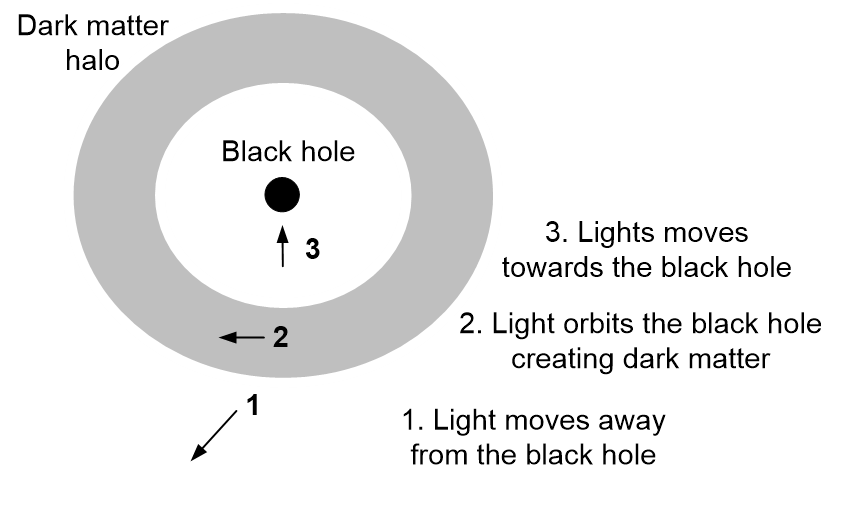
Figure 4.27. Dark matter is light in orbit

What then is the alternative? If mass is the net processing that repeats, could a halo do that? We expect the black hole at the center of our galaxy to trap light in a halo around it. Light near the black hole is pulled in, and light far away escapes, but at some radius it will constantly circle it (Figure 4.27).

This halo of light will build-up over time as more photons join, until it is a dense flow of wave-fronts that move on each cycle. Light circling the opposite way would be the same, as light in our space vibrates first up then down. No particles are created because it isn’t light colliding, but a constant net processing excess at every point would produce mass. A dense halo of light around a black hole would then cause mass as usual but without particles.

Yet the halo passes on photon tails as well as heads, so won’t the result cancel out? Current research suggests that dark matter has a tiny negative charge, about a millionth of an electron’s charge (ScienceAlert), so it seems that at each halo point, more heads are processed than tails. The effect is very weak, but a permanent net processing excess throughout a huge halo will add a lot of mass.

A halo of light circling a black hole could then generate mass as electrons do, but spread through a stream of light not concentrated at a point. Extreme light trapped at a point then causes ordinary matter while dense light trapped in orbit around a black hole causes dark matter. Dark matter isn’t particle-based, so the halos of galaxies don’t collide when they do but remain around each galaxy when they separate. Note that small galaxies can exist with no black holes, and galaxies that have lost their stars can consist of 99.9% dark matter.

Ordinary and dark matter then both come from light, but dark matter isn’t visible because photons either pass through the halo at an angle or join the stream, so no particles will ever explain it.

Next